 repowise
 lee-to/ai-factory

lee-to / ai-factory
You want to build with AI, but setting up the right context, prompts, and workflows takes time. AI Factory handles all of that so you can focus on what matters — shipping quality code.
github.com/lee-to/ai-factoryIndexed at ac92bebUp to date with upstream
What is ai-factory?
ai-factory is a command-line tool for setting up an AI-powered development environment in a project. It installs relevant skills, configures integrations, and supports spec-driven workflows for coding agents. The repository primarily uses Shell, with TypeScript, JavaScript, Python, and Go code.
Written by a model from the README and the source
297 files and 853 symbols in 5 modules, led by TypeScript (26 files) and Shell (23).
Code health
This codebase scores 6.2 out of 10 for code health, which we rate fair. It also scores maintainability 7.1 and static performance 9.2 out of 10. The three are scored separately and never blended into one number. Risk is concentrated, as it usually is: 10 of 297 files are git hotspots, and they average 4.8 — which is where the fixes pay off most.
Use lee-to/ai-factory in your agent
Point Claude Code, Cursor, Codex or VS Code at this repository. Your agent gets the index this page is built from: cited answers, callers, history and health for any file.
- 1.In Claude, open Customize → Connectors, click +, then Add custom connector. On a Team or Enterprise plan an owner adds it first under Organization settings → Connectors.
- 2.Paste the server URL below as the Remote MCP server URL, then click Add.
- 3.Click Connect. A Repowise sign-in window opens. Approve access.
- 4.Repowise's tools are now available in your Claude chats.
Connect with one click. Sign in with Repowise (OAuth), no API key to copy. Works in Claude on the web, desktop, and mobile.
Docshttps://api.repowise.dev/mcp/lee-to/ai-factory
This repo is public, so anyone with a Repowise account and an API key can connect.
Try asking
- get_overview()
- get_answer("how is ai-factory put together?")
- get_why("why is ai-factory structured this way?")
Explore ai-factory
- DocumentationModule-by-module documentation, 124 pages.
- ArchitectureDependency graph, layers and third-party dependencies.
- Code healthEvery file's score and the findings behind it.
- CommitsEach commit's effect on code health.
- OverviewEverything else the index found: contributors, decisions, what changed this week.
Key features of ai-factory
- ai-factory installs relevant skills and configures integrations for an AI development environment.
- ai-factory supports spec-driven development with plans intended to make work predictable, resumable, and reviewable.
- ai-factory supports community skills from the skills.sh ecosystem and custom skill generation.
- ai-factory supports any language, framework, or platform.
- ai-factory supports multiple coding agents, including Claude Code, Cursor, Windsurf, Roo Code, Kilo Code, Antigravity, OpenCode, Warp, Zencoder, Codex CLI, Codex app, GitHub Copilot, Gemini CLI, Junie, and Qwen Code.
How lee-to/ai-factory works
The workflow starts with the ai-factory init command, which asks for an AI agent or accepts agent selections through flags. The scripts directory handles setup and validation tasks, including skill and integration workflows. The src directory provides the TypeScript implementation, including src/core/installer.ts for installation and src/core/skills-migration.ts for skill migration. The skills directory stores the skill files used by supported workflows. The bin directory provides the command-line entry point, while examples contains an example project or usage material. After setup, users invoke the installed workflows through /aif, or through $aif style invocations with Codex CLI and Codex app.
The codebase has 297 files and 853 symbols in 5 modules, led by TypeScript, Shell and JavaScript. Code health is 6.2 out of 10, rated fair.
Getting started with ai-factory
- Install ai-factory globally with npm.
npm install -g ai-factory - Initialize ai-factory in your project directory.
ai-factory init - Initialize ai-factory non-interactively with selected agents and MCP servers.
ai-factory init --agents claude,codex --mcp playwright,github
Commands copied from the README
lee-to/ai-factory FAQ
What is ai-factory?
ai-factory is a command-line tool for setting up an AI-powered development environment. It installs skills, configures integrations, and supports spec-driven coding workflows.
How does ai-factory work?
ai-factory initializes a project, selects or installs skills, configures MCP servers, and prepares supported AI agents. Users then start the configured workflow with /aif.
How do I install ai-factory?
ai-factory can be installed globally with npm or mise. Use npm install -g ai-factory or mise use -g npm:ai-factory.
What language is ai-factory written in?
ai-factory primarily uses Shell. Its code also includes TypeScript, JavaScript, Python, and Go.
How is the ai-factory code organized?
ai-factory organizes implementation in src, setup and validation scripts in scripts, reusable skills in skills, the command entry point in bin, and example material in examples.
Who is ai-factory for?
ai-factory is for people who want to build with AI without manually setting up context, prompts, workflows, skills, and integrations. It supports multiple coding agents and project technology stacks.
The summary, features and answers on this page are written by a model from the README and the source, and refreshed with each index.
About this page
Get a page like this for your own codebase
Repowise built this map of lee-to/ai-factory from its source and git history. It parses every symbol, draws the dependency graph, scores each file's health from complexity, duplication, coverage and churn, finds hotspots and owners in the history, and writes documentation for every module. Your coding agent reads the same index over MCP, so its answers cite real files.
Prefer local? pip install repowise && repowise init indexes your own checkout, no account needed.
Maintain lee-to/ai-factory?
Claim this page, add a badge to the README, or re-index it.
Claim this page
Sign in with GitHub and we check that you are an admin or maintainer of lee-to/ai-factory. Then add a badge to the README that links readers here.
Add a badge to your README
Every badge is public, cached, and updates on its own after every index. Nothing to install.
Repowise badge
Links to this page, with no score on it. Adding it also re-indexes the repo every week.

[](https://repowise.dev/repo/lee-to/ai-factory?src=badge_wiki)Code health badge
The repo's health score out of 10, from the latest index.

[](https://repowise.dev/repo/lee-to/ai-factory?src=badge_health)Code health card
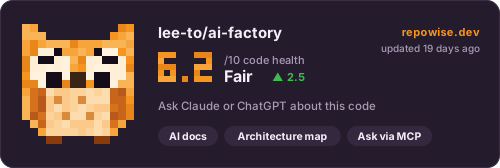
A larger card with the score, its change since the last index, and when it was measured. The HTML version follows the reader's light or dark theme.

[](https://repowise.dev/repo/lee-to/ai-factory?src=badge_card)