 repowise
 code-yeongyu/oh-my-openagent


code-yeongyu / oh-my-openagent
omo/lazycodex: The coding agent for tokenmaxxers;the one and only agent harness for complex codebases. For your Codex, for your OpenCode
github.com/code-yeongyu/oh-my-openagentIndexed at c6b845fUp to date with upstream
What is oh-my-openagent?
oh-my-openagent is a TypeScript coding-agent system for complex codebases. It coordinates specialized agents, tools, hooks, and model integrations for OpenCode and Codex CLI. The project uses an npm-based TypeScript stack with JavaScript, Python, shell, Go, and Dockerfile code.
Written by a model from the README and the source
5,591 files and 20,416 symbols in 12 modules, led by TypeScript (4,496 files) and JavaScript (197).
Code health
This codebase scores 8.1 out of 10 for code health, which we rate good. It also scores maintainability 8.9 and static performance 9.8 out of 10. The three are scored separately and never blended into one number. Risk is concentrated, as it usually is: 498 of 5,591 files are git hotspots, and they average 6.0 — which is where the fixes pay off most.
On the leaderboards:#1 of 6 Coding agents#8 of 45 TypeScript repos
Use code-yeongyu/oh-my-openagent in your agent
Point Claude Code, Cursor, Codex or VS Code at this repository. Your agent gets the index this page is built from: cited answers, callers, history and health for any file.
- 1.In Claude, open Customize → Connectors, click +, then Add custom connector. On a Team or Enterprise plan an owner adds it first under Organization settings → Connectors.
- 2.Paste the server URL below as the Remote MCP server URL, then click Add.
- 3.Click Connect. A Repowise sign-in window opens. Approve access.
- 4.Repowise's tools are now available in your Claude chats.
Connect with one click. Sign in with Repowise (OAuth), no API key to copy. Works in Claude on the web, desktop, and mobile.
Docshttps://api.repowise.dev/mcp/code-yeongyu/oh-my-openagent
This repo is public, so anyone with a Repowise account and an API key can connect.
Try asking
- get_overview()
- get_answer("how is oh-my-openagent put together?")
- get_why("why is oh-my-openagent structured this way?")
Explore oh-my-openagent
- DocumentationModule-by-module documentation, written from the source.
- ArchitectureDependency graph, layers and third-party dependencies.
- Code healthEvery file's score and the findings behind it.
- CommitsEach commit's effect on code health.
- OverviewEverything else the index found: contributors, decisions, what changed this week.
Key features of oh-my-openagent
- Specialized agents include Sisyphus, Prometheus, Oracle, Librarian, Explore, and Multimodal Looker.
- Background agents can run in parallel for development tasks.
- LSP and AST tools support refactoring, renaming, diagnostics, and AST-aware code search.
- Hash-anchored edits use LINE#ID references to validate content before applying changes.
- Context injection can load AGENTS.md, README.md, and conditional rules.
- Built-in MCPs provide websearch, context7, and grep_app capabilities at runtime.
How code-yeongyu/oh-my-openagent works
Input enters through agent and plugin surfaces for OpenCode or Codex CLI. The Sisyphus agent handles primary work while Prometheus plans, Oracle supports architecture and debugging, Librarian searches documentation and code, Explore performs codebase searches, and Multimodal Looker handles visual analysis. The packages directory holds the main implementation and shared components. The .agents directory provides agent instructions, skills, scripts, and commands, including .agents/AGENTS.md and .agents/background-tasks.json. The .opencode directory contains OpenCode-related configuration and components. The packages/omo-codex/plugin/components/codegraph/src/hook.ts file implements a codegraph hook, while packages/omo-codex/plugin/components/codegraph/dist/cli.js and packages/omo-codex/plugin/components/codegraph/dist/serve.js provide built codegraph interfaces. Results include code changes, diagnostics, searches, delegated background work, and session operations.
The codebase has 5,591 files and 20,416 symbols in 12 modules, led by TypeScript, JavaScript and Python. Code health is 8.1 out of 10, rated good.
code-yeongyu/oh-my-openagent FAQ
What is oh-my-openagent?
oh-my-openagent is a coding-agent system for complex codebases. It provides agent orchestration, lifecycle hooks, tools, MCPs, commands, and support for OpenCode and Codex CLI.
How does oh-my-openagent work?
oh-my-openagent combines specialized agents, background execution, hooks, MCPs, LSP and AST tools, and session features. Sisyphus leads tasks while other agents plan, search, debug, or inspect code.
What language is oh-my-openagent written in?
oh-my-openagent is primarily written in TypeScript. The repository also includes JavaScript, Python, shell, Go, and Dockerfile code.
How is the oh-my-openagent code organized?
oh-my-openagent is organized mainly under packages, with agent resources under .agents and OpenCode resources under .opencode. The repository also includes script, docs, tests, .github, and root modules.
Who is oh-my-openagent for?
oh-my-openagent is for people working on complex codebases with OpenCode or Codex CLI. Its features target delegated agent work, code search, refactoring, diagnostics, session recovery, and model setup.
The summary, features and answers on this page are written by a model from the README and the source, and refreshed with each index.
About this page
Get a page like this for your own codebase
Repowise built this map of code-yeongyu/oh-my-openagent from its source and git history. It parses every symbol, draws the dependency graph, scores each file's health from complexity, duplication, coverage and churn, finds hotspots and owners in the history, and writes documentation for every module. Your coding agent reads the same index over MCP, so its answers cite real files.
Prefer local? pip install repowise && repowise init indexes your own checkout, no account needed.
Maintain code-yeongyu/oh-my-openagent?
Claim this page, add a badge to the README, or re-index it.
Claim this page
Sign in with GitHub and we check that you are an admin or maintainer of code-yeongyu/oh-my-openagent. Then add a badge to the README that links readers here.
Add a badge to your README
Every badge is public, cached, and updates on its own after every index. Nothing to install.
Repowise badge
Links to this page, with no score on it. Adding it also re-indexes the repo every week.

[](https://repowise.dev/repo/code-yeongyu/oh-my-openagent?src=badge_wiki)Code health badge
The repo's health score out of 10, from the latest index.

[](https://repowise.dev/repo/code-yeongyu/oh-my-openagent?src=badge_health)Code health card
A larger card with the score, its change since the last index, and when it was measured. The HTML version follows the reader's light or dark theme.

[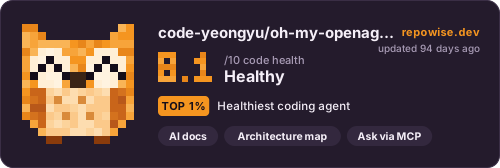](https://repowise.dev/repo/code-yeongyu/oh-my-openagent?src=badge_card)