



andrewyng / openworker
github.com/andrewyng/openworkerIndexed at 5870585Up to date with upstream
About this codebase
OpenWorker is a local-first coworker that turns your intent and connected work sources into governed, approval-gated deliverables by running a multi-surface agent loop (CLI/TUI/GUI/server) over integrations (via MCP connectors) and your files, then emitting finished artifacts (documents, reports, and web pages) back to your desktop and chat threads. Inputs are the outcome you want (e.g., “prepare a customer brief” or “draft a report”), your selected connectors/tools, and the relevant repository/app context; the pipeline plans steps, reads what’s eligible under the permission model, prompts you when actions need approval, and executes commands in a sandbox when enabled; outputs are deliverables you can open and share, plus session transcripts recorded for scheduled runs and interactive sessions.
Written by gpt-5.4-nano from the index
768 files and 8,036 symbols in 6 modules, led by Python (401 files) and TypeScript (290).
Code health
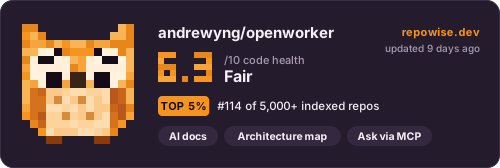
This codebase scores 6.3 out of 10 for code health, which we rate fair. It also scores maintainability 6.6 and static performance 9.6 out of 10. The three are scored separately and never blended into one number. Risk is concentrated, as it usually is: 145 of 768 files are git hotspots, and they average 4.7 — which is where the fixes pay off most.
On the leaderboards:#34 of 44 Python repos
Do next
2 things worth doing in the week to Sep 24, the last indexed commit, 1 of them now.
Now
- Critical
Clean up what this week's commits left: 32 serious findings in 13 files
14 commits in the last 7 days added or worsened them, and they are still open. Start with
coworker/engine.py, which has 3 critical.- serious findings
- 32
- critical
- 11
- files
- 13
Large effort
Improve what Repowise can see
Add a test coverage report
Without one, Repowise cannot tell tested code from untested code, so every test-related action says “unknown”.
- line coverage
- Unknown, no report
Small effort
Use andrewyng/openworker in your agent
Point Claude Code, Cursor, Codex or VS Code at this repository. Your agent gets the index this page is built from: cited answers, callers, history and health for any file.
https://api.repowise.dev/mcp/andrewyng/openworkerOne command, run anywhere. Adds the server to your local Claude Code config.
Docsclaude mcp add --transport http repowise https://api.repowise.dev/mcp/andrewyng/openworker \ --header "Authorization: Bearer rw_live_xxxxxxxxxxxxxxxxxxxxxxxxxxxxxxxx"
This repo is public, so anyone with a Repowise account and an API key can connect.
Try asking
- get_overview()
- get_answer("how is openworker put together?")
- get_why("why is openworker structured this way?")
Prefer local? pip install repowise && repowise init indexes your own checkout, no account needed.
Go deeper
- OverviewEverything the index found, what changed this week, commits and decisions.
- DocumentationModule-by-module documentation, 999 pages, 29 written by a model.
- ArchitectureDependency graph, layers and third-party dependencies.
- Code healthEvery file's score, the findings behind it, tests and refactoring plans.
- CommitsEach commit's effect on code health, with agent provenance.
- ContributorsWho owns what, and where one person holds most of the knowledge.
- DecisionsArchitectural decisions mined from commits and pull requests.
- Ask this codebaseSign inGrounded answers over the indexed code.
Maintain this repo? Claim the page
Sign in with GitHub and we check that you are an admin or maintainer of andrewyng/openworker. Then add a badge to the README that links readers here.
Use this repo from Claude or ChatGPT
Add this URL as a custom connector and sign in with repowise when asked. No API key to copy.
https://api.repowise.dev/mcp/andrewyng/openworkerFor maintainers
Add a badge to your README
Every badge is public, cached, and updates on its own after every index. Nothing to install.
Repowise badge
Links to this page, with no score on it. Adding it also re-indexes the repo every week.

[](https://repowise.dev/repo/andrewyng/openworker?src=badge_wiki)Code health badge
The repo's health score out of 10, from the latest index.

[](https://repowise.dev/repo/andrewyng/openworker?src=badge_health)Code health card
A larger card with the score, its change since the last index, and when it was measured. The HTML version follows the reader's light or dark theme.

[](https://repowise.dev/repo/andrewyng/openworker?src=badge_card)What is openworker?
openworker is a local-first AI coworker for turning requested outcomes into finished documents, reports, spreadsheets, web pages, and other work products. It plans tasks across files, terminal access, connected applications, and selected models while requiring approval for consequential actions. The project is primarily written in Python, with TypeScript and Rust components for its desktop surfaces.
Written by a model from the README and the index
Key features of openworker
- OpenWorker produces documents, spreadsheets, reports, and web pages as files that can be opened and shared.
- OpenWorker runs recurring automations such as morning briefs, weekly reports, and channel monitoring with full transcripts.
- OpenWorker gates writes, messages, and shell commands for approval and records each tool call with its approval provenance.
- OpenWorker can run agent shell and file tools inside an NVIDIA OpenShell Linux container with session-specific folders and an allow-listed network.
- OpenWorker supports model providers including OpenAI, Anthropic, Google Gemini, open-weight providers, and Ollama.
How andrewyng/openworker works
Input enters through the desktop application, CLI, TUI, GUI, server, or connected chat workflows as an outcome such as a customer brief or report. coworker/server/app.py provides the server entry path, while coworker/engine.py runs the agent workflow that plans steps and coordinates tools. The coworker subsystem manages permissions, risk and eligibility checks, session state, and audit records. coworker/connectors defines integrations and their tool descriptions, configuration, and connector abstractions. The surfaces directory provides the application interfaces, including surfaces/gui/src/App.tsx and surfaces/gui/src/components/SettingsView.tsx. Results are emitted as finished files or replies, with session transcripts recorded for interactive and scheduled runs.
This page is a map of the andrewyng/openworker repository, written primarily in Python, rebuilt from the source each time it is indexed. Repowise parses every symbol, computes a dependency graph, scores per-file code health from complexity, duplication, test coverage and churn, mines git history for hotspots and ownership, and lifts the architectural decisions into documentation you can read here or query through MCP.
The codebase has 768 files and 8,036 symbols in 6 modules, led by Python, TypeScript and Rust. Code health is 6.3 out of 10, rated fair.
Use the links above to open each view, or connect this repository to your agent for grounded answers inside Claude, Cursor, Codex or VS Code.
andrewyng/openworker FAQ
What is openworker?
openworker is a local-first AI coworker that turns requested outcomes into finished deliverables such as documents, reports, spreadsheets, and web pages.
How does openworker work?
openworker plans tasks across files, terminal access, connected applications, and selected models, then asks for approval before consequential actions and emits finished work.
What language is openworker written in?
openworker is primarily written in Python, with TypeScript and Rust components. Its repository also includes JavaScript and shell files.
How is the openworker code organized?
openworker is organized around the coworker control plane, surfaces for application interfaces, tests, packaging, scripts, and stt. coworker includes agents, connectors, and server components.
Who is openworker for?
openworker is for people who want an AI coworker to handle everyday work, security reviews, cloud posture audits, incident triage, and scheduled automations.
What license does openworker use?
openworker uses the MIT license.
Answers written by a model from the README and the index