On this page
The best static analysis tools for a large codebase are SonarQube for org-wide quality gates, Semgrep for fast custom rules, CodeQL for deep security queries and Coverity for regulated enterprise code. Add one free analyzer per language (Ruff, ESLint, SpotBugs, staticcheck and similar), and a context layer such as repowise when the hard part is knowing what a finding connects to.
The short list, as of October 2026:
- SonarQube: one policy layer (quality gates) for many teams and languages.
- Semgrep: readable custom rules, quick CI feedback, autofix.
- CodeQL: queryable code database, precise security analysis and variant hunting.
- Coverity: path-sensitive enterprise SAST with compliance reporting.
- repowise: not a scanner; the dependency, ownership and change-risk layer that sits beside one.
We build repowise, so weigh our entry accordingly. The measurements we publish about it, with their methods, are on the benchmarks page.
How we evaluated
We compared each tool on what changes a decision for a large repository, using the vendors' own docs and pricing pages (read October 12, 2026). We did not run the tools head to head on one repo, so nothing here ranks them on accuracy.
- Cross-file reach: does analysis follow code across functions, files and modules?
- Actionability: does a finding point to a fix, and can a team separate "fix now" from "review later"?
- Fit and cost: languages, hosting, free tier and pricing model.
- CI behavior: predictable runtimes and a diff-aware path for pull requests, because teams skip scans that are slow.
False positive rate on your own code is the one signal no table can give you. Run your shortlist on one real service for a week and count the findings you would act on.
Comparison table
| Tool | Best for | Languages | Pricing (October 2026) | Cross-file depth |
|---|---|---|---|---|
| SonarQube | Quality gates across teams | 30+ on Cloud Team, more on Enterprise | Free Community Build; Cloud free to 50k private LOC, Team from $34/month for 100k LOC; Server editions by LOC | Rule-based, per project |
| Semgrep | Custom rules, fast PR scans | 35+ | Free for up to 10 contributors; Teams from $30 per contributor per month | Cross-file with Pro rules (paid engine) |
| CodeQL | Security research, variant analysis | C/C++, C#, Go, Java/Kotlin, JS/TS, Python, Ruby, Rust, Swift, GitHub Actions | Free for open source code; private code needs GitHub's paid security product | Database model, multi-file queries |
| Coverity | Regulated and legacy-heavy code | 22 languages, 250+ frameworks | Custom quote; on-prem, air-gapped or SaaS | Path-sensitive, whole-project |
| repowise | Context around findings | 27 languages parsed to a full AST | Open source (AGPL-3.0); hosted Free is two public repositories | Dependency graph across the whole repo |
Scroll the table sideways to see every column.
Free static analysis tools by language
Most large repos run one platform from this list plus a fast, free analyzer per language. These are the open-source tools we would start with, and all of them run locally and in CI with no account.
| Language | Linting and bugs | Types | Security | Notes |
|---|---|---|---|---|
| Python | Ruff, Pylint | mypy, Pyright | Bandit | Ruff replaces flake8, isort and many plugins in one fast binary |
| JavaScript / TypeScript | ESLint with typescript-eslint, Oxlint, Biome | tsc --noEmit | eslint-plugin-security | Oxlint reached 1.0 in June 2025 and is built to run next to ESLint |
| Java | SpotBugs, PMD, Error Prone, Checkstyle | the compiler | Find Security Bugs (SpotBugs plugin) | Error Prone runs as a compiler plugin, so it fails the build early |
| Kotlin | detekt | the compiler | ||
| Go | go vet, staticcheck, golangci-lint | the compiler | gosec | golangci-lint runs staticcheck, gosec and dozens more in one pass |
| C / C++ | Clang Static Analyzer, clang-tidy, Cppcheck | Flawfinder | Clang's analyzer does path-sensitive checks across functions | |
| C# / .NET | Roslyn analyzers (built into the SDK), Roslynator | the compiler | Security Code Scan | Configure severity in .editorconfig |
| Ruby | RuboCop | Sorbet | Brakeman | Brakeman is the standard Rails security scanner |
| PHP | PHPStan, Psalm | (same tools) | Psalm taint analysis | |
| Rust | Clippy | the compiler | cargo-audit (dependencies) | |
| Many languages | Semgrep CE, Opengrep, SonarQube Community Build | Semgrep CE, Opengrep | Opengrep is an LGPL-2.1 fork of Semgrep CE |
Scroll the table sideways to see every column.
Two licensing details trip teams up. CodeQL is free only for open source code: its license forbids using the CLI on code that is not open source unless you pay for GitHub Advanced Security. (github.com) And Semgrep Community Edition does not do inter-file taint analysis (tracking untrusted input from where it enters the code to where it is used), which is part of Semgrep's paid tier. (semgrep.dev)
The per-language tools are fast and precise inside one language. They do not look across the repo, so none of them tells you which module everything depends on, who owns it, or which files keep breaking. The platforms below and the context layer after them close that gap.
SonarQube
SonarQube is the default pick for one quality platform across many teams and languages. Cloud Team supports 30+ languages and Enterprise adds specialized ones such as ABAP, Apex and COBOL; the self-hosted Community Build is free but leaves out C and C++ and branch and pull-request analysis. (sonarsource.com, language docs)
Its strength is the policy layer. Quality gates turn findings into pass-or-fail conditions on new code, so legacy debt stays visible without blocking every old issue. Pricing follows lines of code, and only the largest branch counts.
Pick SonarQube if you want one shared gate for maintainability, reliability and security across a mixed-language organization. See also the SonarQube alternative comparison.
Semgrep
Semgrep is the best pick when engineers should write and read the rules themselves. Patterns look like the code they match, rules can carry fixes, and Semgrep covers SAST, supply chain (dependency) scanning and secrets. (semgrep.dev)
The free tier covers up to 10 contributors, and cross-file analysis comes with Pro rules. The open-source Community Edition (LGPL-2.1) does not do inter-file taint analysis, which is why some teams look at the Opengrep fork or the paid engine. Rule-defined fixes and Autofix PRs cut cleanup time. (docs)
Pick Semgrep if you need custom rules for internal APIs, fast CI scans and developer adoption.
CodeQL
CodeQL is the strongest option for security research on large codebases. It extracts your code into a database and runs queries against it, so one query can express a vulnerability class and find every variant, including across many repositories. (codeql.github.com)
It runs through GitHub code scanning (default setup, an advanced workflow, or the CLI in external CI) and supports the languages in the table above. It is free only for open source code: the license forbids using the CLI on other code without GitHub's paid security product.
Pick CodeQL if an application security team can invest in queries and your code lives on GitHub.
Coverity
Coverity is enterprise SAST for hard correctness and compliance requirements. It belongs to Black Duck (formerly the Synopsys Software Integrity Group), covers 22 languages and 250+ frameworks, and maps findings to standards such as OWASP, CWE, MISRA, AUTOSAR and ISO 26262. (blackduck.com)
It deploys on premises, air-gapped, on Kubernetes or as SaaS through Black Duck Polaris, and is sold by custom quote. Platform teams running a formal scanning program on C, C++ or Java portfolios choose it for accuracy at scale.
Pick Coverity if you scan regulated or legacy systems where a missed defect costs more than the setup.
repowise: the context around findings
repowise answers what to do after a scanner flags something: who owns this code, what depends on it, and how risky it is to change. It indexes the repository into a dependency graph (27 languages parsed to a full AST, 14 at the Full tier) with PageRank, community detection and cycle analysis, and mines git history for ownership, hotspots, co-change and bus factor. (github.com)
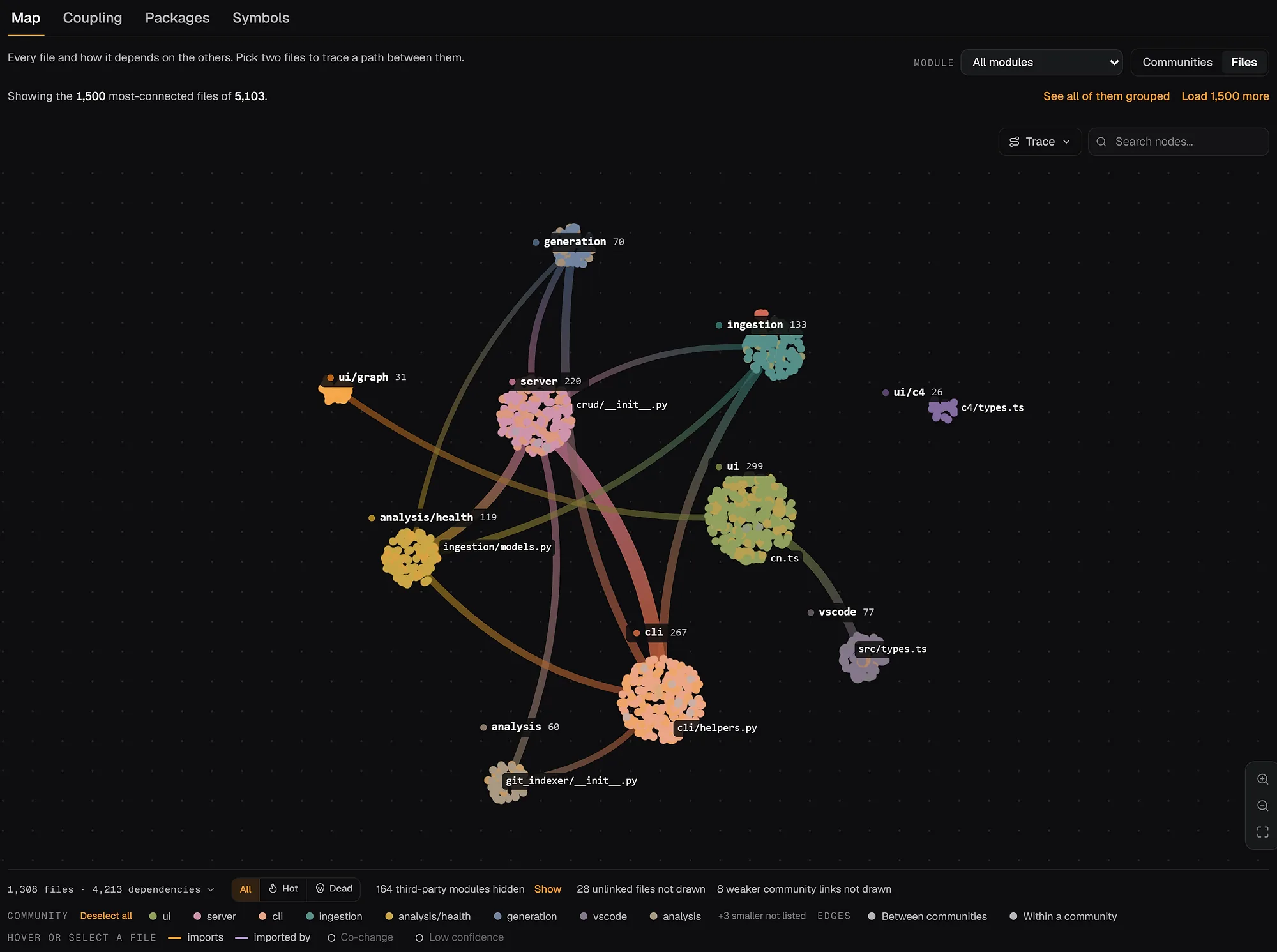
It also scores every file from 1 to 10 for defect risk, runs a registry of 25 security patterns for leaked secrets and risky constructs (a signal, not a taint-tracking scanner), and scores a commit or diff range with get_change_risk before merge. Agents reach all of it through ten MCP tools: get_overview, get_context, get_symbol, search_codebase, get_risk, get_change_risk, get_health, get_dead_code, get_why and get_answer. Read more on code health and change risk, or browse a live repo such as the FastAPI code health page.
pip install repowise
repowise init      # index, score and map the repo; no API key needed for the core index
repowise health    # fix-first list and KPIs
Pick repowise if you already run a scanner and need to turn findings into a plan: what depends on the flagged file, who knows it, and whether the fix is safe.
How to choose
- One policy layer for many teams: SonarQube.
- Custom rules and fast PR feedback: Semgrep.
- Security queries across big repos on GitHub: CodeQL.
- Enterprise SAST with compliance reporting: Coverity.
- Ownership, dependency and change-risk context: add repowise to any of the above.
By stack: for JavaScript, TypeScript or Python, start with Ruff or ESLint in every repo, add Semgrep for custom rules and SonarQube if you need org gates. For C and C++ in regulated industries, Coverity or the Clang analyzers with SonarQube Server. For a GitHub-centered security team, CodeQL first and Semgrep for simpler rules. Small teams can stop at the free analyzer per language and Semgrep's free tier.
FAQ
- What are static analysis tools?
- Static analysis tools examine source code without running it. They range from linters that catch style problems and simple bugs inside one file, to type checkers, to security scanners (SAST) that trace data through many functions, to platforms like SonarQube that track quality across an organization.
- What are the best static analysis tools for large codebases?
- SonarQube, Semgrep, CodeQL and Coverity. Pick by job: quality gates, custom rules, security queries or enterprise SAST. Large repos usually add a free analyzer per language and a context layer like repowise.
- What are the best free and open-source static analysis tools?
- Per language: Ruff and mypy for Python, ESLint or Oxlint for JavaScript and TypeScript, SpotBugs and PMD for Java, staticcheck and golangci-lint for Go, the Clang Static Analyzer and clang-tidy for C and C++, Roslyn analyzers for C#, RuboCop and Brakeman for Ruby, PHPStan for PHP and Clippy for Rust. Across languages: Semgrep Community Edition, Opengrep and SonarQube Community Build.
- Is SonarQube free?
- The self-hosted Community Build is free and open source. SonarQube Cloud has a free tier for up to 50k lines of private code, and public repositories get Team plan features. C and C++, branch analysis and pull-request analysis on self-hosted Server need a paid edition. (sonarsource.com)
- Is Semgrep better than CodeQL?
- They solve different problems. Semgrep is better for readable custom rules and quick adoption; CodeQL is better for deep security analysis and variant hunting, but is free only for open source code. Many teams run both.
- Does repowise replace SonarQube, Semgrep or CodeQL?
- No, it works one layer up. Use a scanner for findings and repowise for context: what the code does, who owns it, what depends on it and what is risky to change. See the FastAPI dependency graph for that split in practice.