Source-linked documentation
Read the codebase as a system, then follow every claim back to evidence.
Repowise builds documentation hierarchically from symbols, files, modules, architecture, history, and decisions. Freshness, authoring method, related files, and supporting source remain visible while you read.
AST-aware indexing spans 16 languages, with full-tier depth for 11.
Explore live documentation- parsed languages
- 16
- freshness cycle
- Every commit
- writing styles
- 4
- retrieval
- Hybrid
11 currently receive full-tier parsing and analysis depth.
Affected pages regenerate incrementally; the page reports freshness beside the content.
Comprehensive, reference, tutorial, and caveman over the same index.
Full-text and vector results fused with graph-aware expansion.
Real generated knowledge
The reading surface keeps provenance, freshness, and related source within reach.
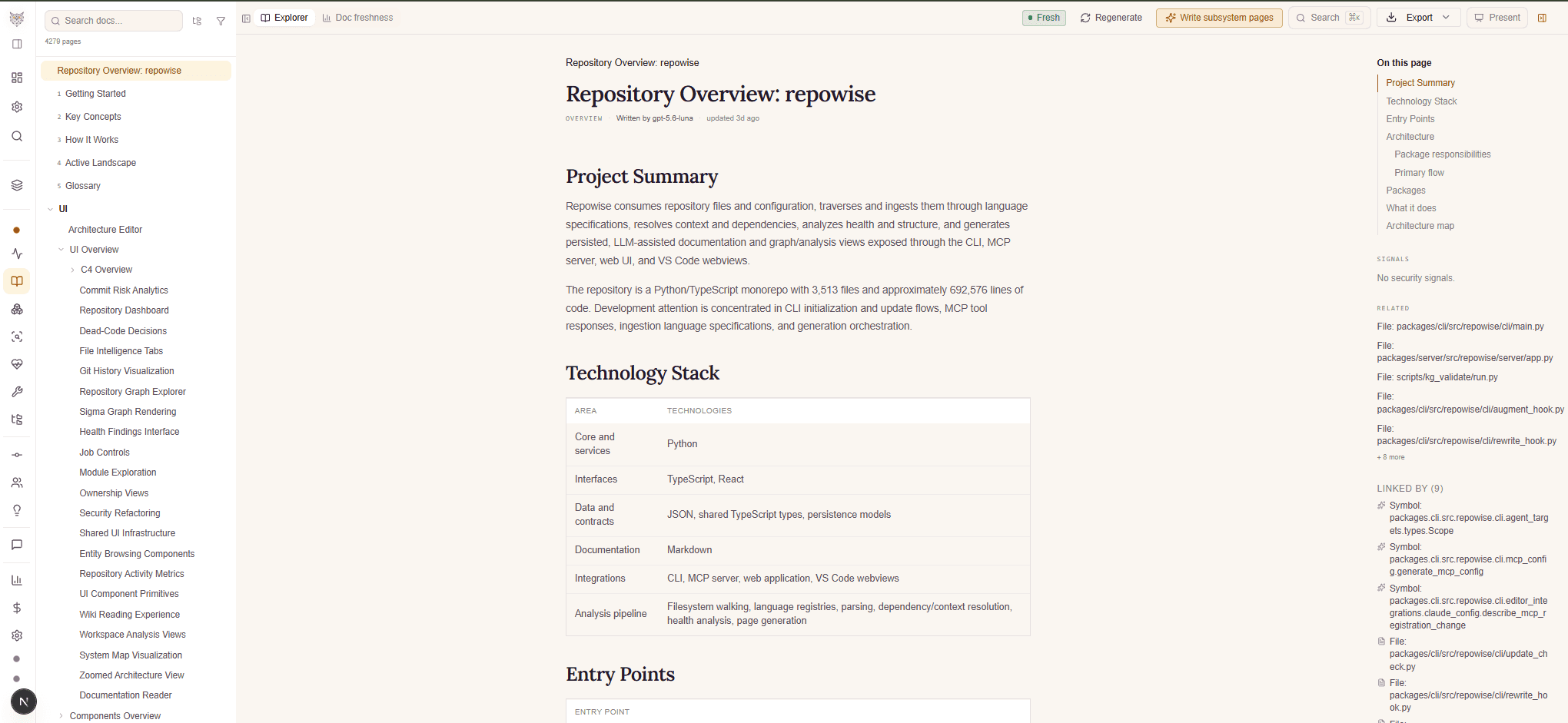
This repository overview is useful because it is more than prose. The page identifies the indexed repository, who or what wrote the content, when it changed, the architecture and entry points it describes, and the source records related to the current passage.
Capture: Repowise documentation for the Repowise repository. Counts and paths in the image belong to that index state.
How the index produces it
Build bottom up, update only what changed.
The index supplies the structure and source relationships. Generation turns that evidence into navigable reading pages, while freshness tracking keeps the relationship to the current code explicit.
- 01 / Compose
Generate hierarchically
Symbol and file knowledge composes into module pages and a repository overview, so higher-level explanations retain the evidence below them. - 02 / Connect
Link prose to source
Architecture, entry points, files, symbols, decisions, and related pages remain navigable from the reading surface and retrieval tools. - 03 / Refresh
Regenerate affected knowledge
Git-informed freshness identifies the pages touched by a change so the system can update the affected slice instead of silently serving an undated snapshot.
Honest limitations
Freshness is visible, not magical.
Generated prose can still need review, especially when the index has incomplete language or framework coverage. A freshness indicator reports the relationship to indexed source; it does not guarantee every sentence is correct. Optional model-backed generation may send code-derived context to the configured provider unless you run an offline model.
Questions, answered
The details behind the claim.
Does the wiki go stale?
No. The wiki is rebuilt incrementally on every commit. Only the pages affected by a change regenerate, typically 3 to 10 pages, in seconds. Every page also carries a freshness and confidence score with git-informed decay, so when the code underneath a page changes the page ages and regenerates automatically instead of quietly drifting out of date.
Which languages are supported?
16 languages in total, with full-tier depth for 11 of them: Python, TypeScript, JavaScript, Java, Kotlin, Go, Rust, C++, C#, Scala, and Ruby. Full tier means AST parsing, import and call resolution, heritage extraction, docstrings, framework-aware edges, and code-health markers. C, Swift, PHP, and Dart are good tier, with more config and markup formats parsed beyond that.
Can I choose the writing style?
Yes. Wiki styles let you pick the documentation voice: comprehensive, reference, tutorial, or caveman. The same indexed graph and git history feed every style, so you can switch the tone of the generated pages without re-indexing the codebase.
How does search work?
Search over the wiki is hybrid RAG. Full-text and vector results are fused via reciprocal rank fusion, biased by PageRank so central code ranks higher, then expanded one hop along the dependency graph to pull in directly related pages. The result is a cited answer rather than a raw file dump, available in the dashboard and over MCP through get_answer and search_codebase.
Can I self-host it for private repos?
Yes, today. repowise is open source under AGPL-3.0 and runs fully self-hosted with pip install repowise, so the wiki for a private repo never leaves your infrastructure. You bring your own API key for generation, or run fully offline with a local embedding model. There is no waitlist and no logging into a competitor's agent to read your own docs.
How is it different from DeepWiki or Google Code Wiki?
DeepWiki and Google Code Wiki generate a snapshot wiki. repowise generates the wiki hierarchically from symbols up to files, modules, and the whole repo, then adds the four other intelligence layers around it: code health proven to predict real bugs, git risk and ownership, and architectural decision archaeology. It keeps the wiki fresh on every commit, and you can self-host it for private repos today.
Last reviewed: September 2026
Open a real codebase and read what the index knows.
Browse public repository documentation without an account, then index your own repository when you want the same source-linked view.