On this page
The best dependency graph tools for a monorepo depend on which layer of the graph you need: Nx or Turborepo for the package graph that drives builds, Madge or dependency-cruiser for JavaScript and TypeScript import cycles and rules, and repowise for a file and symbol graph with history and change impact across 28 languages. Most teams end up with two of these, because a package graph and a code graph answer different questions.
The code layer matters more than most teams expect. In our analysis of 195 public GitHub repos with 1,000+ stars (November 2026), the median repo routes 20% of its production files through a single hub file, and 89% of repos contain at least one circular import chain between files. Neither shows up on a package graph.
The short list, as of November 2026:
- Nx: a project graph tied to affected commands, caching and CI.
- Turborepo: a package and task graph with low setup, for JavaScript and TypeScript.
- Madge: the fastest way to draw a module graph and list circular imports.
- dependency-cruiser: dependency rules you can fail CI on, plus graph output.
- Knip: the module graph used to find unused files, exports and dependencies.
- repowise: a file and symbol graph with ownership, churn and blast radius, readable by agents over MCP.
We build repowise, so weigh our entry accordingly. The measurements we publish about it, with their methods, are on the benchmarks page.
How we evaluated
We read each tool's own documentation and repository on 10 November 2026 and compared them on four things.
- Graph depth: packages and tasks, files and modules, or symbols (functions, classes, methods).
- Cycles: can it find a circular dependency, and can it forbid one?
- Languages: one ecosystem or many.
- What the graph is for: running tasks, enforcing rules, cleaning up, or understanding the code.
Comparison table
| Tool | Graph depth | Circular dependencies | Languages | Main job | License |
|---|---|---|---|---|---|
| Nx | Projects and tasks | Through enforced boundaries | TypeScript first; plugins for Gradle, Maven, .NET and more | Affected tasks, caching, CI | MIT |
| Turborepo | Packages and tasks | Not its focus | JavaScript and TypeScript | Task pipelines and caching | MIT |
| Madge | Files and modules | --circular | JavaScript (AMD, CommonJS, ES modules), CSS preprocessors | Quick module graph | MIT |
| dependency-cruiser | Files and modules | Rules that fail the build | JavaScript, TypeScript, CoffeeScript, Vue, Svelte | Rule enforcement and graph output | MIT |
| Knip | Files and exports | Not its focus | JavaScript and TypeScript | Unused code and dependencies | ISC |
| repowise | Files and symbols, with 17 edge types | Break Cycle refactoring plans; cycles in the workspace architecture view | 28 languages parsed to a full AST | Understanding and change impact | AGPL-3.0 |
Scroll the table sideways to see every column.
Why package graphs are not enough
A package graph tells you which package depends on which, and that is the right level for build order, caching and release order. It stops there. It cannot say which function inside a package carries the risk, or which file closes a loop.
In a monorepo that gap matters because most architectural trouble lives below the package boundary: a shared utility that became a dumping ground, two modules that each import the other, one file that everything routes through. A graph that only shows package arrows treats all of that as one line.
So the first decision is the layer. Package level for orchestration, file level for cycles and boundaries, symbol level for refactors and change impact. The tools below sit at different layers, which is why they are rarely substitutes for each other.
What dependency graphs look like in 195 popular repos
The median popular open-source repo has 513 production source files across 7 top-level modules, with 3.0 import edges per file, and one hub file that 20% of the codebase imports. Those are file-level facts, the layer a package graph collapses into a single arrow.
| Import graph metric (195 repos, November 2026) | p25 | Median | p75 |
|---|---|---|---|
| Production source files | 194 | 513 | 1,165 |
| Top-level modules | 5 | 7 | 11 |
| Import edges per production file | 2.37 | 3.02 | 4.15 |
| Share of files that import the top hub file | 12% | 20% | 29% |
| Share of import edges into the top 1% of files | 12% | 17% | 29% |
| Circular import groups per repo | 2 | 5 | 18 |
| Production files inside a circular import group | 2.7% | 9.2% | 21.5% |
| Files in the largest circular import group | 4 | 16 | 104 |
Scroll the table sideways to see every column.
Three findings change how you pick a tool:
- Hubs are the norm. In 68 of 195 repos (35%), one file is imported by a quarter or more of the codebase. In grafana/grafana,
packages/grafana-data/src/index.tsis imported by 3,178 of 10,090 production files (31%); in keycloak/keycloak,KeycloakSession.javais imported by 1,690 of 6,626 (26%). A change to a file like that has the widest blast radius in the repo, and a file-level graph is the only place it shows. - Circular import chains between files are almost universal. 173 of 195 repos (89%) have at least one group of files that all reach each other through imports, and 66 repos (34%) have a single group of 50 or more files. Many of these run through package
__init__.pyre-exports or TypeScript barrelindex.tsfiles, so the job is finding the chains that matter, which is why ownership and change activity belong on the same graph. - It is not inevitable. gohugoio/hugo, gin-gonic/gin, temporalio/temporal and binwiederhier/ntfy have zero circular import groups among production files.
The shape differs by language:
| Primary language | Repos | Repos with circular import chains | Files in circular groups (median) | Hub reach (median) |
|---|---|---|---|---|
| TypeScript | 52 | 92% | 6.4% | 17% |
| Python | 51 | 100% | 16.4% | 18% |
| Go | 22 | 55% | 0.6% | 27% |
| Rust | 15 | 93% | 22.2% | 21% |
| JavaScript | 13 | 69% | 3.1% | 15% |
| C# | 10 | 100% | 8.1% | 18% |
| C++ | 8 | 100% | 20.2% | 15% |
Scroll the table sideways to see every column.
Go's compiler rejects import cycles between packages, which helps explain its lower 55%; Python has a circular chain in every repo we measured. Groups under 15 repos are small, so read those rows as indicative. "Hub reach" is the share of production files that import the repo's most-imported file.
Method. We analysed 195 public GitHub repositories with 1,000+ stars each that are indexed on repowise.dev: 253,688 production source files, each repo measured at its latest index between May and November 2026. Tests, generated code, vendored copies, build scripts and tooling are excluded by repowise's code-origin rules. An import edge is a file-to-file import between production files; a circular import group is a set of two or more files that all reach each other (a strongly connected component). Figures are medians across repos, each repo counted once. The full report, with every table by language and repository size, is State of open-source code health 2026.
1. Nx
Nx is a monorepo platform whose project graph decides which tasks run, what can be restored from cache and which projects a change affects. You open the graph with npx nx graph, and nx affected runs tasks only for the projects a change touches.
- Where it shines: a graph wired straight into CI behavior. Nx plugins cover Vite, Webpack, Jest, Gradle, Maven and .NET, so the graph is not limited to JavaScript, and
npx nx initadds it to an existing npm, pnpm or yarn workspace (repository). - Granularity: projects and tasks. It models how workspace projects relate, not the symbols inside them.
- Pick it if you want the graph to drive affected builds, caching and boundary tags, or your workspace is already on Nx.
2. Turborepo
Turborepo derives a package graph from your package manager and a task graph from your pipeline configuration. turbo query runs GraphQL queries against the repository, turbo ls lists packages, and turbo query affected reports which packages or tasks changed between two git refs (query reference).
- Where it shines: low ceremony for JavaScript and TypeScript workspaces, with caching and task pipelining.
- Granularity: packages and tasks.
- Pick it if your workspace maps cleanly to npm, pnpm or yarn packages and the graph exists to speed up builds and tests.
3. Madge
Madge generates a visual graph of module dependencies and lists circular ones. It reads AMD, CommonJS and ES modules plus Sass, Stylus and Less, and offers --circular, --orphans, --leaves and --image for SVG or PNG output (repository).
npx madge --circular --extensions ts,tsx src/
npx madge --image graph.svg src/
- Where it shines: the quickest first pass on an import loop in a JavaScript or TypeScript package.
- Granularity: files and modules, within one language family.
- Pick it if you want a one-off audit or a graph you can export to Graphviz. For a head-to-head, see Madge vs dependency-cruiser.
4. dependency-cruiser
dependency-cruiser validates dependencies against rules you write, and draws the graph as a by-product. It handles JavaScript, TypeScript, CoffeeScript, Vue and Svelte, ships rules for circular dependencies, orphaned modules and production code importing dev dependencies, and outputs text, dot, HTML, CSV, JSON and Mermaid (repository).
- Where it shines: encoding architecture as config and failing CI when code crosses a boundary.
- Granularity: files and modules.
- Pick it if you want to forbid cycles and layering violations, not only look at them.
5. Knip
Knip reads the dependency graph from real entry points to find unused files, exports and dependencies in JavaScript and TypeScript monorepos. Its 200+ plugins teach it each framework's entry points, and it understands workspaces (knip.dev).
- Where it shines: turning the graph into a delete list.
- Granularity: files and exports.
- Pick it if your question is "what can we remove", not "what depends on what". Our dead code guide covers Knip and the other ecosystems.
6. repowise
repowise builds a two-tier graph of files and symbols with no model calls, then attaches git history, ownership, health and change impact to it. It runs during repowise init, needs no API key, and parses 28 languages to a full AST. Every edge records how it was resolved and with what confidence, so a guessed edge is never presented as a certain one (graph layer docs).
pip install repowise
repowise init                                    # builds the graph, no API key needed
repowise context src/app.py --include callers    # who depends on this file, with confidence
repowise serve                                   # dashboard: map, coupling, blast radius
- Where it shines: questions a package graph cannot answer. The map view groups files into communities and draws the dependencies between them, the blast radius of a change lists direct and transitive dependents plus the files that usually change with it, and Break Cycle refactoring plans name the smallest set of import edges to invert to remove a runtime cycle.
- History on the graph: co-change edges are kept separate from imports, so "edited in the same commit" never pollutes the dependency view. See the git intelligence guide for hotspots, ownership and coupling.
- Agents: the graph is readable over MCP through ten tools.
get_contextreturns callers and callees with confidence,get_riskscores a change set, and the opt-inget_dependency_pathreturns the shortest path between two files. - Workspaces: in a multi-repo workspace, the opt-in
get_architecturereports cycle counts andget_conformancechecks the dependency rules you declare. - Pick it if you need file and symbol edges across more than one language, or you want ownership, churn and change impact on the same graph. Zombie packages are covered too:
repowise dead-code --kind zombie_packagelists workspace packages that no other package imports.
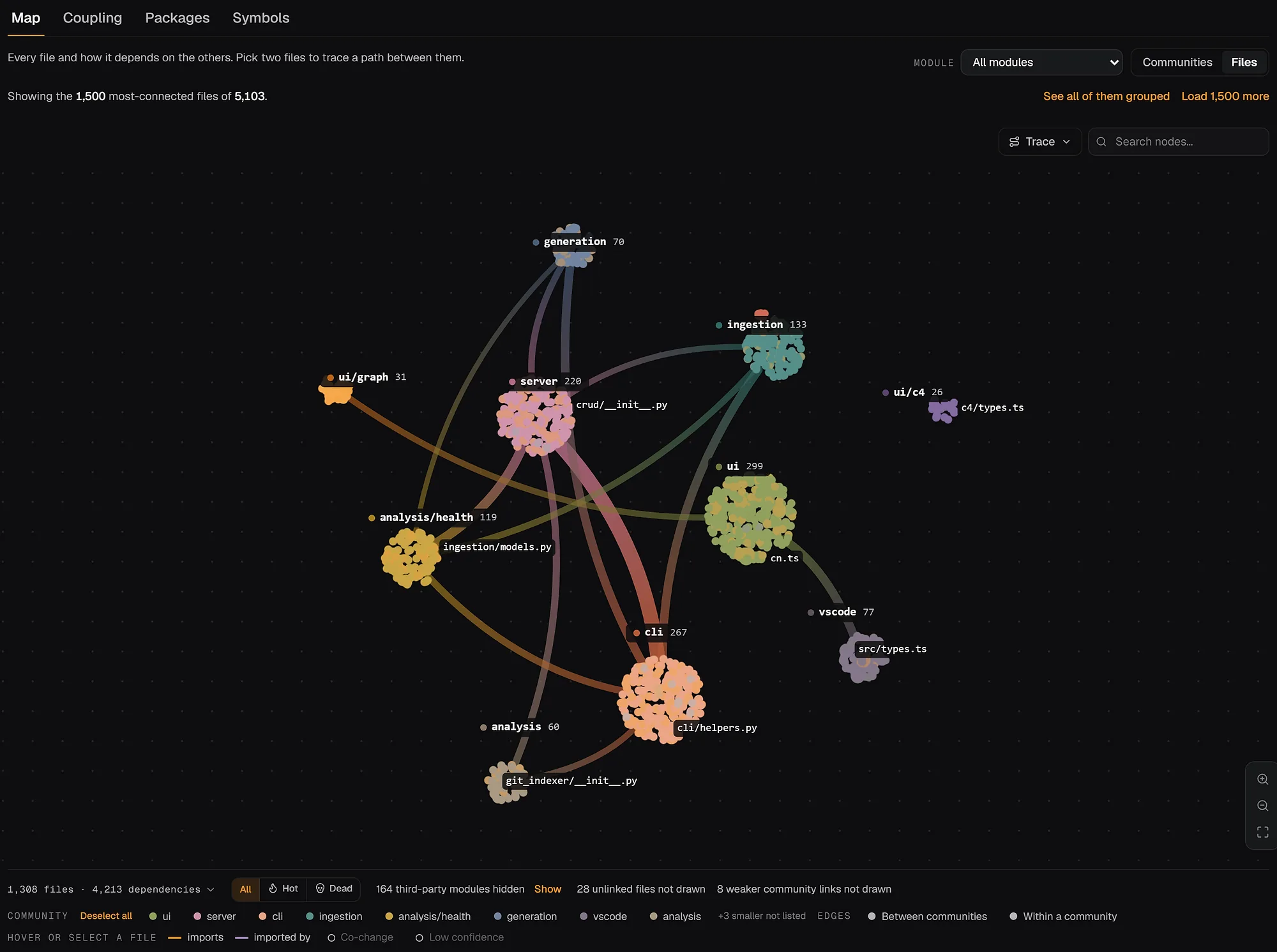
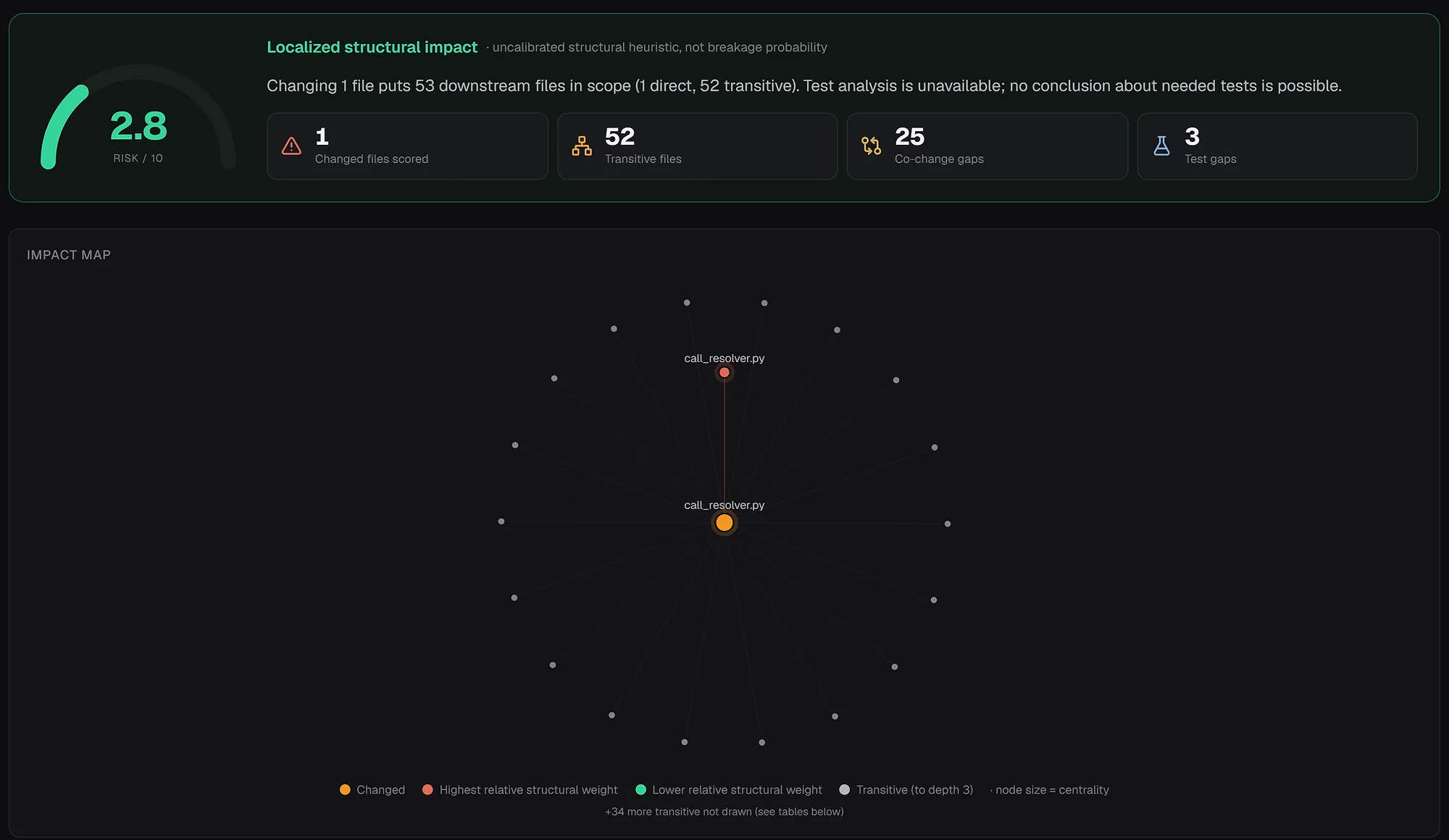
You can also inspect a real index in the browser: open the FastAPI architecture view or browse the live examples.
Other dependency graphs you will run into
GitHub's dependency graph and language-native commands draw package dependencies, not the imports between your own files. They answer "which third-party packages do we pull in", which is a supply-chain question.
| Tool | What it graphs | Use it for |
|---|---|---|
| GitHub dependency graph | A summary of the manifest and lock files in a repository | Vulnerable and outdated third-party packages |
go mod graph, cargo tree, npm ls | The module or package requirement tree | Why a package version is in the build |
| pydeps | Python module dependencies, drawn with Graphviz | A quick picture of one Python package |
Scroll the table sideways to see every column.
For the imports between your own files in a monorepo, use one of the six tools above.
How to choose
Choose by the first problem you have, then add a second layer.
| Your situation | Start with |
|---|---|
| Builds and CI are slow; you want affected-only runs | Nx or Turborepo |
| You have one import loop to find in a JS or TS package | Madge |
| You want CI to fail when code crosses a boundary | dependency-cruiser |
| You want to delete what nothing reaches | Knip, or repowise for files and packages across languages |
| The repo mixes languages, or you need ownership and change impact | repowise |
| An AI agent needs structured repo context | repowise over MCP |
Scroll the table sideways to see every column.
A common stack: Nx or Turborepo runs the work, dependency-cruiser guards module boundaries in CI, and repowise shows where the risk and the refactor targets are. Asking one tool to do all three jobs blurs the graph. See the comparison pages for how repowise sits next to other code intelligence tools, and the codebase visualization roundup if the goal is a picture for people.
Finding circular dependencies
A cycle usually means a shared module became a dumping ground, a package boundary is wrong, or two modules own the same concept. With 89% of popular repos carrying at least one circular import chain between files, the useful skill is triage. The workflow that works across tools:
- Run the package graph first to rule out a cycle between packages.
- Run a file-level check (
madge --circularor a dependency-cruiser rule) on the suspect package. - Take the smallest loop and ask who owns those files and whether they are hotspots.
- Break the cycle at the lowest-risk edge.
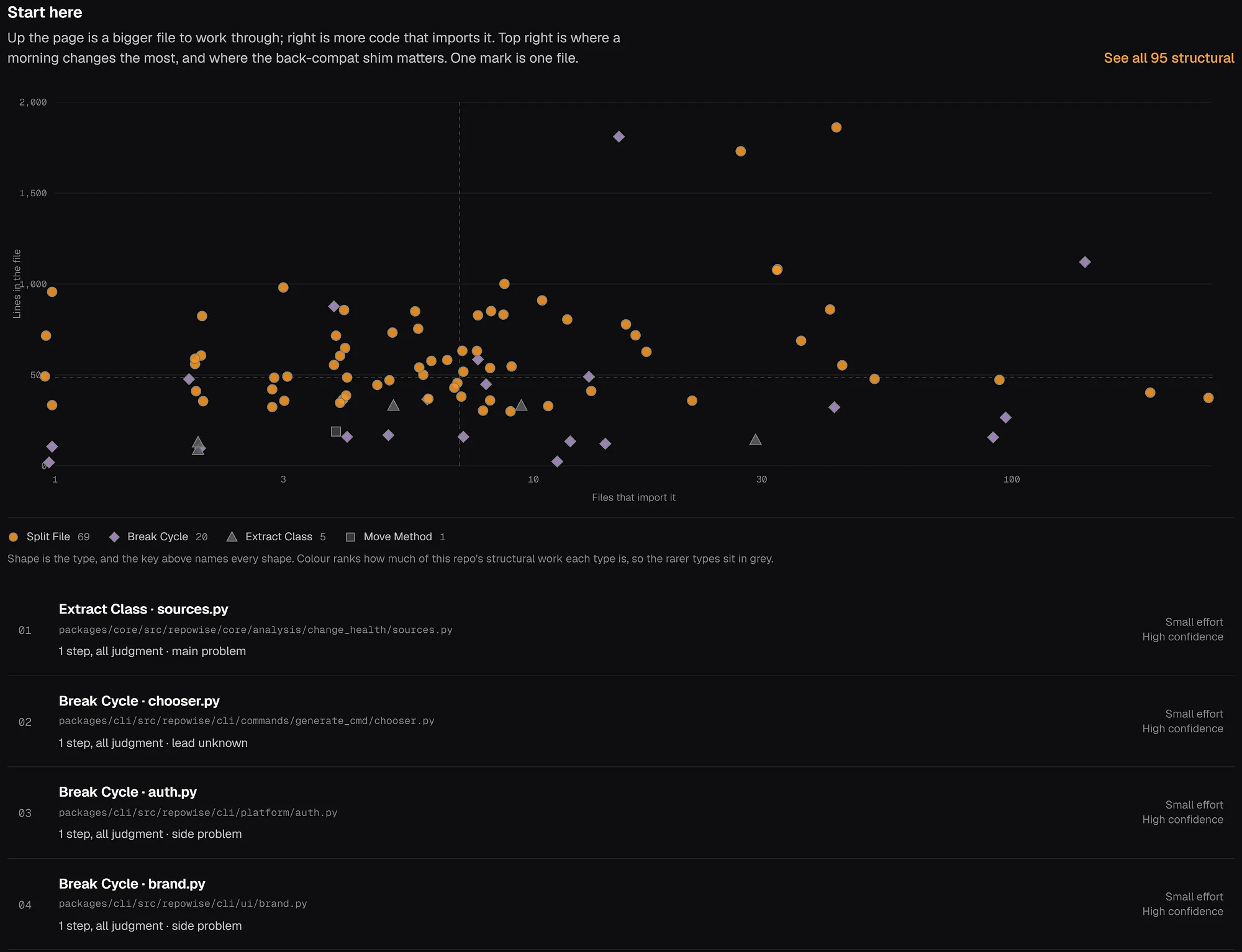
The last two steps are where repowise helps: its refactoring view ranks Break Cycle plans from the same graph, so you start with the edge that is cheapest to invert. The circular dependency guide walks through the commands per language.
FAQ
- What is the best dependency graph tool for monorepos?
- It depends on the layer. Nx or Turborepo for a package graph that drives builds, Madge or dependency-cruiser for JavaScript and TypeScript import cycles and rules, and repowise for a file and symbol graph with history and change impact across many languages.
- What are dependency graph tools?
- Dependency graph tools read code or manifests and draw what depends on what: packages, files or symbols as nodes, imports or requirements as edges. Task runners such as Nx use the graph to decide what to build, linters such as dependency-cruiser enforce rules on it, and code intelligence tools such as repowise use it for change impact and refactoring.
- What is the best tool to visualize a monorepo dependency graph?
- For the package level,
npx nx graphopens an interactive project graph in the browser, andturbo run build --graphwrites Turborepo's task graph as SVG, HTML, Mermaid or DOT. For files inside a JavaScript or TypeScript package,npx madge --image graph.svg src/writes an image. For a map that spans languages and adds ownership and blast radius,repowise serveopens a community view of every file. - How common are circular dependencies in real codebases?
- Very common at file level. In 195 public GitHub repos with 1,000+ stars, 173 (89%) have at least one circular import chain between files, and in the median repo 9% of production files sit inside one. Every Python repo in the set has one; 12 of 22 Go repos do.
- Are there free dependency graph tools?
- Yes. Madge, dependency-cruiser and Knip are free and open source for JavaScript and TypeScript, pydeps covers Python packages, and the repowise CLI is open source (AGPL-3.0) and builds a graph for 28 languages locally with no API key.
- How do I find unused dependencies in a monorepo?
- Knip reads a JavaScript or TypeScript monorepo from its entry points and reports unused files, exports and dependencies per workspace. dependency-cruiser can flag orphaned modules and production code that imports dev dependencies. repowise reports workspace packages that nothing else in the repository imports, next to unreachable files and unused exports.
- How do I generate a dependency graph for a JavaScript project?
- With dependency-cruiser,
npx depcruise src --include-only "^src" --output-type dot | dot -T svg > graph.svgdraws the graph and the same config can enforce rules in CI. Our JavaScript and TypeScript dependency graph guide walks through it, and Madge, on a real project. - What is the difference between a package graph and a symbol graph?
- A package graph shows relationships between workspace packages and is used for build order, caching and release order. A symbol graph tracks files, classes, functions and methods, and is used for refactors, change impact and finding the file that closes a cycle.
- Is GitHub's dependency graph the same thing?
- No. GitHub's dependency graph is a summary of the manifest and lock files in a repository, so it lists third-party packages and their known vulnerabilities. It does not draw the imports between your own source files, which is what monorepo dependency graph tools do.
- Which tool finds circular dependencies fastest?
- Madge is usually the fastest first pass:
npx madge --circular src/lists the loops. dependency-cruiser is the better choice when you want a cycle to fail the build, since it enforces rules in CI. - Does Nx or Turborepo find circular dependencies?
- Nx can enforce project boundaries with tags, which prevents many cycles. Turborepo's graph exists to run tasks, and cycle detection is not its focus. For file-level cycles inside a package, add Madge or dependency-cruiser.
- Do these tools work outside JavaScript?
- Madge, dependency-cruiser, Knip and Turborepo target JavaScript and TypeScript. Nx extends further through plugins for Gradle, Maven and .NET. repowise parses 28 languages to a full AST, so a repository that mixes languages gets one graph.
- Why does MCP matter for a dependency graph?
- MCP is an open standard for connecting AI applications to tools and data (modelcontextprotocol.io). A graph exposed over it lets an agent ask for callers, impact and the path between two files instead of guessing from raw file text.
- Can I run repowise on a private monorepo?
- Yes. The open source CLI (AGPL-3.0) runs locally with
pip install repowise && repowise init, so the graph is built on your machine with no model calls. Private repositories on the hosted product are part of Pro.