Free field guide
Who Wrote This?
The engineering leader's guide to governing AI-written code, and the technical debt that comes with it.
By Raghav Chamadiya, co-founder of Repowise
8 chapters, a maturity scorecard and a do-it-yourself appendix.
PDF, 71 pages, about 55 minutes
Executive summary
Five findings, five actions.
Your engineers already work with coding agents, and your repository is changing shape faster than your dashboards can show. The guide measures that change and turns it into a plan you can start on Monday.
- 4.5x
Popular open-source projects built with coding agents carry about 4.5 times the share of too-big functions that projects started in 2021-22 had at the same age, and about 3 times after accounting for codebase size.
Our study of 200+ open-source repositories, 2026, observational, projects compared at the same age. Chapter 2.
- 34/79
Commit trailers miss much of the agent use: 34 of 79 young projects that barely credited agents still added an agent config file within two months.
Our study of 200+ open-source repositories, 2026, observational, young projects with few agent credits. Chapter 3.
- 3.3x
In agent-era projects, each contributor adds over three times as much new code a week as in older projects of the same age, and all of it lands on the same reviewers.
Our study of 200+ open-source repositories, 2026, observational, lines added per contributor-week at six months. Chapter 4.
- 41-57%
Splitting a big function moves the work: its new helpers take 41% to 57% of the later edits in that area.
Our study of 200+ open-source repositories, 2026, observational, later edits after a split. Chapter 6.
- 19%
In a controlled trial, experienced developers were 19% slower with AI while believing they were faster.
METR randomised trial, 16 developers, 246 issues, early 2025. Chapter 1.

Five actions
- 01
Report the agent share of your code only with its label coverage, the share of commits you could label at all.
- 02
Name the 20 functions that are both too big and busy, and give each one an owner.
- 03
Order the review queue by each file's fix history, and save second reviewers for the top of it.
- 04
Write the reason behind every settled decision next to the code, where agents and new hires will read it.
- 05
Turn one review rule you already follow into a CI check this month, in warning mode first.
A look inside
Written to be read on a phone, in about 7 minutes a chapter.
Swipe for more pages.
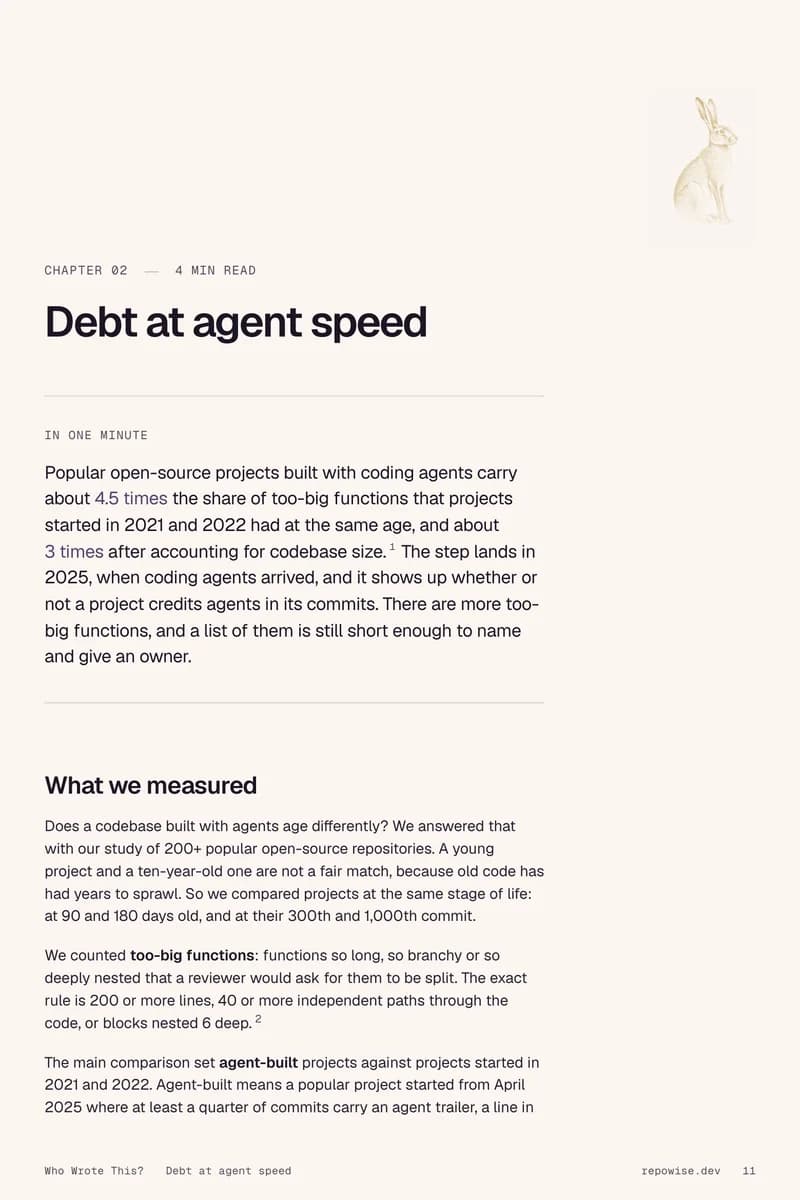
A chapter openerEvery chapter starts with its point in one minute. Chapter 2, Debt at agent speed. 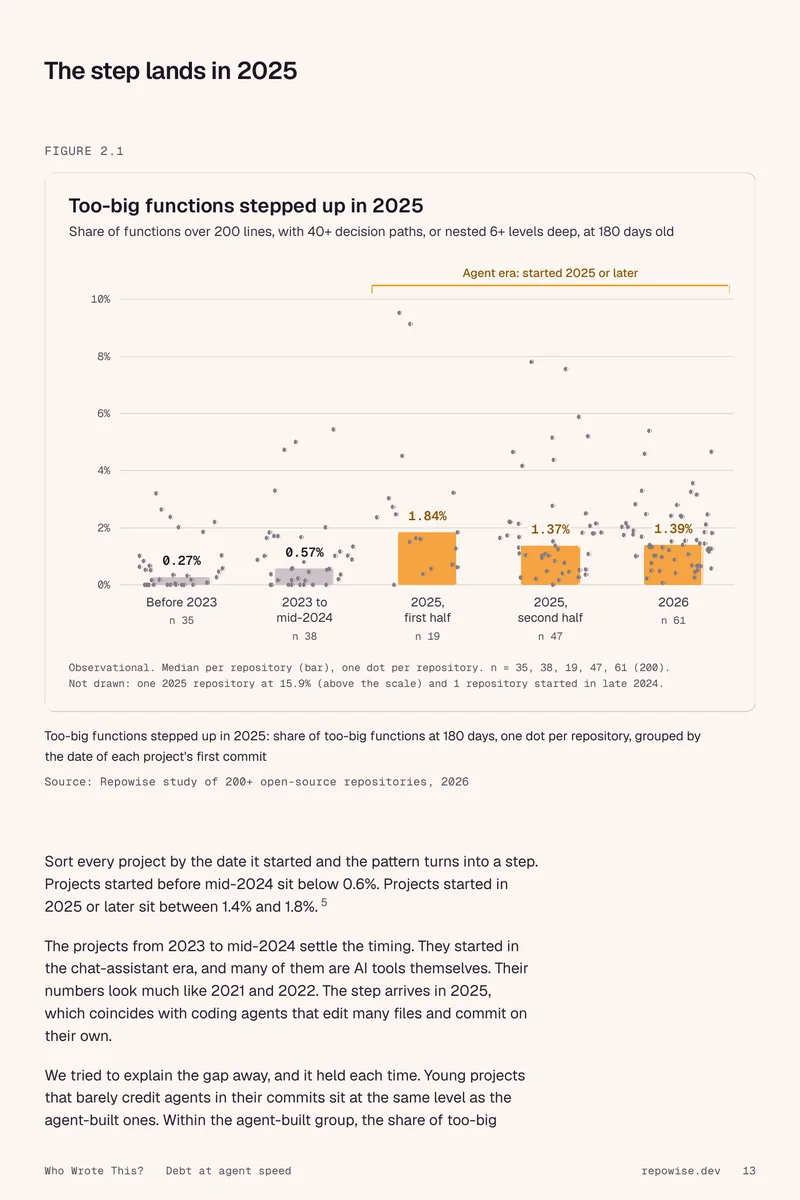
The data, drawn plainlyFigure 2.1: too-big functions by the date each project started, one dot per repository. 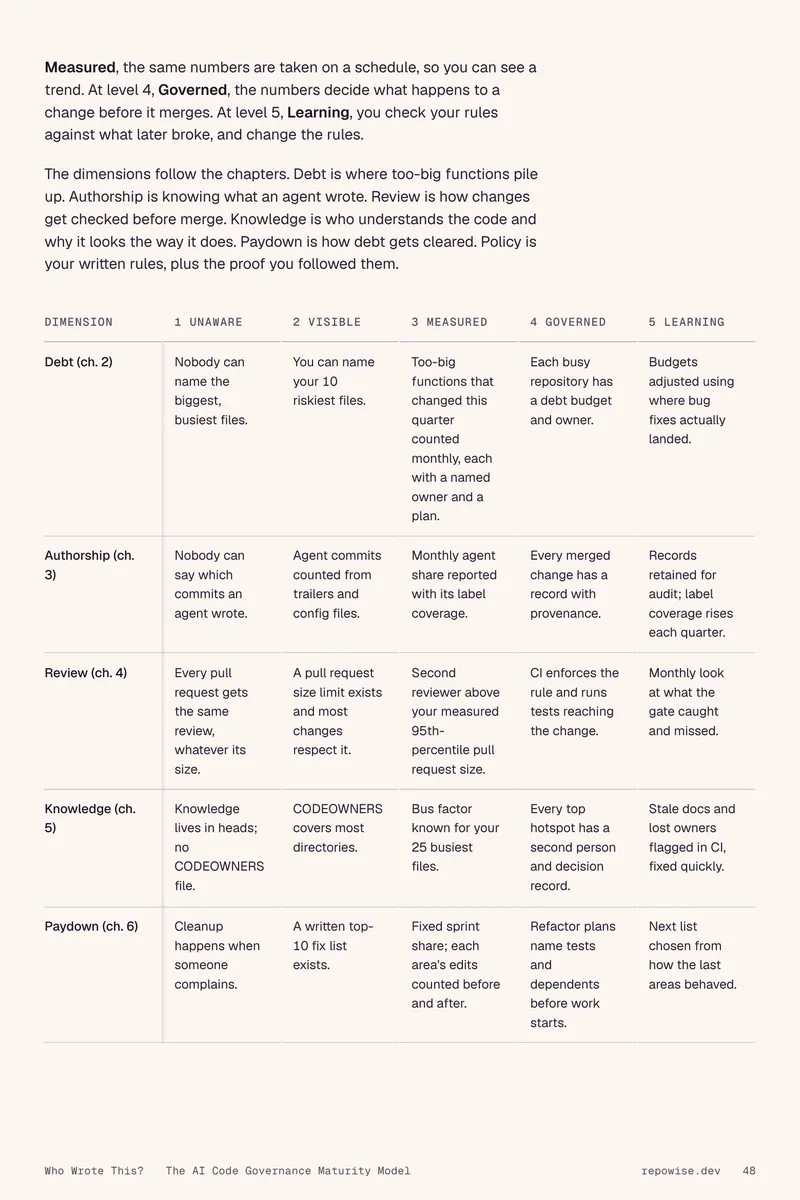
The maturity modelSix dimensions and five levels, scored against evidence you can open today. 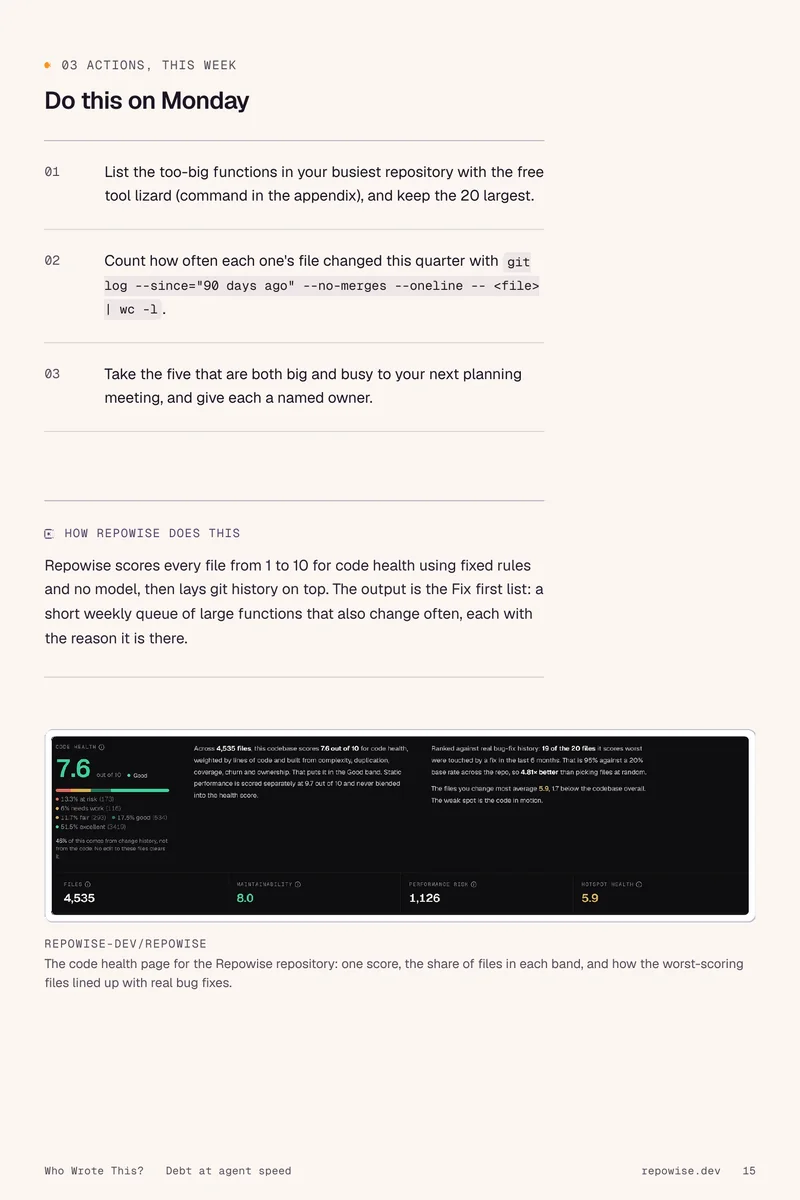
Do this on MondayThree actions to close every chapter, with the tools you already have.
Contents
Eight chapters, a scorecard and the recipes.
Each chapter opens with the point in one minute and closes with three things to do on Monday.
- 01
Your codebase has a new author
How much of your code an agent wrote, where it lives, and why most teams cannot answer yet.
- 02
Debt at agent speed
More too-big functions at the same age, on a list still short enough to name and own.
- 03
Who wrote this?
Label each change as agent, human-attested or unknown, and keep one record per merged change.
- 04
Reviewing at agent speed
Point a fixed amount of reviewer attention at the code that history says breaks.
- 05
When nobody remembers why
Single-owner files show no clear difference between eras. Keep the reasons behind decisions where agents and new hires will read them.
- 06
Paying it down without breaking things
Plan each split around how the code changes, and judge it by the whole area.
- 07
Policy engineers will actually follow
The change-management questions you already ask, answered with evidence on every change.
- 08
The AI Code Governance Maturity Model
Six dimensions, five levels each, and a 90-day plan to move up.
- +
Scorecard and do-it-yourself appendix
A ten-minute self-assessment, plus git and shell recipes for every measure in the book.
The data
Built on our study of 200+ popular open-source repositories.
- 200+
- popular open-source repositories, read commit by commit
- 131 vs 80
- projects started in the agent era, against projects started before it
- 4 stages
- compared at the same age: 90 days, 180 days, the 300th and the 1,000th commit
The method and the cohort lists are in the guide's appendix.
FREQUENTLY ASKED
Before you download
Who is this guide for?
Engineering leaders, platform and developer experience leads, and staff engineers whose teams work with coding agents such as Claude Code, Cursor, Copilot or Codex. The whole guide reads in about 55 minutes, about 7 minutes a chapter.
Is it free?
Yes. Leave your work email and the PDF downloads straight away. We also email you a link so you can find it later.
What do you do with my email?
We send you the guide, and occasional emails about our research and product updates. You can unsubscribe at any time. We keep any name, company and role you give us with your email, and the privacy policy has the details.
Is there a vendor pitch?
A short box at the end of each chapter says how Repowise does that chapter's work. The rest is a playbook you can run with the tools you already have.

Read it this week. Measure it on your own code next week.
The guide is free. Repowise reads your code graph and git history and hands your agents and reviewers the same evidence the guide uses.