

On this page
For a private repository, DeepWiki means a Devin account, a self-hosted open-source generator, or a hosted wiki tool that reads the repo through a GitHub App. Public DeepWiki and its free MCP server cover public repositories only, so this post is about the private-repo route; for the general tool-versus-tool comparison, read repowise vs DeepWiki. Pick the Devin route if Cognition is already an approved processor, self-host if code cannot leave your network, and use a hosted tool that re-indexes on push if you want a current wiki with no operations work.
| Route | What it costs | Where the code is processed | Fresh after a push | Agent access (MCP) |
|---|---|---|---|---|
| DeepWiki through a Devin account | Viewing an indexed wiki is free per Cognition; low effort generation is free, medium and high bill ACUs; Devin sessions need a paid plan (Pro $20/mo, Max $200/mo, Teams $80/mo plus $40 per dev seat) | Cognition's cloud | Not documented for private wikis | Devin MCP server with an API key |
| deepwiki-open (self-hosted) | Free (MIT) plus your model bill, or $0 with local Ollama models | Your machine, plus the model provider you pick | You re-run generation | Not a documented feature |
| OpenDeepWiki (self-hosted) | Free (MIT) plus your model bill | Your server, plus your model provider | Scheduled incremental updates | Yes, per-repo endpoints |
| OpenWiki by LangChain (self-hosted) | Free (MIT), uses your coding agent's model session | Your machine and your agent's model provider | You run an update; it tracks which facts changed | Yes, local read-only search tools |
| repowise, self-hosted | Free (AGPL-3.0); runs with no API key, or with your own model | Your machine | repowise update or a git hook | Yes, local stdio server, ten tools |
| repowise, hosted Pro | $15/mo, trial offered at checkout | repowise's cloud, read-only GitHub App, clone deleted after each run | Re-indexed about 30 seconds after each push | Yes, one URL per repo, works in Claude Code, Cursor, VS Code and Claude.ai |
Scroll the table sideways to see every column.
Prices and features are as of October 2026, checked on each vendor's own page. We build repowise, which is two rows in this table, so read those rows knowing who wrote them.
We build repowise, so weigh our entry accordingly. The measurements we publish about it, with their methods, are on the benchmarks page.
How does DeepWiki work for private repos?
DeepWiki for a private repository goes through a Devin account, not the free public site. Cognition, the company behind the Devin coding agent, runs DeepWiki. Its help article says to sign up for Devin and add your repos, and once they are indexed "the wikis will be accessible for free". Starting Devin sessions on top of that needs a paid plan.
Generation has effort levels. Per Cognition's DeepWiki documentation, low effort is the free default, medium costs roughly 5 to 10 ACUs (Devin's usage unit) per wiki and high roughly 20 to 40, billed against your team's usage.
For agents, the DeepWiki MCP documentation describes a free, no-authentication server at mcp.deepwiki.com with three tools (read_wiki_structure, read_wiki_contents, ask_question) for public repositories. MCP is the Model Context Protocol, the standard way a coding agent such as Claude Code or Cursor calls an outside tool. Private repositories use the authenticated Devin MCP server with a Devin API key.
Three things are not documented for private wikis, which matters if your team plans to depend on them:
- Refresh schedule. Cognition does not publish how often a private wiki refreshes. For public repos, guides quoting DeepWiki's FAQ say wikis refresh about weekly when the README carries the DeepWiki badge.
- Export. The help center article on wiki export says it is not possible to export the wiki contents. Plan around that if you want the docs in your own repo or docs site.
- Self-managed processing. Per devin.ai/pricing (October 2026), the plans are Free, Pro ($20/month), Max ($200/month), Teams ($80/month plus $40/month per full dev seat) and Enterprise. VPC deployment sits in Enterprise, so processing inside your own cloud means talking to sales.
If your team already pays for Devin and your security review has approved Cognition, the private wiki is close to free and the generated pages read well.
Three questions that decide it
These three questions settle more than a feature table does.
Where is the code allowed to go?
If code cannot leave your network, every hosted option is out, including DeepWiki and hosted repowise. Then check which model each self-hosted tool calls, because a generator that sends every file to a hosted model API is only half self-hosted. deepwiki-open and repowise can both run against a local model through Ollama, and repowise builds its graph, git history and health data with no model at all.
How stale can the docs get?
Generated documentation that describes last quarter's architecture is worse than none, because people trust it like a green build. Prefer a tool that re-indexes on push or marks the age of each page. Manual regeneration works for a small, slow repo and breaks down on a monorepo with twenty merges a day.
Who reads the wiki?
In 2026 the main reader of codebase documentation is often a coding agent. If agents can query the wiki over MCP, they spend fewer tokens grepping for structure they could look up. Check that the private route gives you an MCP endpoint, and that it works from where you run the agent: a local Claude Code session, or Claude.ai in the browser, which cannot reach a server on your laptop.
Self-hosted options
Self-hosting keeps code on your machines; in exchange you operate the tool and pay your own model bill.
deepwiki-open (AsyncFuncAI, MIT, about 18,000 GitHub stars) is the best-known open re-implementation. You run it with Docker, paste a GitHub, GitLab or Bitbucket URL, and add an access token for private repos. It supports Google Gemini, OpenAI, OpenRouter, Azure OpenAI and local Ollama, and generates a wiki with diagrams and a chat. You regenerate when the code moves. Its English README now mostly points to a successor desktop app called Grok-Wiki.
OpenDeepWiki (AIDotNet, MIT, about 3,600 stars) is a C# and TypeScript platform with an admin console, users and roles, GitHub App imports and background workers for scheduled incremental updates. It serves MCP endpoints per repository. It is the most platform-like open option, and the most to operate.
OpenWiki (LangChain, MIT, about 17,000 stars) runs inside the coding agent you already use (Claude Code, Codex, Cursor and others), uses that agent's model session, and writes a Markdown wiki into an openwiki/ folder in your repo. It tracks which facts came from which source lines, so an update can focus on what changed. Because the wiki is plain files you own, export is not an issue.
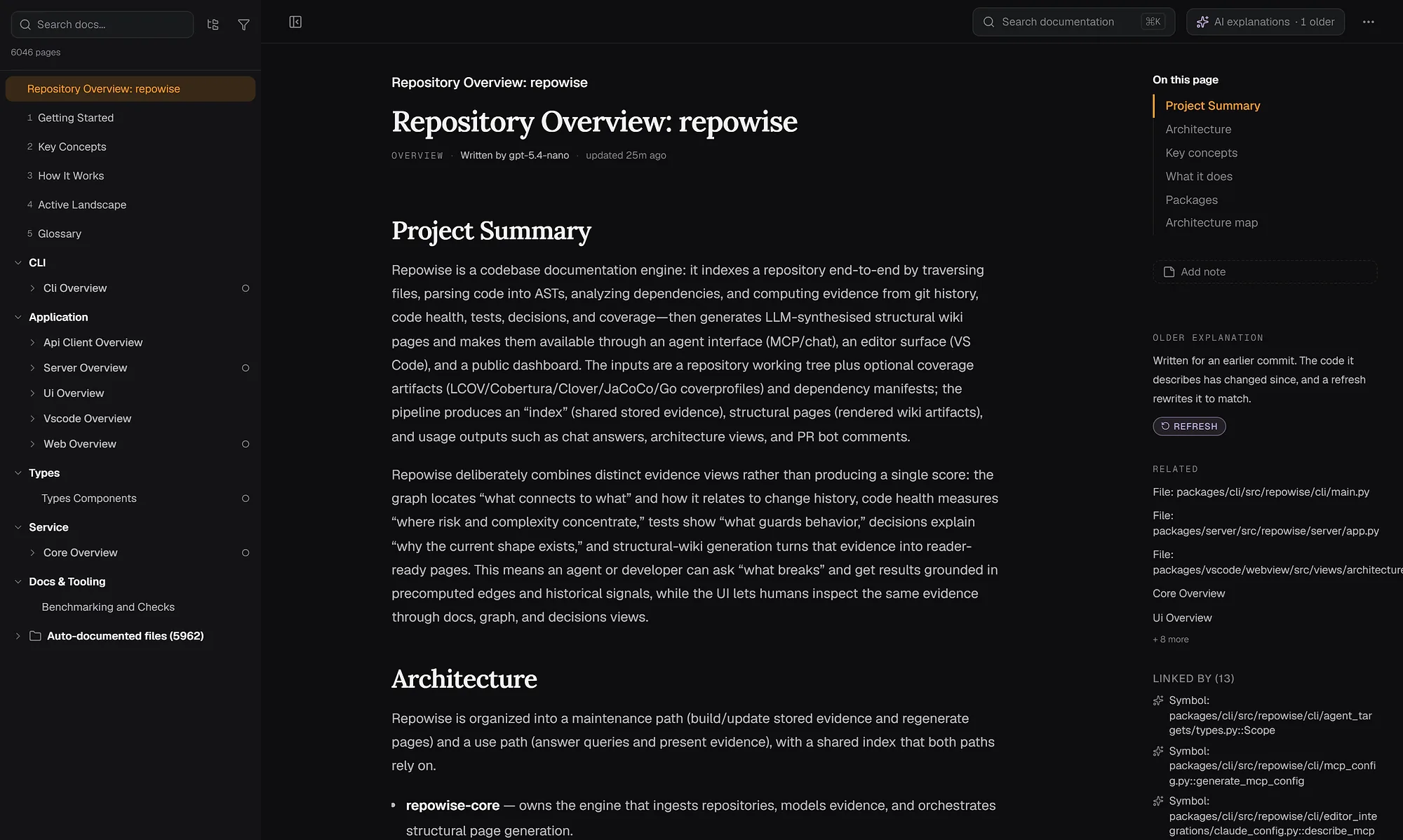
repowise (AGPL-3.0) is for teams that want the dependency graph and git history next to the wiki. repowise init parses the code into a dependency graph (28 languages to a full AST), reads git history for hotspots, ownership and files that change together, and renders a wiki from that index. It needs no API key; a model writes prose pages only if you provide one, and Ollama works. It writes an .mcp.json so Claude Code, Cursor and other agents query it locally.
Choosing a hosted tool
Plenty of teams may send code to a vendor and mostly want to know what happens to it. Before you pick any hosted wiki, read its data handling page for four things: how it gets access (an OAuth token with write scope, or a read-only GitHub App), whether the clone is kept, which model providers see code excerpts, and whether stored output (pages, graph, embeddings) is separated per account.
For hosted repowise, the answers are on the data handling page: a read-only GitHub App, a clone in a short-lived container deleted at the end of every run, raw source not kept, and model features (AI-written pages, chat) sending excerpts to OpenAI or Google Gemini through business API accounts. The graph, git analysis, health and dead-code scans call no model. Pro re-indexes about 30 seconds after each push and gives each repo an MCP address for Claude Code, Cursor, VS Code or a Claude.ai connector. That last part is why hosted suits many small teams: a local MCP server cannot be reached from a chat in the browser or on a phone.
Which route to pick
- Pick DeepWiki through Devin if you already pay for Devin and Cognition is an approved processor. Accept the refresh and export unknowns.
- Pick OpenWiki if code stays on your network and you want docs as files in the repo, and are happy to spend agent tokens.
- Pick OpenDeepWiki if you want a multi-user platform and have the capacity to run it.
- Pick self-hosted repowise if code stays on your network and you also want the dependency graph, git history, health signals and agent access without a model bill.
- Pick hosted repowise if code can leave and you want it current with no ops work. Compare it with DeepWiki on one of your own repos before deciding.
For a broader list, see DeepWiki alternatives in 2026, the one-tool comparison repowise vs DeepWiki and the DeepWiki alternative page.
Try it on a private repo
Self-hosted, on your machine:
pip install repowise
cd your-private-repo
repowise init
Hosted: install the read-only GitHub App, index one private repository and read its wiki, graph and ownership pages on Pro. Then run the same repo through DeepWiki and compare the pages side by side.
How we checked
We read each vendor's pricing page, docs and help center, and each open-source project's README and GitHub metadata (stars, license, last push), in October 2026. We did not subscribe to a paid Devin plan, so the Devin rows describe what Cognition documents, not what we observed on a private repo. Star counts move daily and are rounded. If something is out of date, tell us and we will fix it.
FAQ
- Does DeepWiki work with private repos?
- Yes, but not through the free public site. You sign up for a Devin account, connect your GitHub, and add the private repositories. Once they are indexed, Cognition says the wikis are viewable for free, while Devin sessions need a paid plan. For agent access to the private wiki you use the authenticated Devin MCP server with an API key.
- How much does DeepWiki cost?
- Public DeepWiki is free. For private repos, viewing the indexed wiki is free with a Devin account, and Devin's plans are Free, Pro at $20/month, Max at $200/month, Teams at $80/month plus $40/month per full dev seat, and Enterprise on request. Medium and high effort wiki generation is billed in ACUs.
- Can I self-host DeepWiki?
- You cannot self-host Cognition's DeepWiki itself. You can self-host open-source alternatives: deepwiki-open and OpenDeepWiki (both MIT), LangChain's OpenWiki (MIT), and repowise (AGPL-3.0). Each runs on your own machine, so check which model it calls, because that is where your code excerpts go.
- What is the best DeepWiki alternative for private codebases?
- It depends on your constraint. If code cannot leave your network, a self-hosted tool with a local model is the only option. If it can, pick the tool that re-indexes on every push and gives your coding agents MCP access, and test two of them on the same private repo for a week before deciding.
- Can I export a DeepWiki wiki?
- Cognition's help center article on wiki export (dated August 2025) says it is not currently possible to export wiki contents. Tools that write the wiki as Markdown into your repo (OpenWiki) or let you export pages avoid that problem.
- Does DeepWiki update automatically when code changes?
- For public repos, guides quoting DeepWiki's FAQ say wikis refresh automatically, about weekly, for repositories that carry the DeepWiki badge in their README. For private repos Cognition does not publish a refresh schedule, so ask before you depend on it.