In one minute AI-written code does not need a new rulebook. It needs the change-management questions you already answer for auditors, answered with evidence on every change. Only 48% of developers say they always check AI-written code before they commit it,1 so the check has to live in the pipeline, where it runs whether anyone remembers or not.
The questions have not changed
Every change-management process asks the same five things: who or what made this change, who reviewed it, what it touched, which tests ran, and whether it touched anything sensitive.
Those questions are older than coding agents, and the frameworks your auditors use already ask them. None of SOC 2, ISO/IEC 27001, SOX or PCI DSS has a special section for code an agent wrote, and you do not need to write one. What has moved is volume and authorship. Your team ships more changes than it did, and a tool typed part of many of them. An agent can author a change. It cannot approve one.
So keep the questions you already have, and make sure each one has an answer you can show for every change, without asking the person who merged it.
How the controls map
The table maps the change-management controls regulated teams meet most often. Read each row as a question an auditor will ask about a sample of your changes.
| Control | What it asks | Evidence an auditor wants | Where AI-written changes make it harder | What a Change Record gives you |
|---|---|---|---|---|
| SOC 2, Trust Services Criteria CC8.12 | Changes to infrastructure, data, software and procedures are authorized, designed, developed, configured, documented, tested, approved and implemented | A sample of changes, each traced to an authorization, a test result and an approval | More and larger changes per period, and an author field that names the person who committed the agent's work | Each merged change with its commits, files, author and an agent, human-attested or unknown label, exportable as an in-toto statement |
| ISO/IEC 27001:2022, the Annex A change management control3 | Changes to information processing facilities and systems follow change management procedures | A documented procedure and records showing changes were assessed, approved and tested | The record of who wrote a change stops at the committer | A per-change record of what landed and how it was written, kept in your own audit store |
| SOX IT general controls, change management4 | Program changes to systems that support financial reporting are requested, approved, tested and moved to production under control | A population of changes to in-scope systems, each with approval and test evidence | Higher change counts mean a larger population to sample, and authorship needs its own evidence | A complete list of merged changes per repository, read from git, to reconcile against your tickets |
| PCI DSS v4.0, requirement 6.5.15 | Changes to system components in production follow procedures covering reason, security impact, documented approval by authorized parties, testing and a way back | Change records with a stated reason, an approval and a security test result | Generated code can carry a security impact nobody wrote down | The change's files and provenance, so the security review knows which changes need a closer look |
A Change Record answers who and what, and it carries an approval wherever your git history holds one. Your code host's review records and your CI logs supply the rest. Together they cover the evidence column for every row. If your product could fall under rules aimed at AI systems, check with your counsel what applies to you.
Two engineering frameworks sit beside these controls. NIST's Secure Software Development Framework (SSDF) sets out a core set of secure development practices that US federal software suppliers attest to.6 SLSA covers build provenance, meaning tamper-resistant evidence of how a piece of software was built, and in-toto, a graduated Cloud Native Computing Foundation project, gives a common format for statements about each step.7 A Change Record exported as an in-toto statement sits next to that build evidence.
Rules that hold up
Most companies already have a secure development policy. It lives in a wiki, someone signed it off two years ago, and few people on the team could quote a line from it. A reviewer who has never opened it cannot apply it to a 600-line agent pull request at 5pm.
Rules that hold up have four things in common:
- They are written as code, in the repository, next to what they govern. A change to a rule gets reviewed like any other change.
- They run on every change, in CI or as a pre-commit hook, with no one needing to remember.
- They explain themselves in the pull request. A failing check names the rule, the file that tripped it and what to do next.
- They treat missing evidence as unknown. A change with no record of who wrote it is "unknown", never "human".
The fourth point carries the most weight for AI-written code. As chapter 3 showed, commit trailers often leave agents out, so a rule that reads silence as "human" waves through exactly the changes you wanted to see.
Five policies a team can adopt
Start small. Each policy below answers one of the five questions, and each runs on tools most teams already have.
| Policy | Question it answers | Enforce it with what you have |
|---|---|---|
| Changes to payment code need approval from a payments owner | Who reviewed it? | A CODEOWNERS file plus branch protection |
| Agent-written changes over 200 lines must reach at least one test | Which tests ran? | A CI job that reports test coverage on the changed lines of pull requests marked as agent-assisted |
| No new secrets in any commit | Did it touch anything sensitive? | An open-source secret scanner as a pre-commit hook and again in CI |
| Files with a bug fix in the last 90 days get a second reviewer | What did it touch? | A CI step that searches git history for fix commits on the changed files and requests a reviewer |
| Every pull request states how it was written | Who or what made it? | A pull request template field or commit trailer, checked in CI, where a blank counts as unknown |
The 200-line bar and the 90-day window are examples. Pick numbers from your own pull request sizes and fix history, then adjust them after a month.
Roll each rule out as a warning first. Let it run for two weeks, read what it flagged, and fix the rule before it blocks anyone. Promote it to a hard failure once the engineers it affects agree the alarms are real. A rule that cries wolf gets bypassed, and the bypass becomes your real policy.
Keep an exception log. When someone overrides a rule, record who, when and why. That log is evidence too, and it tells you which rules need rewriting.
Prepare one answer before anyone asks for it: which changes did an agent write last quarter? Give the changes you know an agent wrote, and the label coverage for the quarter, in the form chapter 3 describes.
What your CISO will ask
- What leaves the network? Repowise runs locally and the core is open source, so you can read what it does. Source code is parsed in memory and never stored; the index lives in a
.repowise/folder in the repository. Health, change risk, attribution and Change Records need no model at all. A model key is optional, used only for generated documentation, chat, decision extraction and opt-in refactoring code, and those calls go straight from your machine to the provider you choose. The hosted option indexes code on Repowise's infrastructure instead, for teams that prefer it.- What does edit capture store? The opt-in hooks record line hashes, the file path, an opaque session id, the tool and the model in
.repowise/attribution/on the developer's machine, a folder git ignores. They never store prompts or code, and nothing leaves the machine unless you push the optional git notes yourself.- How long is it kept? Local data stays until you delete it, and
repowise attribution purgeremoves the attribution data in one step. The CLI's anonymous usage telemetry holds no code, paths or repository names, keeps events for 90 days, and turns off with one command.
Do this on Monday
- Write down your five riskiest directories, such as payments, auth or data deletion, and name one owner for each.
- Turn one review rule you already follow into a CI check in warning mode, and read what it flags after two weeks.
- Take the control table above to your compliance lead and mark which evidence cells you can already fill for last quarter.
How Repowise does this Repowise reads a change policy from
.repowise/policies.yaml, andrepowise checktests each change against it. Rules select components by name, tag or criticality, test evidence such as agent authorship, reaching tests and decisions crossed, then warn, ask for an owner review or tests, or fail the build. Results go to CI as SARIF or JUnit, and each merged change exports as an in-toto statement. Missing evidence reports as "not evaluated", never as a pass.
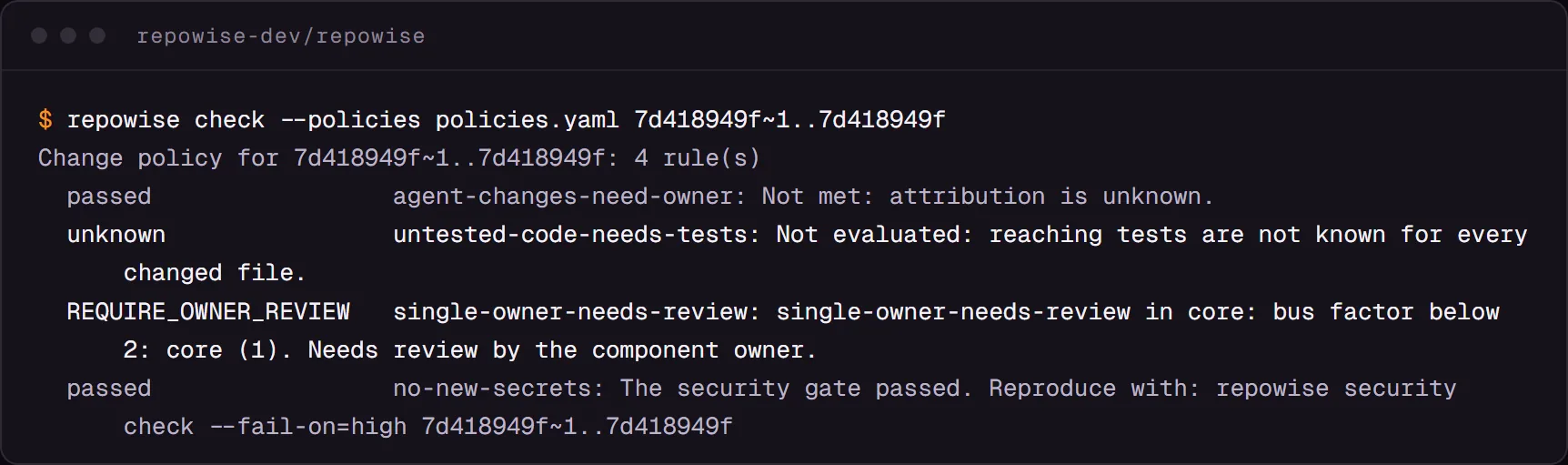
repowise check with an example four-rule policy, run on one merged change. A rule with missing evidence reports as not evaluated.Sources
Footnotes
-
State of Code Developer Survey 2026, Sonar. 1,100+ developers, released 8 January 2026. https://www.sonarsource.com/company/press-releases/sonar-data-reveals-critical-verification-gap-in-ai-coding/. Vendor survey, self-reported. ↩
-
AICPA, 2017 Trust Services Criteria (with revised points of focus, 2022), criterion CC8.1. Criterion text as published in NIST's crosswalk of the Privacy Framework to the Trust Services Criteria: https://www.nist.gov/itl/applied-cybersecurity/privacy-engineering/american-institute-certified-public-accountants-aicpa. Reference document. ↩
-
ISO/IEC 27001:2022, Annex A, change management control. Commonly mapped to by practitioners as the 2022 change management control; the standard itself is sold by ISO, https://www.iso.org/standard/27001. Reference document. ↩
-
SOX IT general controls are commonly grouped into access, program changes, program development and computer operations, assessed by auditors under PCAOB auditing standards. https://pcaobus.org/oversight/standards/auditing-standards. Reference document. ↩
-
PCI DSS v4.0, requirements 6.5 ("Changes to all system components are managed securely") and 6.5.1, as printed in the PCI SSC Self-Assessment Questionnaire D for Merchants: https://listings.pcisecuritystandards.org/documents/PCI-DSS-v4-0-SAQ-D-Merchant.pdf. Reference document. ↩
-
Secure Software Development Framework (SSDF) v1.1, SP 800-218, NIST, February 2022. https://csrc.nist.gov/pubs/sp/800/218/final. Reference document. ↩
-
SLSA specification v1.0, "About SLSA", https://slsa.dev/spec/v1.0/about; in-toto project, https://in-toto.io/. Reference documents. ↩