
On this page
- What does each CodeRabbit plan cost?
- Who counts as a seat on CodeRabbit?
- Is CodeRabbit free?
- What are the hourly review limits?
- How does CodeRabbit usage billing work?
- What does CodeRabbit cost for 5, 25 and 100 developers?
- What does a busy or agent-heavy team actually pay?
- How does repowise price the same job?
- When does each pricing model win?
- How we checked
- FAQ
CodeRabbit costs $24 per developer a month on Essentials, $48 on Team and $72 on Advanced when billed annually, with Enterprise on custom pricing. Monthly billing is $30 on Essentials and $60 on Team. Only developers who open pull requests are charged, public repositories are reviewed free, and every paid plan starts with a 14-day trial.
All numbers here were checked on coderabbit.ai/pricing and docs.coderabbit.ai on 15 October 2026. CodeRabbit changes its plans often (Pro became Essentials, Pro Plus became Team), so confirm on the page before you budget.
We build repowise, so weigh our entry accordingly. The measurements we publish about it, with their methods, are on the benchmarks page.
What does each CodeRabbit plan cost?
| Essentials | Team | Advanced | Enterprise | |
|---|---|---|---|---|
| Per developer, annual billing | $24 a month | $48 a month | $72 a month | Contact sales |
| Per developer, monthly billing | $30 a month | $60 a month | Not listed | Contact sales |
| Hourly PR reviews per developer | 5 | 8 | 10 | 12 |
| Linked repositories | 1 | 5 | 10 | 20 |
| MCP connections | 5 | 10 | 15 | 20 |
| Custom pre-merge checks | None | 10 | 20 | 20 |
| Trial | 14 days | 14 days | 14 days | Contact sales |
Scroll the table sideways to see every column.
What each step adds, per CodeRabbit's pricing page:
- Essentials: AI review in the pull request, CLI, IDE and agent loops, plus learnings, chat, pre-merge checks, slop detection, one-click fixes, change explanations and security code review.
- Team: everything in Essentials, plus unit test generation, finishing touches, post-merge actions, Triage (a prioritized PR queue with review guidance and Slack triage) and an expanded Change Stack.
- Advanced: everything in Team, plus security-informed prioritization, Blast Radius, architecture impact review, continuous security monitoring and attack-surface visibility.
- Enterprise: everything in Advanced, plus multi-org administration, enforced workspace policies, custom RBAC, SSO, audit logs, API access and usage metrics, a support SLA with dedicated customer success, custom deployment options and marketplace purchasing.
Essentials already covers the core job, a line-by-line AI review on every pull request, in the PR, the CLI and the IDE. The jump to Team is about workflow (tests, triage, post-merge actions) and the jump to Advanced is about security and architecture depth.
Who counts as a seat on CodeRabbit?
Only developers who create pull requests. CodeRabbit's pricing page states that plans are priced per developer who creates pull requests and that only those developers are charged. Reviewers, managers and engineers who never open a PR don't take a seat.
That makes the headcount you pay for smaller than the headcount you employ. A 40-person engineering org where 25 people open PRs in a given month is a 25-seat purchase. CodeRabbit's docs also describe a seat assignment page, where admins control whether seats are assigned to team members automatically or manually.
Is CodeRabbit free?
For public repositories, yes. Install CodeRabbit on a public repo after signing up with GitHub or GitLab and reviews are free, with no extra setup. CodeRabbit's plans documentation says open-source projects receive Team features with no paid subscription, and that the hourly allowance on the OSS tier runs from 1 to 10 PR reviews depending on repository star count.
Private repositories need a paid plan. New organizations start with a 14-day Advanced trial, and trials use the same hourly numbers as the plan they mirror. Organizations that don't subscribe revert to Free, which is limited to 1 PR review an hour (summary only), 3 IDE reviews and 3 CLI reviews.
What are the hourly review limits?
Each plan includes a rolling hourly allowance per developer, not a monthly quota. Per CodeRabbit's plans documentation, that is 5 reviews each for PR, IDE and CLI on Essentials, 8 on Team, 10 on Advanced and 12 on Enterprise.
Most developers never reach these numbers. Five PR reviews an hour is a lot for a person, and the allowance refills continuously. The limits start to matter for developers who run many CLI or IDE reviews in a burst, and for agents that push several branches in quick succession under one user.
How does CodeRabbit usage billing work?
Past the hourly allowance, eligible PR and CLI reviews can continue as pay-as-you-go usage. Per CodeRabbit's usage-based billing docs:
- The price is $0.25 per reviewed file, which the docs also express as $1.00 per credit and 4 files reviewed per credit.
- It applies to Essentials, Team and Advanced organizations. Enterprise customers arrange paid usage through their account team.
- Admins choose Automatic, On demand or Off, and set a monthly spending cap or select Unlimited. When the cap is reached, new reviews over the included limit stop, and they resume when an admin raises the cap or the month resets. Reviews already in progress finish.
- A valid payment method is required before paid usage can be enabled, and charges are added to the monthly invoice.
- CLI and agentic API-key reviews use the assigned user's allowance first, and usage is billed only after that limit is reached.
- Pull requests with more than 300 files can't be reviewed through the usage-priced on-demand action.
The cap is the useful part. You decide the most overage can ever cost, and the default of paying nothing past the allowance is always available.
CodeRabbit also lists two products billed separately from plans: Deep Scan, with variable pricing based on the scan, and the CodeRabbit Agent at $0.40 per agent minute after applicable trial and free minutes.
What does CodeRabbit cost for 5, 25 and 100 developers?
The arithmetic is seats times price, using annual billing. Every developer here opens pull requests and holds a seat.
| Team size | Essentials | Team | Advanced |
|---|---|---|---|
| 5 developers | $120 a month | $240 a month | $360 a month |
| 25 developers | $600 a month | $1,200 a month | $1,800 a month |
| 100 developers | $2,400 a month | $4,800 a month | $7,200 a month |
Scroll the table sideways to see every column.
On monthly billing, Essentials is $150, $750 and $3,000 for the same three team sizes, and Team is $300, $1,500 and $6,000. Annual billing saves 20 percent on both plans.
Seat pricing gets cheaper per review the more each developer ships. At 10 PRs per developer a month, Essentials works out to $2.40 a PR on annual billing. At 30 PRs per developer it is $0.80 a PR. If you review a lot, a flat seat is a good deal.
What does a busy or agent-heavy team actually pay?
Usually the seat price and nothing more. Because the hourly allowance refills every hour, a team of humans opening a handful of PRs a day stays inside it, and the bill is the table above.
Agent-heavy teams are where usage billing can appear. A coding agent working under one developer's account can open many PRs and trigger many CLI reviews in an hour. Once that user passes their allowance, each extra review is billed per file. As arithmetic, using CodeRabbit's rate: an agent PR touching 12 files that is reviewed over the allowance costs 12 x $0.25 = $3.00, and 100 such reviews cost $300. With the monthly cap set to, say, $200, spending stops there and reviews over the limit pause until the next period.
So the practical advice for agent-heavy teams is to turn usage billing to On demand or set a cap on day one, and to watch how many reviews each agent identity triggers per hour. The same advice applies to any usage-metered tool.
How does repowise price the same job?
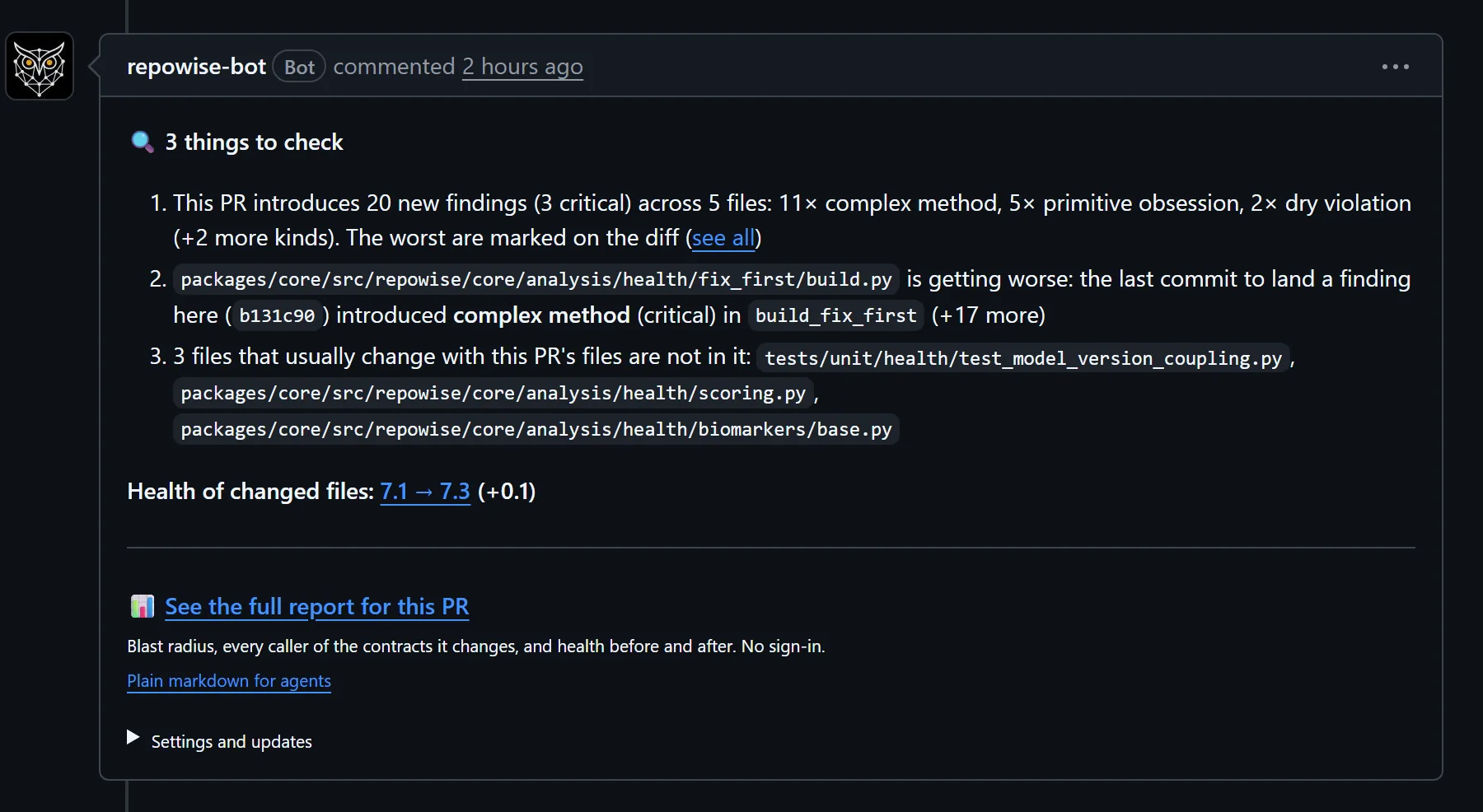
repowise prices code review per pull request instead of per seat. The PR bot has three modes, chosen per repository. Signals is deterministic, uses no model, is free on public repositories and posts nothing on a clean PR. AI triage costs 1 to 2 cents a pull request. Full AI review costs about 20 to 35 cents a pull request, so 100 PRs cost about $20 to $35 of pay-as-you-go credits, measured on 291 real pull requests. The Pro plan is $15 a month and includes $5 of credits, enough for about 15 to 25 full reviews, and there is no per-seat review fee. Each repository gets a monthly AI spend limit the owner sets, and when it is reached the bot falls back to the free Signals comment and says so.
When does each pricing model win?
Per-seat pricing wins when your developers open many PRs. A busy team spreads a flat $24 to $72 over hundreds of reviews, the bill is the same every month, and finance can plan around headcount. CodeRabbit's plans also bundle a lot beyond review (IDE and CLI reviews, unit tests, triage, security analysis on higher tiers), so the seat buys a product, not only a comment.
Per-PR pricing wins when volume is uneven. A small team, a quiet month, a repository that only gets occasional PRs, or an organization where many people open one PR a quarter all cost less when the price follows the review. It also keeps a free first pass on every PR through Signals, and spends model credits only where you ask for them.
Many teams will use both. CodeRabbit for the repositories where every developer ships daily, repowise Signals as a free layer everywhere, and Full AI review where a deep look is worth about 20 to 35 cents. For a side-by-side on features as well as price, see the CodeRabbit alternative comparison, the AI code review pricing comparison across five tools, and the roundup of GitHub PR review bots. To try the repowise side, see the PR bot.
How we checked
We fetched coderabbit.ai/pricing, the plans page and the usage-based billing page on 15 October 2026 and took every CodeRabbit number from those pages. CodeRabbit doesn't list a monthly price for Advanced on its pricing page, so we don't quote one. The worked examples are our own arithmetic on list prices, in US dollars, before taxes, discounts and startup programs, and the agent example is illustrative, not measured. repowise figures come from the credit ledger on the repowise repository, re-reviews on later pushes included.
FAQ
- How much does CodeRabbit cost?
- CodeRabbit costs $24 per developer a month on Essentials, $48 on Team and $72 on Advanced with annual billing. Monthly billing is $30 on Essentials and $60 on Team. Enterprise is custom, quoted by sales.
- Is CodeRabbit free?
- CodeRabbit is free for public repositories, with Team features and no setup beyond installing it after signing up with GitHub or GitLab. Private repositories need a paid plan after a 14-day trial.
- Who counts as a seat in CodeRabbit?
- Only developers who create pull requests are charged. People who only review, manage or never open a PR don't take a seat, so the seat count is usually lower than your engineering headcount.
- What is CodeRabbit's hourly review limit?
- Each developer gets a rolling hourly allowance of 5 PR reviews on Essentials, 8 on Team, 10 on Advanced and 12 on Enterprise. IDE and CLI reviews have the same per-plan numbers, and the allowance refills continuously instead of monthly.
- What does CodeRabbit charge past the hourly limit?
- Usage billing charges $0.25 per reviewed file ($1 per credit, 4 files per credit) on Essentials, Team and Advanced. Admins choose Automatic, On demand or Off and set a monthly spending cap, and charges are added to the monthly invoice.
- How much does CodeRabbit cost for 25 developers?
- On annual billing, 25 developers cost $600 a month on Essentials, $1,200 on Team and $1,800 on Advanced. On monthly billing, Essentials is $750 and Team is $1,500. That assumes all 25 open pull requests.
- Is there a CodeRabbit free trial?
- Yes. Paid plans start with a 14-day trial, and new organizations start with a 14-day Advanced trial. Organizations that don't subscribe afterward revert to the Free plan.