
On this page
- What is Claude Code Review?
- How is Claude Code Review billed?
- What does Claude Code Review cost for 200 PRs a month?
- What does the open Claude Code GitHub Action cost?
- How does it compare with CodeRabbit, Greptile, Cursor Bugbot and repowise?
- How do I budget 200 PRs: deep review where it counts, cheap review elsewhere?
- Which should you pick?
- How we checked
- FAQ
Claude Code Review costs an average of $15 to $25 per pull request, according to Anthropic's Code Review docs. It is billed on token usage through usage credits, not as a seat, and the figure scales with PR size, codebase complexity and how many findings need verification. At that rate, 200 PRs reviewed once cost about $3,000 to $5,000 a month, which is why most teams point it at the PRs that matter and use something cheaper for the rest.
That price buys depth. Anthropic describes a fleet of specialized agents that read the diff in the context of your full codebase, then a verification step that checks each candidate against actual code behavior before anything is posted. In Anthropic's own launch numbers, substantive review comments on PRs went from 16% to 54%, and fewer than 1% of findings were marked incorrect.
| Option | Who can use it | How it bills | Typical cost per PR |
|---|---|---|---|
| Claude Code Review (managed) | Claude Team and Enterprise, research preview | Token usage via usage credits, monthly cap you set | $15 to $25 average, per Anthropic |
| Claude Code GitHub Action | Anyone with an API key or Claude subscription token | Your API tokens plus GitHub Actions minutes | Depends on your prompt and model; about $1 in our worked example below |
| Cursor Bugbot | Cursor paid plans | Usage-based | $1.00 to $1.50 average, per Cursor |
| CodeRabbit | Any plan, public repos free | Per developer, annual or monthly | $24 per developer a month (Essentials, annual) |
| Greptile | Starter free, Pro from $30 a seat | Seat with 50 credits, extra at $1 | 1 credit (base) to 10 credits (Apex) |
| repowise Full AI review | Any repo with credits | Pay-as-you-go credits | about 20 to 35 cents |
| repowise Signals | Free on public repos | No model call | $0 |
Scroll the table sideways to see every column.
Prices checked on the vendors' own pages on 15 October 2026. The sections below show where each number comes from.
We build repowise, so weigh our entry accordingly. The measurements we publish about it, with their methods, are on the benchmarks page.
What is Claude Code Review?
Claude Code Review is Anthropic's managed, multi-agent pull request reviewer. It was announced on 9 March 2026 and, per the docs checked on 15 October 2026, it is a research preview for Team and Enterprise subscriptions. It is not available for organizations with Zero Data Retention or the HIPAA configuration.
An Owner enables it once at claude.ai/admin-settings/claude-code, installs the Claude GitHub App and picks repositories. Agents then analyze the diff and surrounding code in parallel on Anthropic infrastructure and post findings as inline comments tagged Important, Nit or Pre-existing. The check run always completes neutral, so it never blocks a merge. A review takes about 20 minutes on average.
Anthropic's launch post adds the shape of the results: PRs over 1,000 lines got findings 84% of the time with 7.5 issues on average, while PRs under 50 lines got findings 31% of the time with 0.5 issues. Depth shows up where the diff is large.
People on other plans are not shut out. The /code-review command reviews a diff in your own Claude Code session without installing the GitHub App, and uses your normal session usage.
How is Claude Code Review billed?
Claude Code Review is billed on token usage, and the docs state it is billed separately through usage credits and does not count against your plan's included usage. Admins set a monthly spend cap for the Claude Code Review service at claude.ai/admin-settings/usage. When the cap is reached or credits run out, the review is skipped and one comment on the PR says why, so spend stops at a number you chose.
The cost levers are the review trigger and the repository list:
- Once after PR creation runs one review per PR.
- After every push runs a review on each push, which multiplies cost by the number of pushes.
- Manual reviews only when someone comments
@claude review. Commenting@claude review alwayssubscribes that one PR to push reviews.
The repository table in the admin settings also shows the average cost per review for each repo from recent activity, and an analytics page at claude.ai/analytics/code-review shows PRs reviewed and cost so far this month. Anthropic notes these cost figures are estimated at list price and can differ from your invoice.
What does Claude Code Review cost for 200 PRs a month?
At the $15 to $25 average, the arithmetic for 200 PRs is short:
| Trigger | Reviews | Monthly cost at $15 to $25 |
|---|---|---|
| Once after PR creation | 200 | $3,000 to $5,000 |
| After every push, about 1.8 pushes per PR | about 360 | about $5,400 to $9,000 |
| Manual, 10 PRs opted in | 10 | $150 to $250 |
Scroll the table sideways to see every column.
The 1.8 pushes per PR is what we see on the repowise repository: 517 pushes across 291 pull requests in the 30 days to 12 October 2026. Your repos will differ, and the analytics dashboard will tell you. The point stands for any value above 1: a push trigger is the largest single line in the bill, and Anthropic says so in its own pricing section.
This is a price for depth, and it is easy to justify on a payments or auth change. It is harder to justify on a dependency bump or a typo fix, which is the reason for the tiers below.
What does the open Claude Code GitHub Action cost?
The Claude Code GitHub Action is a different product from the managed review. It runs Claude Code inside your own workflow on your own runner, so you pay for API tokens and GitHub Actions minutes instead of a per-review average. Anthropic's GitHub Actions docs say each run consumes two things: Actions minutes on GitHub-hosted runners, and API tokens based on prompt and response length, task complexity and codebase size. If you authenticate with a subscription OAuth token, runs use your subscription instead of API billing.
The docs list the levers: keep CLAUDE.md concise because Claude reads it on every run, set --max-turns in claude_args, set workflow timeouts, and use concurrency controls. You also pick the model with --model.
To see the shape of the bill, take the list prices on Anthropic's pricing page: Claude Sonnet 5.5 is $2 per million input tokens, $0.10 per million for cache hits and $10 per million output tokens. A review run that reads 300,000 fresh input tokens, re-reads 1.5 million cached tokens across turns and writes 25,000 output tokens costs about $0.60 + $0.15 + $0.25, close to $1.00 in tokens. That is our arithmetic on list prices for an illustrative run, not a measurement, and a larger codebase or more turns moves it up. Opus models cost more per token, which is where a workflow starts to approach the managed review's range.
The trade is clear. The Action gives you control of the prompt, model, triggers and cost per run, at the price of maintaining a workflow file. The managed review gives you the multi-agent pipeline and the verification step with nothing to maintain.
How does it compare with CodeRabbit, Greptile, Cursor Bugbot and repowise?
These tools bill in four different ways, so the useful number is cost per PR at your volume.
CodeRabbit is per developer: Essentials is $24 a month on annual billing and $30 monthly, and public repositories get free reviews. At 10 PRs per developer a month, Essentials annual works out to $2.40 a PR and falls as PR volume rises. Plan details are in CodeRabbit pricing and repowise vs CodeRabbit.
Greptile Pro is $30 per seat with 50 credits per seat and $1 per extra credit. A base review is 1 credit, Plus 3 and Apex 10, so depth is the lever, as it is for Claude. See Greptile pricing and repowise vs Greptile.
Cursor Bugbot is usage-based and billed through your Cursor plan. Cursor's Bugbot page states the average review costs $1.00 to $1.50 depending on PR size and complexity, and its pricing page lists Bugbot on Premium, Super, Ultra, Teams and Enterprise. Bugbot suits teams already in Cursor, where findings flow to its agents.
repowise prices review per pull request from pay-as-you-go credits with no per-seat review fee. Full AI review costs about 20 to 35 cents a pull request, about $20 to $35 per 100, measured on 291 PRs from the credit ledger on the repowise repository, re-reviews on later pushes included. AI triage costs 1 to 2 cents. Signals mode runs no model, is free on public repos and posts nothing on a clean PR. For the wider price table, see AI code review pricing compared and the PR review bots roundup.
How do I budget 200 PRs: deep review where it counts, cheap review elsewhere?
Most PR volume is routine. A tiered setup spends the deep-review money on the few changes that can hurt production and covers the rest with cheap or free signals.
| Tier | Share of 200 PRs | PRs | Review | Monthly cost |
|---|---|---|---|---|
| 1. Can hurt production: auth, payments, migrations, core libraries | 5% | 10 | Claude Code Review, once or on demand | $150 to $250 |
| 2. Normal feature and fix work | 20% | 40 | repowise Full AI review | about 20 to 35 cents a PR |
| 3. Everything else: docs, bumps, small fixes | 75% | 150 | repowise Signals, deterministic | $0 |
Scroll the table sideways to see every column.
The total is the Tier 1 line plus a small credit spend, so the budget is dominated by how many PRs you choose to send to Tier 1. Compare that with $3,000 to $5,000 for sending all 200 to the managed review once, or the push-multiplied figure above.
Three settings keep this honest:
- Set Claude Code Review to Manual and comment
@claude reviewon Tier 1 PRs, or use@claude review alwayson the one long-running risky PR where every push matters. Set the monthly cap at claude.ai/admin-settings/usage to your Tier 1 figure. - Pick Tier 1 by risk, not by guess. repowise scores each change from the diff, the dependency graph and git history, so the PRs touching hotspots or with a wide blast radius are the ones that get the deep review. The silent-by-default PR bot comments only when something fires.
- Cap the cheap tier too. Each repository has a monthly AI spend limit the owner sets, and when it is reached the bot falls back to the free Signals comment and says so.
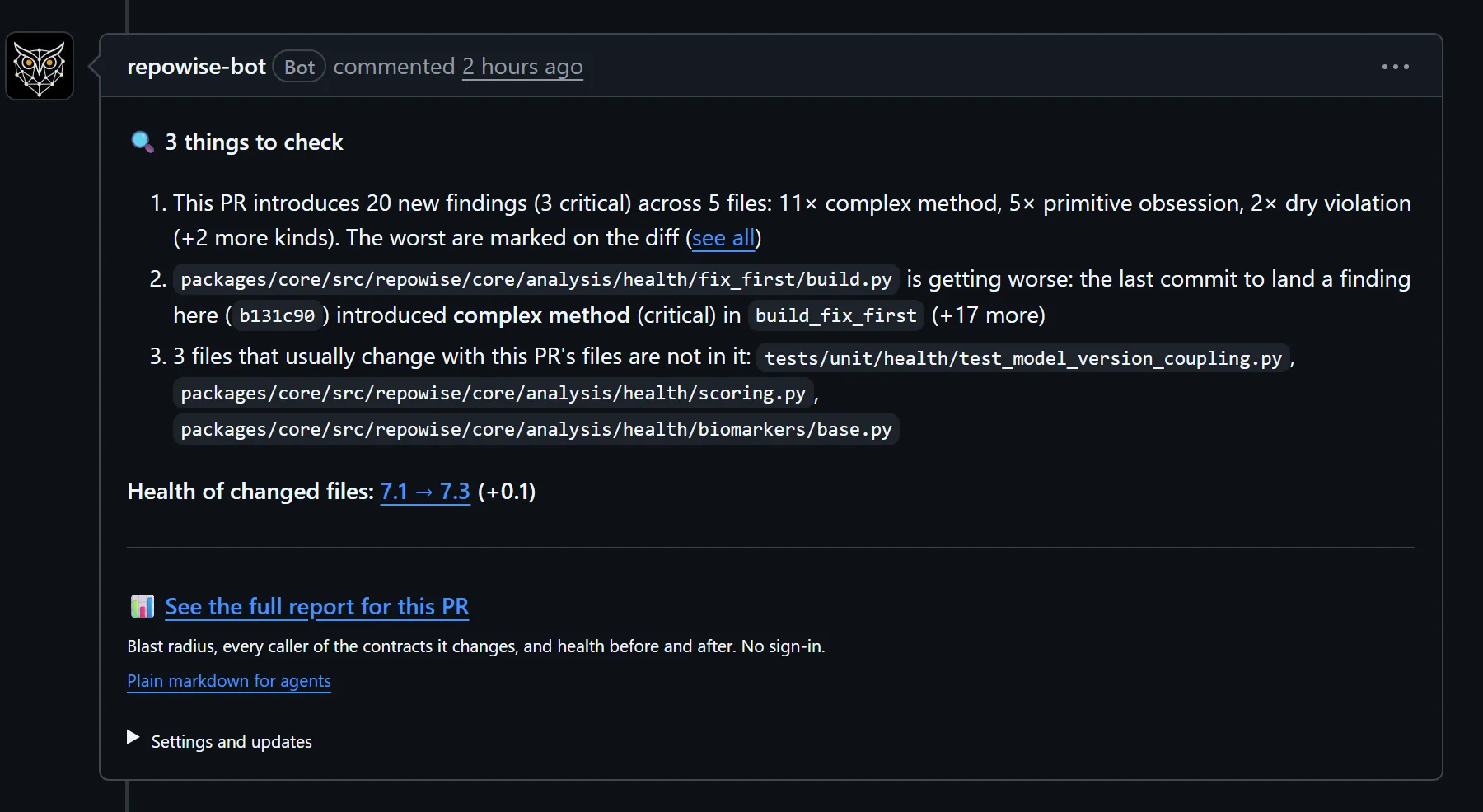
The two kinds of review also find different things. Deterministic signals report facts about the change: callers it breaks, files that usually change with it, tests to run first. A multi-agent LLM review reasons about logic, security and edge cases. For the longer version of that split, read deterministic vs LLM code review.
Which should you pick?
- Pick Claude Code Review if you are on Team or Enterprise, you want the most thorough managed review, and the PRs in question are expensive to get wrong. Cap it per month and scope it per repository.
- Pick the Claude Code GitHub Action if you want control of the prompt, model and trigger, and you are comfortable owning a workflow file and an API key.
- Pick CodeRabbit or Greptile if you want a predictable seat price for high PR volume on every PR.
- Pick Cursor Bugbot if your team already lives in Cursor.
- Pick repowise as the cheap per-push layer and the free signal layer, and use it to decide which PRs earn a deep review. It works alongside any of the others.
How we checked
On 15 October 2026 we read Anthropic's Code Review docs, GitHub Actions docs, launch post and API pricing page, the CodeRabbit and Greptile pricing pages, and Cursor's Bugbot page and pricing page. Every vendor figure above comes from those pages. The 200-PR tables and the Action example are our arithmetic on the listed prices; the Action figure is illustrative, not measured. repowise figures come from its own credit ledger, 291 PRs over the 30 days to 12 October 2026, and the 1.8 pushes per PR is from the same period. We did not run Claude Code Review on the same PRs as the other tools, so this post compares cost, not review quality.
FAQ
- How much does Claude Code Review cost per pull request?
- Anthropic's docs say each review averages $15 to $25 in cost, scaling with PR size, codebase complexity and how many issues require verification. It is billed on token usage through usage credits, separate from your plan's included usage. The Code Review analytics page shows the average cost per review per repository from your own activity.
- Who can use Claude Code Review?
- It is in research preview for Claude Team and Enterprise subscriptions, enabled by an Owner in the Claude Code admin settings. It is not available with Zero Data Retention or the HIPAA configuration. People on other plans can run the
/code-reviewcommand locally in a Claude Code session, which needs no GitHub App. - Does Claude Code Review charge for every push?
- Only if you set it to. The "After every push" trigger runs a review on each push and multiplies cost by the number of pushes, while "Once after PR creation" runs one review and "Manual" runs only when someone comments
@claude review. Anthropic notes that reviewing on every push runs the most reviews and costs the most. - How do I cap Claude Code Review spending?
- An admin sets a monthly spend cap for the Claude Code Review service at claude.ai/admin-settings/usage, and can enable it per repository. When the cap is reached, reviews are skipped and the PR gets one comment explaining why. Reviews resume at the next billing period or when the cap is raised.
- How much does the Claude Code GitHub Action cost to run?
- You pay GitHub Actions minutes plus Claude API tokens at list rates, or use your Claude subscription if you authenticate with an OAuth token. Token cost depends on prompt length, turns, codebase size and model. Setting
--max-turns, keepingCLAUDE.mdshort and choosing a smaller model are the documented ways to lower it. - Claude Code Review vs CodeRabbit: which costs less?
- CodeRabbit is cheaper per PR at normal volume: Essentials is $24 per developer a month on annual billing, about $2.40 a PR at 10 PRs per developer. Claude Code Review averages $15 to $25 a PR and goes deeper with multiple verifying agents. Many teams use the managed review on high-risk PRs and a seat or per-PR reviewer for the rest.
- What is the cheapest way to add AI review to every PR?
- Use free deterministic signals on every PR and add model review where it pays. repowise Signals is free on public repos and uses no model, and Full AI review costs about 20 to 35 cents a PR. Cursor Bugbot lists $1.00 to $1.50 an average review.