On this page
Cursor Bugbot is usage-based since May 2026: Cursor says the average run costs $1.00 to $1.50, depending on PR size and complexity, with no separate seat fee. That makes 50 PRs a month about $50 to $75, 250 PRs about $250 to $375 and 1,000 PRs about $1,000 to $1,500, at one run per PR. The $40 per user a month figure you will still find on review sites is Bugbot's legacy plan, and Cursor lists no free tier.
Third-party pages disagree because Bugbot's pricing changed in the middle of 2026 and directories update slowly. The numbers below come from Cursor's own pages, checked on 15 October 2026.
We build repowise, so weigh our entry accordingly. The measurements we publish about it, with their methods, are on the benchmarks page.
How much does Cursor Bugbot cost?
Three numbers circulate, and each was true at some point or for some plan.
| What you read | Where it comes from | Status on 15 October 2026 |
|---|---|---|
| $40 per user a month | Cursor's legacy Bugbot pricing doc | The old model. Teams paid $40 per user who authored a reviewed PR, with a pooled cap of 200 PRs per license each month. Individuals paid $40 a month for up to 200 PRs. |
| $1.00 to $1.50 a run | Cursor's Bugbot usage-based billing help article and the May 2026 announcement | The current model. "The average Bugbot run costs between $1.00 and $1.50, depending on PR size and complexity." |
| Free | Directory and comparison sites | Not on Cursor's pages. The Bugbot docs and the help article mention no free tier. Enterprise teams can arrange a trial through their account team. |
Scroll the table sideways to see every column.
Cursor announced the change on 11 May 2026: "We are removing seat fees for Bugbot and transitioning to purely usage-based billing." New customers moved to usage-based billing immediately, and existing customers move at their next billing renewal after 8 June 2026. Until then their billing stays as it was, so a team that signed up before the change can still see $40 on an invoice.
Who pays from where depends on the plan:
- Individual plans: reviews use the plan's included usage first, then on-demand usage if you turned it on. If on-demand is off, Bugbot pauses until limits reset at the next billing cycle.
- Teams plans: reviews are charged from on-demand usage, which has to be enabled in the Cursor dashboard.
- Autofix: spawns Cloud Agents, billed as Cloud Agent credits at your plan rates, and needs additional usage enabled.
- Dry-run reviews through the API: billed like normal reviews.
Cursor's pricing page lists "AI code reviews via Bugbot" as included from the Premium plan ($30 a month) up, with a dash on Free and Plus. It does not list a per-run rate, so the $1.00 to $1.50 average on the help article is the number to plan with.
What counts as a Bugbot run?
Cursor does not define a run on its docs or help pages. Reading them together, a run is one automated review that Bugbot performs on a pull request, and the price is an average across all runs, so a small PR costs less than $1.00 and a large one more than $1.50.
Two details are worth knowing before you budget:
- Effort level. Bugbot Automations has Low, Default, High and Smart settings. Low costs less at quality close to Default. High reasons longer, costs more and, per Cursor, finds 35% more bugs while the share of identified bugs resolved by merge stays at 80%. Smart lets you describe in plain language when each level applies.
- Re-runs. The help article does not say whether a new push to the same PR starts another billed run. If it does, a PR with three pushes costs about three runs. We did not test this, so watch your first month of usage before you extrapolate.
Bugbot runs AI code review in the background on new PRs once enabled, and it is a strong fit when your team already works in Cursor, where Autofix can hand a finding to a Cloud Agent.
What does a month of Bugbot cost at 50, 250 and 1,000 PRs?
This is list-price arithmetic at Cursor's own average, one run per PR, before any plan fees.
| PRs reviewed a month | Low end ($1.00) | High end ($1.50) |
|---|---|---|
| 50 | $50 | $75 |
| 250 | $250 | $375 |
| 1,000 | $1,000 | $1,500 |
Scroll the table sideways to see every column.
If your PRs get two runs on average, double the table. If you set Low effort on small PRs, the bill can fall below the range, since Cursor says Low costs less. And since billing is usage-based, a quiet month costs less than a busy one, with no seat sitting idle.
The legacy plan is a useful point of comparison. At $40 per user with a 200-PR pooled cap per license, a team of 10 reviewing 250 PRs paid $400 a month. The same 250 PRs at the current average are $250 to $375. A team of 10 reviewing 2,000 PRs would have paid $400 on legacy and pays about $2,000 to $3,000 now, so the current model favors teams that review fewer PRs per developer.
How does Bugbot compare with CodeRabbit, Greptile, Copilot and repowise?
All prices below are list prices from each vendor's own page on 15 October 2026 (GitHub's plan prices as listed on its docs page), in US dollars, before discounts and taxes. To compare on one scale, we assume 10 PRs per developer a month and one review per PR. Nobody measured that rate; yours is one query away.
| Tool | How it charges | 50 PRs (5 devs) | 250 PRs (25 devs) | 1,000 PRs (100 devs) |
|---|---|---|---|---|
| Cursor Bugbot | $1.00 to $1.50 average per run, no seat fee | $50 to $75 | $250 to $375 | $1,000 to $1,500 |
| CodeRabbit Essentials, annual | $24 per developer a month | $120 | $600 | $2,400 |
| CodeRabbit Essentials, monthly | $30 per developer a month | $150 | $750 | $3,000 |
| Greptile Pro, base reviews | $30 a seat, 50 credits a seat, $1 per extra credit, base review 1 credit | $150 | $750 | $3,000 |
| GitHub Copilot Business | $19 a seat, 1,900 AI credits per user, review cost per PR not published | $95 + usage | $475 + usage | $1,900 + usage |
| repowise Full AI review | about 20 to 35 cents a PR in pay-as-you-go credits, no per-seat review fee | about 20 to 35 cents a PR | about 20 to 35 cents a PR | about 20 to 35 cents a PR |
| repowise Signals | Deterministic, no model call, free on public repos | $0 | $0 | $0 |
Scroll the table sideways to see every column.
Reading the table fairly:
- Bugbot is the cheapest of the per-run options at small volume once you count a seat, because 50 PRs at $1.00 to $1.50 beats five seats at $24 to $30. It is the most expensive at 1,000 PRs a month against CodeRabbit's and Greptile's seat plans, because those fall in price per review as each developer opens more PRs. It is a pure usage plan, so it grows with your PR count, and it is the one built around Cursor's agents.
- CodeRabbit is the predictable choice: the bill follows headcount, only developers who create pull requests count, and public repositories get free reviews. Extra reviews past the hourly allowance cost $0.25 per reviewed file.
- Greptile adds a free Starter plan for one active developer with 50 credits a month, and free use for qualified non-commercial open source projects. At Plus (3 credits) or Apex (10 credits) depth the same PRs cost more.
- GitHub Copilot includes code review in its paid plans, which makes it the lowest-friction start if you already pay for Copilot. GitHub does not publish a per-review cost.
- repowise prices the review a pull request gets, not the seats on the team. Full AI review costs about 20 to 35 cents a pull request, about $20 to $35 per 100 PRs, measured on 291 real pull requests with re-reviews on later pushes included. Pro is $15 a month and includes $5 of credits. For a deeper per-tool breakdown, see AI code review pricing compared.
What are the best Bugbot alternatives that review PRs on GitHub?
None of these needs the Cursor editor. They review pull requests from a GitHub App or an Action, so your team can keep whatever editor it already uses.
- CodeRabbit. The broadest general-purpose AI reviewer, free on public repositories, with a 14-day trial on paid plans. It is the closest Bugbot alternative if you want seat pricing you can forecast. See repowise vs CodeRabbit.
- Greptile. Builds an index of your codebase so reviews can reference code outside the diff, with a free Starter plan and credit-based depth levels. See repowise vs Greptile.
- GitHub Copilot code review. Best when the team already pays for Copilot, since review comes with the plan.
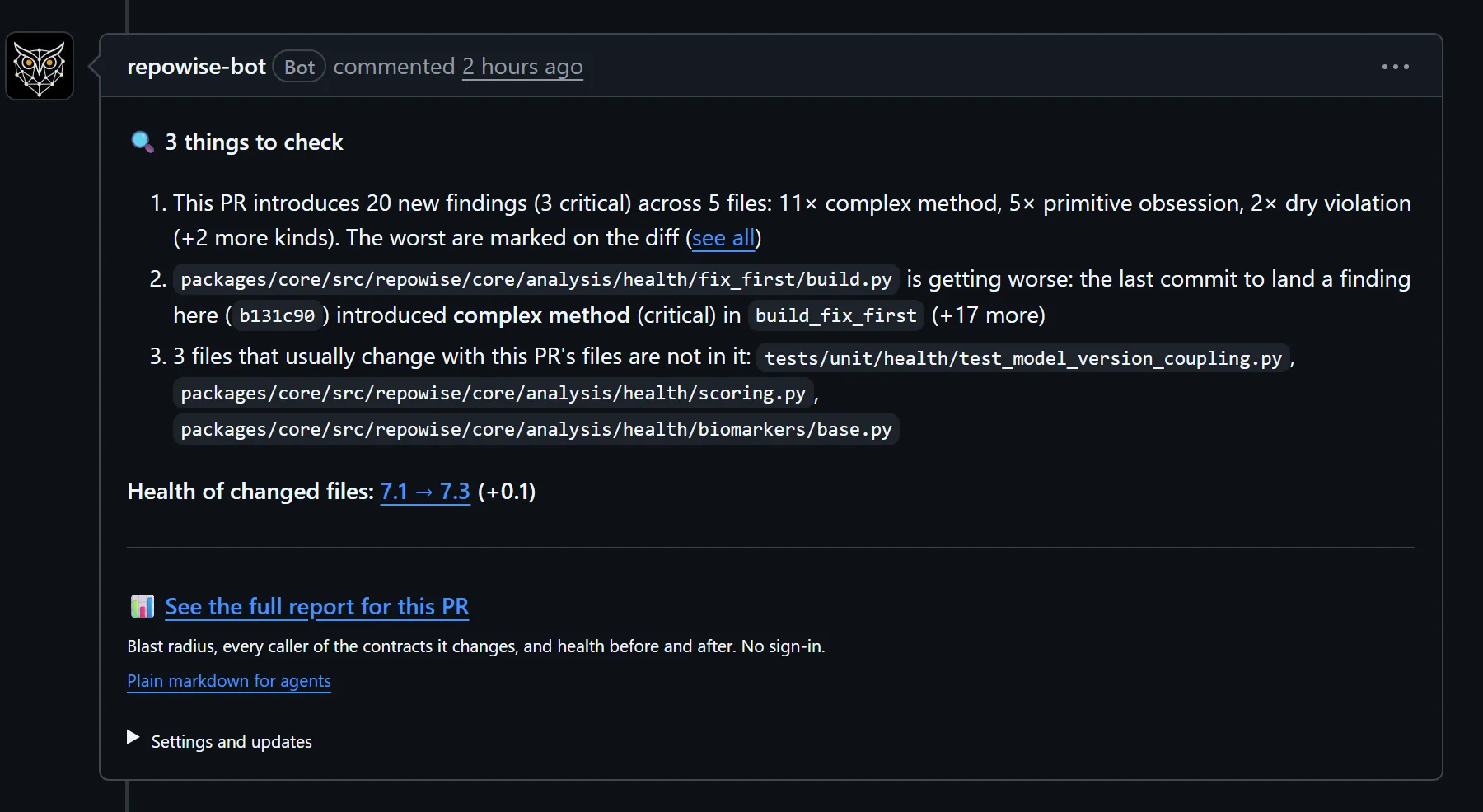
- repowise PR bot. Posts callers a change breaks, files that usually change with it but are not in the PR, and tests to run first, using no model in Signals mode, which is free on public repositories and posts nothing on a clean PR. Full AI review is about 20 to 35 cents a PR, and each repository has a monthly AI spend limit the owner sets, after which the bot falls back to the free Signals comment and says so. See how the bot stays silent by default and deterministic vs LLM code review.
For a wider shortlist with noise and context notes, see the best GitHub PR review bots in 2026.
Should you stay on Bugbot?
Stay if your team builds in Cursor and wants review findings and Autofix inside the same tool, or if your PR volume is modest and you like paying only for the runs you use. Cursor's numbers on default effort, 80% of identified bugs resolved by merge time, are a good result for an automated reviewer.
Look at alternatives if you review hundreds of PRs per developer a year and want a flat seat price, if only some developers use Cursor, or if you want a free first pass on every PR before spending on an AI run. A common setup is a free deterministic comment on every PR and a model review only where it pays.
How we checked
On 15 October 2026 we read Cursor's Bugbot docs, Bugbot page, usage-based billing help article, May 2026 announcement, legacy pricing doc and pricing page, plus the pricing pages of CodeRabbit and Greptile and GitHub's Copilot plans page. Third-party review sites were leads only and are not cited for any price. We did the arithmetic from list prices with the assumptions stated above and did not run the tools on the same PRs, so this compares cost, not review quality. repowise's figures are measured from its own credit ledger across 291 pull requests, not list-price arithmetic. Cursor may change Bugbot's rates at any time, so confirm them on its pricing page before you commit.
FAQ
- How much does Cursor Bugbot cost per month?
- There is no monthly Bugbot fee since Cursor's 11 May 2026 change. Cursor says the average run costs $1.00 to $1.50, so at one run per PR, 50 PRs are about $50 to $75 a month and 250 PRs about $250 to $375.
- Is Cursor Bugbot $40 per user?
- That was the legacy price: $40 per user a month on Teams, with a pooled cap of 200 PRs per license, and $40 a month for Individuals. Cursor removed seat fees for new customers on 11 May 2026, and existing customers move at their first renewal after 8 June 2026.
- Is there a free Bugbot plan?
- Cursor's Bugbot docs, help article and pricing page do not list a free tier. Individual plans have included usage that Bugbot draws first, and Enterprise teams can arrange a trial through their account team. Free review on public repositories is offered by CodeRabbit, Greptile's open-source program and the repowise bot's Signals mode.
- What counts as a Bugbot run?
- Cursor does not give a formal definition. A run is one Bugbot review, billed at an average of $1.00 to $1.50 that varies with PR size and complexity, and with the effort level you set (Low, Default, High or Smart). Cursor's help article does not say whether a new push to the same PR is billed as another run.
- How does Bugbot compare with CodeRabbit on price?
- Bugbot is cheaper at low volume because it has no seat fee: 50 PRs cost $50 to $75 against $120 to $150 for five CodeRabbit Essentials seats. At 1,000 PRs a month, Bugbot is $1,000 to $1,500 against $2,400 to $3,000 for 100 CodeRabbit seats, so the two cross over as PR volume per developer changes.
- What are the best Bugbot alternatives?
- CodeRabbit, Greptile, GitHub Copilot code review and the repowise PR bot all review GitHub pull requests without the Cursor editor. CodeRabbit suits forecastable seat pricing, Greptile suits codebase-aware review, Copilot suits teams already on it, and repowise suits per-PR pricing with a free deterministic mode.
- Do I need Cursor to use Bugbot?
- Bugbot is a Cursor product, billed through a Cursor Individual or Teams plan, so the account that enables it needs a Cursor plan. Cursor's docs do not say that every author of a reviewed PR must use the editor.