On this page
- Which AI code review tools are free for open-source projects?
- Is GitHub Copilot code review free for open source?
- Can I run an AI reviewer on my own model key?
- What does the repowise PR bot give open-source maintainers?
- How do I keep AI review from flooding a busy repository?
- Which free option should a maintainer pick?
- How we checked
- FAQ
Open-source maintainers have at least six free ways to get AI code review in 2026, and four of them are hosted bots you install in a few minutes. CodeRabbit is free and unlimited on public repositories, Qodo is free from 200+ stars, Greptile is free for OSI-licensed non-commercial projects, and repowise Signals is free on every public repository with no application. Each has different limits, so the table below shows who qualifies and what you get. Terms were checked on each vendor's own page on 15 October 2026.
| Tool | Free for | Eligibility and how to get it | Limits we found | What you get |
|---|---|---|---|---|
| CodeRabbit | Public repositories | Install the app; no card. Public repos under 10 stars trigger reviews manually | Per developer per hour: 1 to 10 PR reviews (by stars), 100 to 300 files per review, 25 chat messages | Team-level features: PR reviews, issue planning, unit test generation, merge conflict resolution |
| Qodo | Public GitHub repos | 200+ stars on the repo or on one public repo in the org; actively maintained; install from GitHub Marketplace | No quotas listed; Rules and PR History need a paid plan | Review in PRs, PR summaries, /ask, review suggestions |
| Greptile | OSI-licensed non-commercial projects | Public on GitHub or GitLab; auto-approved at 50+ stars; apply on its open-source page | Terms are on the application page | AI code review on every PR |
| Bito | Public and open-source repos | Start the program's trial; extend it by emailing support | Only the 14-day trial is stated on the page | AI review agent with PR summaries, line suggestions, Ruff, Mypy and fbinfer, review analytics |
| GitHub Copilot code review | Paid Copilot plans | Copilot Free does not include code review | Each review draws AI credits; reviews are blocked when the budget is spent | Review in the GitHub UI and IDEs |
| PR-Agent (open source, MIT) | Anyone, self-hosted | Add a GitHub Action with your own model key | You pay your model provider per review | Review, describe and improve commands on GitHub, GitLab, Bitbucket, Azure DevOps, Gitea |
| reviewdog (open source, MIT) | Anyone | Add it to CI next to your linters | Not an AI reviewer: it posts linter findings on changed lines | Findings from the tools you already run, filtered to the diff |
| repowise PR bot, Signals | Public repositories | Install the GitHub App; no model, no application | Posts nothing on a clean PR | Callers a change breaks, files that usually change together, tests to run, hotspots, health delta |
Scroll the table sideways to see every column.
We build repowise, so weigh our entry accordingly. The measurements we publish about it, with their methods, are on the benchmarks page.
Which AI code review tools are free for open-source projects?
Four hosted reviewers publish a free path for public or open-source repositories, and two open-source tools give you a self-hosted route. The hosted ones differ mostly in how they decide who qualifies.
CodeRabbit states that public repositories are free and unlimited with no credit card, and that open-source projects get Team-level features without a paid subscription, per its plans and pricing documentation. It scopes review limits per developer per hour, from 1 to 10 PR reviews depending on the repository's star count. Repositories with fewer than 10 stars trigger reviews manually by commenting @coderabbitai review.
Qodo runs its open-source program through the GitHub Marketplace app. Its open-source program page says the repository must be public, actively maintained and policy-compliant, with 200+ stars on the repository or on at least one public repository in the organization. The program is offered in partnership with Google and covers review, summaries and /ask.
Greptile has an open-source program for qualified non-commercial projects with an OSI-approved license, on GitHub or GitLab. Its program page says projects with 50+ stars are approved automatically, and smaller projects apply.
Bito offers free access to its AI Code Review Agent for public and open-source repositories on GitHub, GitLab and Bitbucket, per its sponsorship program announcement. The page says your code is not stored or used to train AI models, and lists Ruff, Mypy and fbinfer as built-in static analysis.
Check the exact threshold before you apply. The star counts differ (50, 200, none), and a project that qualifies for one program may not qualify for the next.
Is GitHub Copilot code review free for open source?
Not on the Free plan. GitHub's Copilot code review documentation says Copilot Free does not include code review, and that automatic reviews need Copilot Pro, Pro+, Max, Business or Enterprise.
Two billing details matter to maintainers. Each review consumes AI credits, which GitHub estimates at about $0.05 to $1 per review at Lite effort and $0.25 to $5 at Balanced effort. And while automatic reviews are billed to the pull request author, reviews of bot-authored pull requests, or reviews requested by a bot, are billed to the organization. If agents open PRs on your repository, that rule decides who pays.
Agentic review runs on GitHub Actions. GitHub's changelog for the 1 June 2026 billing change says reviews on public repositories do not consume Actions minutes, and self-hosted runners never do.
Can I run an AI reviewer on my own model key?
Yes. PR-Agent is MIT-licensed, and its repository shows a GitHub Action that runs on pull_request events with your model key as a repository secret. It supports OpenAI, Anthropic Claude, Google Gemini, DeepSeek, Mistral and any model reachable through LiteLLM, including local models through Ollama. It works with GitHub, GitLab, Bitbucket, Azure DevOps and Gitea.
The license is free and the review is not: every run bills your model provider. Pointing it at a local model through Ollama is the zero-spend setup, and pointing it at a small hosted model is the low-spend one. It is the right choice when you want full control of prompts and data and have someone who will maintain a workflow file.
reviewdog solves a different problem. Its repository describes it as a tool that takes output from linters and other analysis tools and posts findings as review comments, filtered to the lines changed in a patch. It runs on GitHub Actions, GitLab CI, CircleCI and others, and its page does not describe any model use. Pair it with an AI reviewer and the cheap, repeatable checks stop costing review tokens.
What does the repowise PR bot give open-source maintainers?
repowise Signals is free on public repositories, uses no model, and posts a comment only when there is a signal worth a reviewer's time. Install the GitHub App, pick the repositories, and the default branch is indexed (the bot docs put it at typically 3 to 10 minutes per repository).
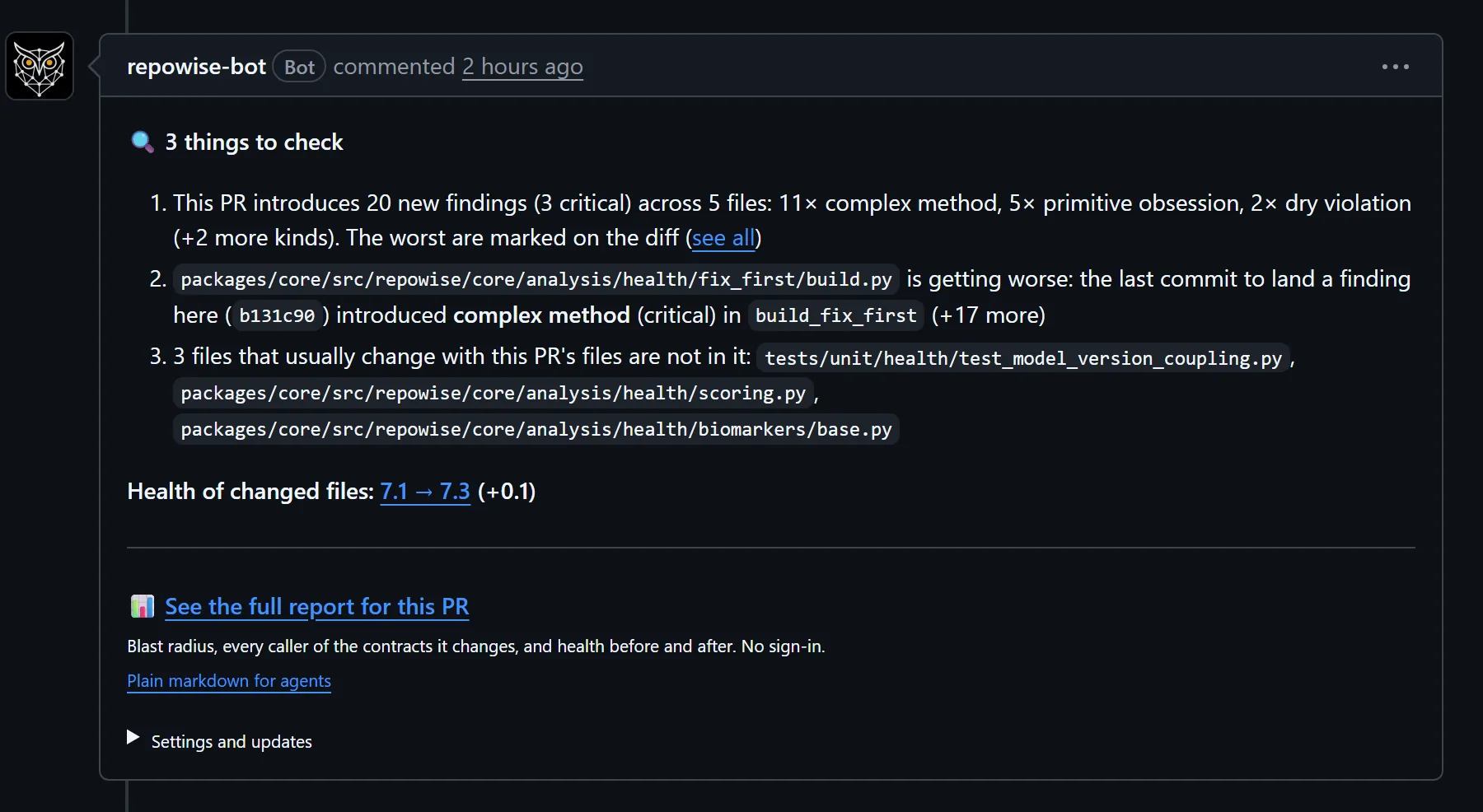
On a pull request, the comment can show the callers a change breaks, files that usually change with it but are missing from the PR, the tests to run first, who owns a hotspot file, and the health delta of the changed files. Because Signals is deterministic, the same PR always produces the same comment, and a clean PR gets no comment at all. The design is covered in why the bot is silent by default.
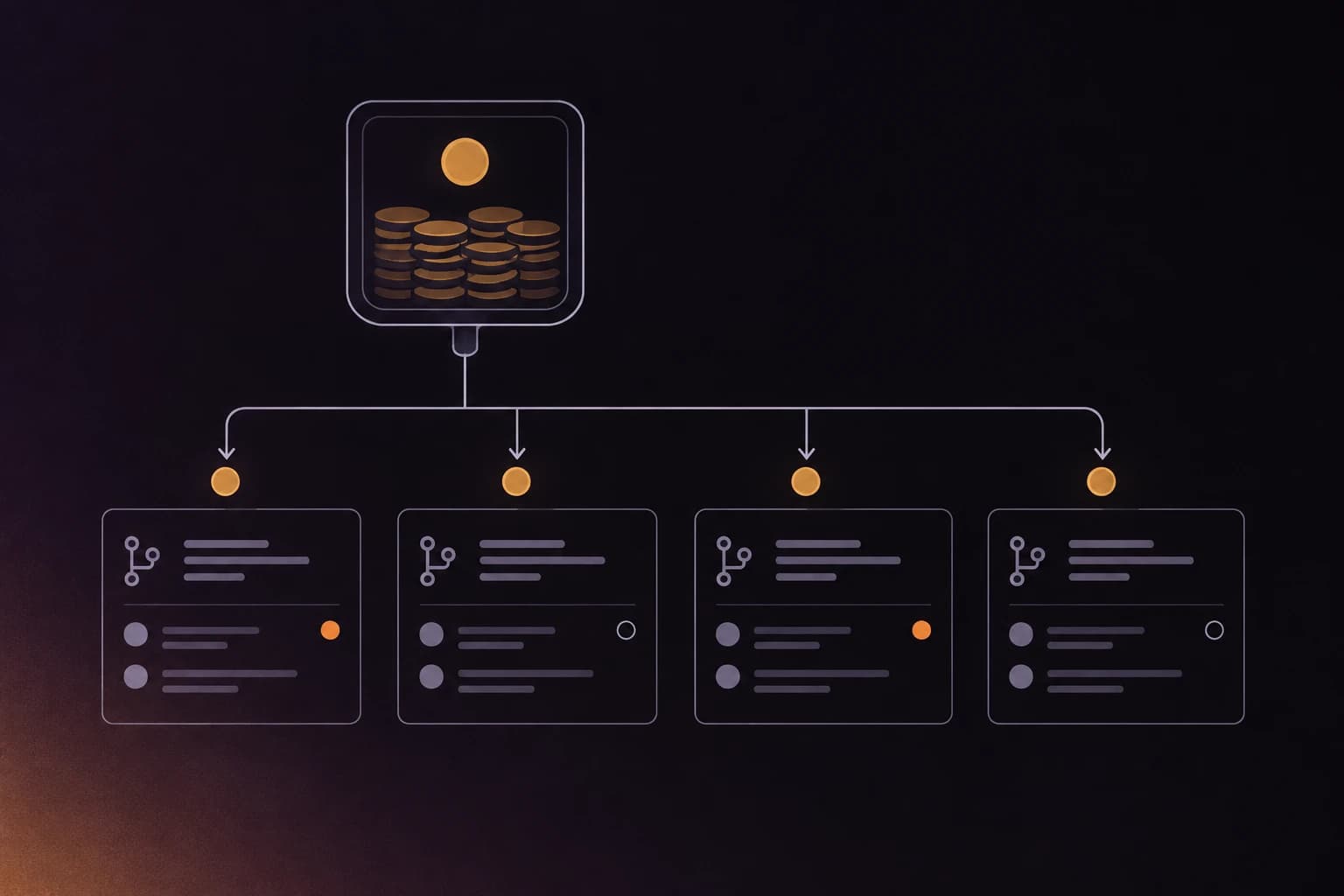
When you want a model on top, AI review is part of Pro and costs about 9 cents a pull request on average from pay-as-you-go credits, with no per-seat fee. It runs a quick pass on every PR that changes code, reviews fix pushes incrementally, and escalates to a deep review when change risk warrants it. A per-PR spend cap (60 cents by default) sits beside a monthly AI spend limit per repository that you set, and when the monthly limit is reached the bot falls back to the free Signals comment and says so. Every push also gets a repowise review check on GitHub, clean or not. Many projects run Signals on every PR and turn on AI review for the one or two repositories that need it.
The repowise open-source CLI is the other free piece. repowise init indexes a repository locally and needs no API key for the structural index, and the same analysis (change risk, hotspots, dead code) runs on your machine before you push.
How do I keep AI review from flooding a busy repository?
Drive-by PRs and agent-authored PRs raise the number of reviews, so a few setup choices keep the volume useful. These are the settings we would apply first.
- Pick a bot that can stay silent. Signals posts nothing on a clean PR, and its comment is edited in place when new commits land instead of stacking duplicates, per the bot docs. A quiet bot means a comment still gets read.
- Use the rate limits you are given. CodeRabbit's open-source tier caps reviews per developer per hour, which blunts a burst from one contributor. Greptile and Qodo scope their free programs to qualifying projects, so a fork does not get its own allowance.
- Review once per push, not per keystroke. Run reviewers on
openedandsynchronize, as the PR-Agent action does, and use manual triggers (@coderabbitai review) for low-star repositories or draft PRs. - Ignore generated paths. The repowise bot reads
ignore_pathsfrom.repowise/bot.yaml, for example the vendor directory and generated files, so lockfiles and generated code never produce a comment. - Put cheap checks first. Let reviewdog, linters and the deterministic Signals comment handle the repeatable findings, and keep model review for the questions a linter cannot ask.
- Set a spend cap before you need one. On any plan or key that bills per review, cap the monthly amount. The repowise per-repository AI limit and Copilot's budget block both stop spend by design.
For agent-authored PRs, remember Copilot's billing rule: reviews of bot-authored pull requests are billed to the organization, so a cap there protects the project account.
Which free option should a maintainer pick?
Pick by what you want the reviewer to do and what you will maintain.
- Pick CodeRabbit if you want a hosted AI reviewer with the broadest free allowance on public repos and do not want to apply for anything. See how repowise compares with CodeRabbit.
- Pick Qodo or Greptile if your project meets their star and license rules and you want their review style. Both apply to qualifying projects only.
- Pick Bito if you host on GitLab or Bitbucket and want built-in static analysis alongside AI summaries.
- Pick PR-Agent if you want to own the prompts, the model and the data path, and are comfortable paying a model provider directly.
- Pick repowise Signals if you want structural context (who calls this, what usually changes with it, which tests cover it) with no model, no application and no noise on clean PRs.
- Use more than one. A deterministic Signals comment and a hosted AI reviewer cover different questions, and both being free on public repositories makes the pair cheap to try. The deterministic vs LLM review post explains where each one fits.
For what the paid plans cost once a project goes private or commercial, see AI code review pricing compared, and for a wider list of bots see best GitHub PR review bots in 2026.
How we checked
On 15 October 2026 we fetched each vendor's own documentation: CodeRabbit's plans page, Qodo's open-source program page, Greptile's pricing page and open-source program, Bito's sponsorship announcement, GitHub's Copilot code review documentation, and the PR-Agent and reviewdog repositories. Where a vendor page left out a limit (Qodo's quotas, Greptile's program terms, Bito's caps), we say so instead of filling it in. Qodo's search snippet showed a 100-star threshold, while its program page, fetched twice, says 200+, so we use the page. We did not run the tools against the same pull requests, so this post compares eligibility and terms, not review quality. repowise terms come from its bot documentation.
FAQ
- Is there a free AI code review tool for open-source projects?
- Yes, several. CodeRabbit is free and unlimited on public repositories, Qodo is free for public GitHub repos with 200+ stars, Greptile is free for OSI-licensed non-commercial projects, Bito offers its review agent for public repos, and repowise Signals is free on public repositories with no model. Terms were checked on each vendor's own page on 15 October 2026.
- Is CodeRabbit free for open source?
- Yes. CodeRabbit's documentation says public repositories are free and unlimited with no credit card, and open-source projects get Team-level features. PR reviews are limited to 1 to 10 per developer per hour depending on the repository's stars, and public repos under 10 stars trigger reviews manually with
@coderabbitai review. - What are the requirements for Qodo's open-source program?
- The repository must be public on GitHub, actively maintained and compliant with Qodo's usage policies, with 200+ stars on the repository or on at least one public repository in your organization. There is no separate form: you install the Qodo app from the GitHub Marketplace. Rules and PR History are paid features.
- Does Greptile have a free plan for open source?
- Greptile's open-source program is free for qualified non-commercial projects with an OSI-approved license, hosted on GitHub or GitLab. Projects with 50+ stars are approved automatically, and other projects apply through the program page.
- Is GitHub Copilot code review free on public repositories?
- The Copilot Free plan does not include code review, and automatic reviews need a paid Copilot plan. Each review draws AI credits, and GitHub's page does not describe a public-repository exemption, so confirm the billing for your account before relying on it.
- Can I self-host a free AI code reviewer?
- Yes. PR-Agent is MIT-licensed and runs as a GitHub Action, in Docker or as a webhook with your own model key. You pay your model provider for each review, or nothing if you point it at a local model through Ollama.
- How do I stop AI review from spamming my open-source repo?
- Choose a reviewer that stays silent on clean PRs, ignore generated and vendored paths, review on push instead of on every event, and cap monthly spend wherever a plan bills per review. The repowise bot, for example, edits its existing comment instead of stacking new ones and supports
ignore_pathsin.repowise/bot.yaml.