On this page
Qodo Pro Team costs $0.012 a credit, pooled across the team, with packs from 2,500 credits ($30), which Qodo estimates at about 18 reviews a month. That works out to about $1.67 a review, so a 20-developer team opening 10 pull requests each a month pays about $4,000 a year. Enterprise, for teams over 30 users, is custom, and there is no permanent free tier, per qodo.ai/pricing on 29 October 2026.
| Plan | Price | Who it is for | What it adds |
|---|---|---|---|
| Pro Team | $0.012 a credit, pooled; packs from $30 | Up to 30 users | Agentic PR code review, unlimited rules, Git and IDE integrations, pre-PR review skills, dashboard and analytics, monthly overage cap |
| Enterprise | Custom, annual contracts | 30+ users | SSO/SAML, audit logs, BYOK, single-tenant SaaS or on-prem, advanced self-learning, dedicated CSM |
| Trial | Free for 14 days, no card | New teams | Unlimited reviews during the trial |
| Open source | Free on application | Qualified open-source projects | Free access through the Qodo for Open Source program |
Scroll the table sideways to see every column.
To compare Qodo with six other reviewers on your own team size, use the AI code review cost calculator.
We build repowise, so weigh our entry accordingly. The measurements we publish about it, with their methods, are on the benchmarks page.
How does Qodo's credit pricing work?
Qodo Pro Team is a pool of credits at $0.012 each, shared by the whole team, and each review draws credits by size. Qodo's page says smaller PRs draw fewer credits and larger or more complex reviews draw more, and it lists three packs with an estimated review count:
| Pack | Price | Qodo's estimate | Cost per review |
|---|---|---|---|
| 2,500 credits | $30 | About 18 reviews a month | About $1.67 |
| 5,000 credits | $60 | About 36 reviews a month | About $1.67 |
| 20,000 credits | $240 | About 144 reviews a month | About $1.67 |
Scroll the table sideways to see every column.
The $30 price is on Qodo's page; the $60 and $240 are the same $0.012 rate times the pack size, and the per-review figure is our division of Qodo's own estimates. Running out does not stop reviews: overage is billed at the same per-credit rate, with no premium, up to a monthly cap you set. Credits expire at the end of each monthly cycle, and each cycle starts with a new pool.
There is no seat price. Qodo's page says there are no limits on repositories, users or reviews, and that developers do not need Qodo accounts. Billing is monthly with no commitment.
How much does Qodo cost per year?
At 10 pull requests per developer a month and about $1.67 a review, Qodo costs about $200 per developer a year. The last column prices the same pull requests with repowise AI review on every one.
| Team, at 10 PRs per developer a month | Reviews a month | Qodo Pro Team | repowise AI review + Pro |
|---|---|---|---|
| 5 developers | 50 | about $1,000 a year | about $246 |
| 20 developers | 200 | about $4,000 a year | about $408 |
| 30 developers | 300 | about $6,000 a year | about $516 |
| 50 developers | 500 | Enterprise, custom | about $732 |
Scroll the table sideways to see every column.
The repowise column is AI review at about 9 cents a pull request on average, plus the Pro plan that private repositories need at $192 a year, its yearly price for new subscribers from November 2026. Against Qodo that is about 4x lower at 5 developers, 10x at 20 and 12x at 30. Per review, before any plan, Qodo's estimate of about $1.67 is roughly 19 times a repowise AI review.
These are list prices, assuming one review per pull request and Qodo's average review size. Your own credits per review show up in Qodo's dashboard after the first weeks.
What hidden costs come with Qodo?
- Review size. The $1.67 figure is an average from Qodo's pack estimates. A codebase with large PRs draws more credits per review.
- Re-reviews. Check Qodo's dashboard for whether each push draws credits; if it does, PRs with several pushes cost more.
- Unused credits. Credits expire at the end of each monthly cycle, so a pack larger than your month's reviews is spend with nothing to show for it.
- The 30-user line. Pro Team is designed for up to 30 users. Past that, Enterprise moves to annual contracts and negotiated pricing.
Is Qodo free?
Not permanently. Qodo says it does not offer a permanent free tier. Pro Team starts with a 14-day trial with no credit card and unlimited reviews, and reviews pause when the trial ends until you choose a plan. Qualified open-source projects can apply to the Qodo for Open Source program for free access.
What does Qodo do well?
Qodo prices review the way it is used. A pooled credit balance with no seats means a team of occasional authors pays for the reviews they get, and the overage cap puts a hard ceiling on any month. Pro Team covers PR review in Git and the IDE with an unlimited rules system, and Enterprise adds the controls large organizations ask for: SSO, audit logs, BYOK and single-tenant or on-prem deployment.
Qodo is a strong pick for teams up to 30 people who want review across the IDE and pull requests, with credits they can cap, and for regulated organizations that need on-prem deployment through Enterprise.
How does repowise price PR review?
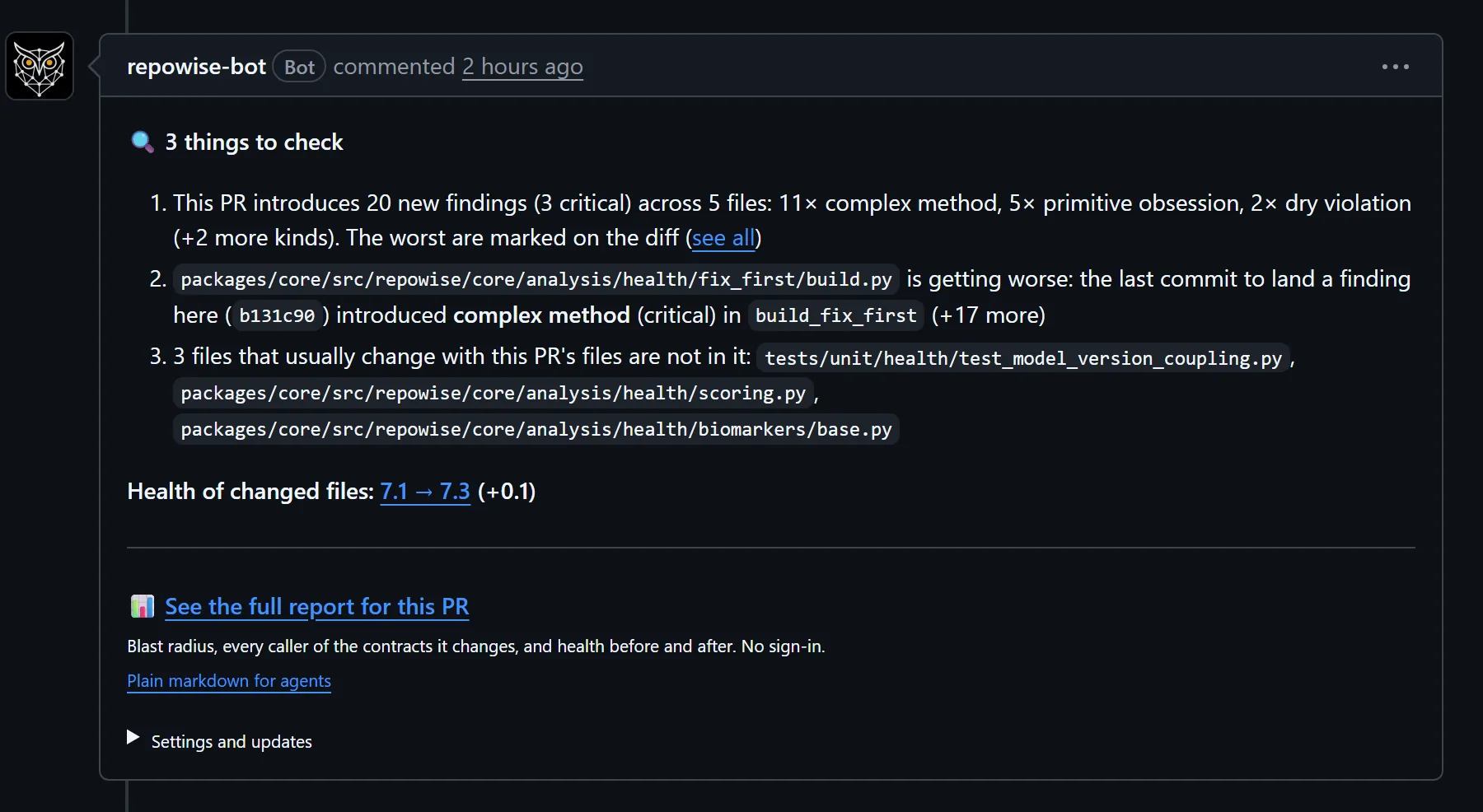
Qodo bills per review from a shared pool, so repowise's per-PR credits are the closest comparison: about 9 cents a review on average against about $1.67, with no per-seat or per-repo fee. The PR bot has two modes. Signals is deterministic and free on every repository, open source included, and posts the callers a change breaks, the files that usually change with it and the tests to run first, with no model call. AI review is paid from your credit balance, so 100 PRs come to about $9.
AI review runs a quick pass on every code change, checks risky claims before it posts them and goes deep once on a risky pull request. Each PR has a default cap of 60 cents and the account has a monthly cap, and there is no user limit. Private repositories need a paid plan, listed on the pricing page.
Which should you pick?
Pick Qodo if you want review in both the IDE and the pull request for a team of up to 30, with pooled credits and an overage cap. It is also the pick if you need on-prem or single-tenant deployment through Enterprise.
Pick repowise if you want per-PR review at about 9 cents on average with no user limit, a free deterministic comment on every PR, and depth that rises on risky changes without a setting. The full side-by-side is on the Qodo alternative page.
For every tool on one table, see AI code review pricing compared, and for what each bot posts, the PR review bots for GitHub roundup. Seat-priced options are covered in CodeRabbit pricing and GitHub Copilot code review cost.
How we checked
On 29 October 2026 we read qodo.ai/pricing and took every Qodo plan, rate, pack size, estimate and limit from that page. The $60 and $240 pack prices, the per-review figure and the yearly bills are our arithmetic on Qodo's $0.012 rate and its own review estimates, assuming 10 PRs per developer a month and one review per PR. repowise figures come from its pricing page and PR bot page. We did not run both tools on the same pull requests, so these figures compare cost, not review quality.
FAQ
- How much does Qodo cost?
- Qodo Pro Team costs $0.012 a credit, pooled across the team, with the smallest pack at 2,500 credits for $30. Qodo estimates that pack at about 18 reviews a month, about $1.67 a review. Enterprise, for teams over 30 users, is custom.
- How much does Qodo cost per month for a team?
- At 10 pull requests per developer a month, Qodo costs about $17 per developer a month on its own review estimate. A 20-developer team opening 200 PRs a month pays about $333 a month, or about $4,000 a year.
- Does Qodo charge per seat?
- No. Pro Team is a pooled credit plan with no limits on repositories, users or reviews, and developers do not need Qodo accounts. It is designed for teams of up to 30 users; larger teams move to Enterprise.
- Is Qodo free?
- Qodo has no permanent free tier. Pro Team has a 14-day free trial with no credit card and unlimited reviews, and qualified open-source projects can apply to the Qodo for Open Source program for free access.
- Do Qodo credits roll over?
- No. Credits expire at the end of each monthly cycle, and each cycle starts with a new pool. Overage past your pack is billed at the same per-credit rate, up to a monthly cap you set.
- What is a cheaper alternative to Qodo?
- repowise AI review costs about 9 cents a pull request on average, with no seat fee and no user limit, and its deterministic Signals review is free on every repository. Greptile Base reviews are $1 each. Every option is on one table in the AI code review pricing comparison.