
On this page
- How does Greptile's credit model work?
- How much does Greptile cost per month for a team?
- What does a mixed month look like?
- What does a high-PR-volume team pay?
- Is Greptile free?
- Did Greptile's price change in 2026?
- What does Greptile do well?
- How does repowise price PR review?
- Which should you pick?
- How we checked
- FAQ
Greptile Pro costs $30 per seat a month, includes 50 credits per seat, and charges $1 for each extra credit. A review spends credits by depth: Base is 1, Plus is 3 and Apex is 10. Starter is free for one developer, qualified open-source projects are free, and Enterprise is custom, all as listed on greptile.com/pricing on 15 October 2026.
| Plan | Price | Included | Best for |
|---|---|---|---|
| Starter | Free | Unlimited repositories, 50 credits a month, 1 active developer | One developer |
| Pro | $30 per seat a month | Unlimited repositories, 50 credits per seat, unlimited users, custom rules | Teams |
| Enterprise | Custom | Self-hosting option, SSO/SAML, GitHub Enterprise support, custom DPA | Large organizations |
| Open source | Free | Qualified non-commercial projects with an OSI-approved license | Maintainers |
| Startup discount | 50% off | Pre-Series A, under $2M revenue in the past 12 months | Early teams |
Scroll the table sideways to see every column.
Greptile's model is easy to budget once you know one number: how many credits your average review spends. The rest of this post works that out.
We build repowise, so weigh our entry accordingly. The measurements we publish about it, with their methods, are on the benchmarks page.
How does Greptile's credit model work?
Every Pro seat comes with 50 credits a month, and each completed review spends credits according to the review depth. Greptile's page lists a Base review at 1 credit, a Plus review at 3 credits and an Apex review at 10 credits. When a seat uses more than 50, the extra credits cost $1 each.
A seat, in Greptile's words, is "any developer who has gotten a review done by Greptile in that billing period." So a teammate who never opens a pull request, or whose PRs are never reviewed, doesn't cost a seat. Pro includes unlimited repositories and unlimited users, and the plan adds custom rules.
What one seat buys before the first dollar of overage:
| Review depth | Credits per review | Reviews in 50 credits |
|---|---|---|
| Base | 1 | 50 |
| Plus | 3 | 16 |
| Apex | 10 | 5 |
Scroll the table sideways to see every column.
Depth is the lever. Base gives a developer 50 reviews a month for $30, which is $0.60 a review at full use. Apex gives 5 reviews for the same $30, which is $6 a review, and every Apex review after the fifth is $10. The two ends of the scale differ by a factor of ten, and that is why teams that pick one depth for the whole org get very different bills.
One detail from Greptile's changelog is worth knowing: on 30 April 2026 Greptile added a dollar cap on overage ("flex") spend. Once projected overage reaches the cap, Greptile pauses new overage reviews until the next billing period or until you raise the limit, and included reviews keep running. That makes the $1-per-credit part of the bill something you can bound.
How much does Greptile cost per month for a team?
At 10 pull requests per developer a month and one review per PR, Base and Plus reviews fit inside the 50 included credits, so the bill is $30 per developer. Apex reviews need 100 credits per developer, so each seat adds $50 of overage and costs $80.
| Team | PRs a month | Base (1 credit) | Plus (3 credits) | Apex (10 credits) |
|---|---|---|---|---|
| 1 developer | 10 | Free on Starter | Free on Starter | $80 on Pro (50 credits free on Starter, then 50 extra) |
| 5 developers | 50 | $150 | $150 | $400 |
| 25 developers | 250 | $750 | $750 | $2,000 |
| 100 developers | 1,000 | $3,000 | $3,000 | $8,000 |
Scroll the table sideways to see every column.
The arithmetic is $30 a seat plus $1 for every credit past 50 per seat. A single developer on Starter gets 50 credits free, so 10 Base reviews or 10 Plus reviews (30 credits) cost nothing, and 10 Apex reviews (100 credits) would need Pro, at $80 for that seat.
These are list prices, before the open-source and startup discounts, taxes and annual contracts. We assume credits are counted per seat and not pooled across the team, which is the conservative way to read "50 credits per seat". If your plan pools them, a team that mixes light and heavy authors will land below these figures.
What does a mixed month look like?
Most teams don't run one depth everywhere. A realistic seat might see 30 Base reviews, 5 Plus reviews and 2 Apex reviews in a month. That is 30 + 15 + 20 = 65 credits, 15 over the allowance, so the seat costs $30 + $15 = $45.
Review depth is usually a per-repository or per-change choice, so a team can keep Base as the default and reserve Apex for the pull requests where a missed bug is expensive, such as payments, auth and migrations. Done that way, the extra spend lands where it earns the most.
What does a high-PR-volume team pay?
Per-seat allowances matter most for developers who open many PRs, and for pushes that trigger a second review. Take a team of 10 developers who each open 40 pull requests a month, 400 PRs in all:
| Scenario | Credits per developer | Overage per developer | Cost per developer | Team of 10 |
|---|---|---|---|---|
| Base, one review per PR | 40 | 0 | $30 | $300 |
| Base, two reviews per PR (a re-review after a push) | 80 | 30 | $60 | $600 |
| Plus, one review per PR | 120 | 70 | $100 | $1,000 |
| Apex, one review per PR | 400 | 350 | $380 | $3,800 |
Scroll the table sideways to see every column.
The break-even points per developer are easy to remember. A seat's 50 credits cover 50 PRs a month at Base, 16 at Plus and 5 at Apex. Past that, each extra PR adds $1, $3 or $10. A busy Base-depth team stays predictable and cheap per review, since the seat price is spread across many reviews. The overage cap from the changelog is the control to set before you move a high-volume team to Plus or Apex.
Is Greptile free?
Yes, in three ways. Starter is a free plan for a single active developer with unlimited repositories and 50 credits a month, added in Greptile's 29 June 2026 changelog. Qualified non-commercial projects with an OSI-approved license can use Greptile free through the open-source application. And Pre-Series A startups with under $2M in revenue over the past 12 months get a 50% discount through the startup application.
Enterprise is the custom tier: self-hosting, SSO/SAML, GitHub Enterprise support, a dedicated Slack channel, custom invoicing and a custom DPA and terms. Annual and multi-year contracts have custom pricing through sales.
Did Greptile's price change in 2026?
Greptile's own pages confirm the credit model and the June 2026 free Starter plan. Third-party price trackers also report that the top plan dropped from $50 to $30 per user per month around 20 May 2026, but we found no Greptile announcement that confirms that date or the old price, so we treat it as a report and not a fact. What you can rely on is the structure on the pricing page today: $30 a seat, 50 credits, $1 per extra credit and three review depths.
Because plans have changed during 2026, the practical habit is to read the pricing page on the day you buy, and to check the changelog for billing entries before a renewal.
What does Greptile do well?
Greptile is a focused AI code reviewer that reads a pull request against the wider codebase, and its pricing reflects that focus. A flat $30 seat with a clear credit schedule is simple to explain to finance, and 50 Base reviews per seat leaves a lot of headroom for most developers. The three depths let a team spend 10 credits on a risky change and 1 on a typo fix, and the free Starter plan, the open-source program and the 50% startup discount mean small teams and maintainers can start at zero.
Greptile is the right pick when you want one dedicated AI reviewer with predictable per-seat billing, depth you can dial per change, and an Enterprise path with self-hosting.
How does repowise price PR review?
repowise prices the review a pull request gets and not the seats on the team. Full AI review costs about 20 to 35 cents a pull request, so 100 PRs cost about $20 to $35 of credits, measured on 291 real pull requests, re-reviews on later pushes included. AI triage costs 1 to 2 cents a pull request and runs only where a signal fired.
Signals mode runs no model, is free on public repositories and posts nothing on a clean PR. Credits are pay-as-you-go with no per-seat review fee, and each repository has a monthly AI spend limit the owner sets. When the limit is reached, the bot falls back to the free Signals comment and says so.
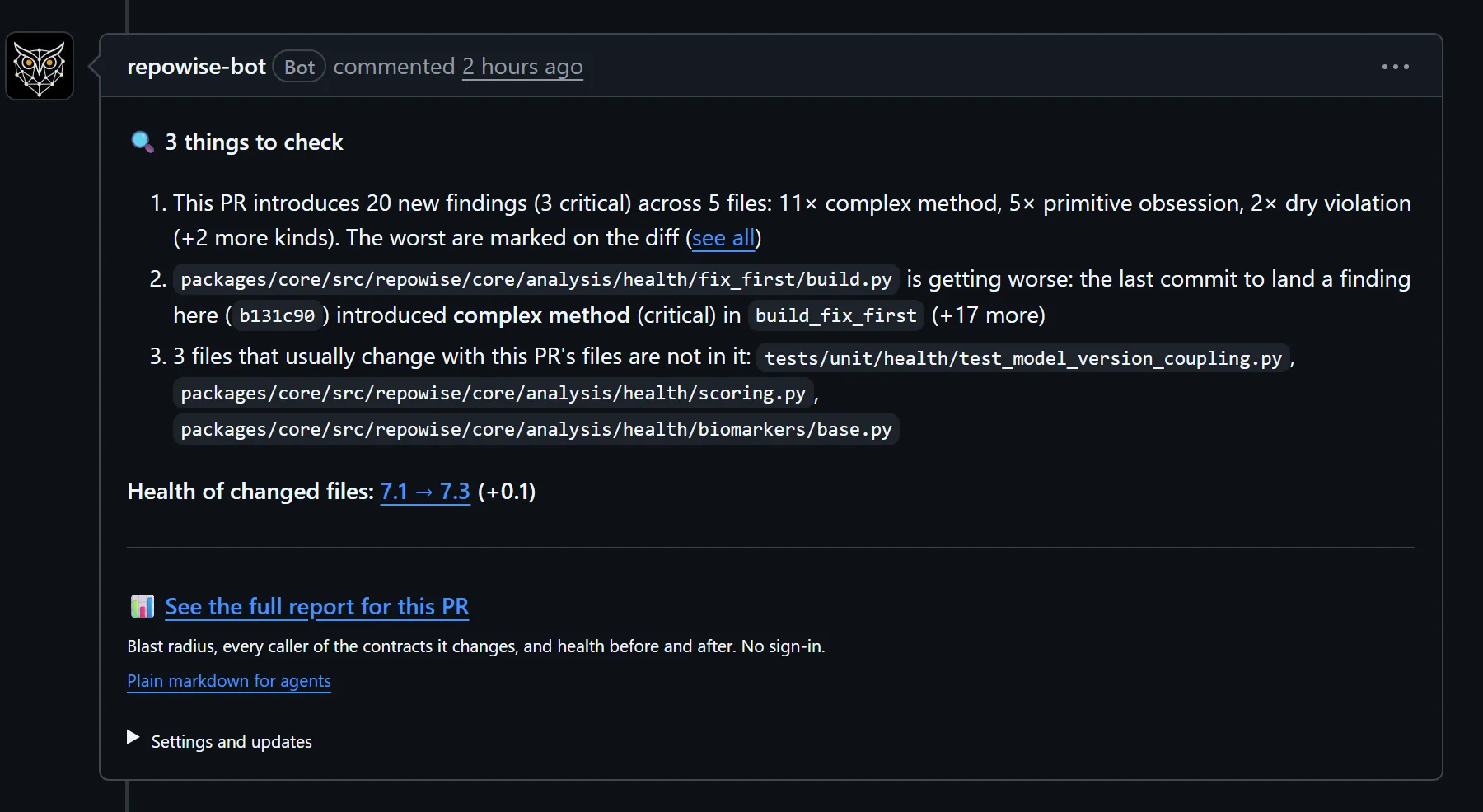
Because the cost follows pull requests, the high-volume team above (400 PRs a month) pays four times the per-100 figure whether it has 10 developers or 40. The per-seat model rewards the opposite shape: many reviews from few people.
Which should you pick?
Pick Greptile if you want a single AI reviewer billed per seat, with 50 included Base reviews per developer, depth you choose per change and an Enterprise self-hosting path. It is strongest for teams of regular size where most developers land between 10 and 50 reviews a month.
Pick repowise if your team is larger than its PR volume suggests, has quiet months, or wants review spend tied to pull requests with a hard per-repo limit. Its free Signals comment is a useful layer in front of any LLM reviewer, and the full side-by-side is on the Greptile alternative page.
Use both if you like Greptile's depth on risky changes and want deterministic signals on every PR. The AI code review pricing comparison puts Greptile next to CodeRabbit, Qodo and GitHub Copilot per 100 PRs, and PR review bots for GitHub covers what each one posts. For how the free layer works, see the silent-by-default PR bot and the bot page.
How we checked
On 15 October 2026 we read the plans, credit costs, seat definition and discounts on greptile.com/pricing and the billing entries on Greptile's changelog. Every Greptile price and credit figure above comes from those two pages. The reported $50 to $30 change comes from third-party trackers and is labeled as such. The monthly bills are our own arithmetic from list prices, assuming 10 PRs per developer unless a table says otherwise, one review per PR unless stated, and credits counted per seat. The repowise figures are measured from its own credit ledger. We did not run both tools on the same pull requests, so this post compares cost only, not review quality.
FAQ
- How much does Greptile cost?
- Greptile Pro costs $30 per seat a month and includes 50 credits per seat. Extra credits are $1 each. A Starter plan is free for one developer, and Enterprise pricing is custom.
- How many credits does a Greptile review use?
- A Base review uses 1 credit, a Plus review uses 3 credits and an Apex review uses 10 credits. One seat's 50 included credits therefore cover 50 Base, 16 Plus or 5 Apex reviews. Anything beyond that costs $1 per credit.
- Is Greptile free?
- Starter is free for one active developer with 50 credits a month. Qualified non-commercial projects with an OSI-approved license can get Greptile free, and Pre-Series A startups under $2M in revenue qualify for 50% off.
- What counts as a seat on Greptile?
- A seat is any developer who has gotten a review done by Greptile in that billing period. Teammates who are not reviewed in that month do not take a seat. Pro includes unlimited users and unlimited repositories.
- What is the difference between Base, Plus and Apex in Greptile?
- They are review depths that spend 1, 3 and 10 credits per review. The deeper the review, the more credits a pull request uses, so depth is the biggest driver of a Greptile bill. Apex at 10 credits costs ten times Base.
- Can I cap Greptile overage spending?
- Greptile's changelog from 30 April 2026 describes a dollar cap on overage (flex) usage. When projected overage reaches the cap, new overage reviews pause until the next billing period or until you raise the limit, and included reviews continue.
- How does repowise pricing compare with Greptile per review?
- repowise Full AI review costs about 20 to 35 cents a pull request from pay-as-you-go credits, with no per-seat review fee. Greptile's Base review works out to $0.60 a review at full use of a seat's 50 credits, and more as depth increases. Which is lower depends on PR volume per developer and the review depth you choose.