
On this page
The best IcePanel alternatives in 2026 are Structurizr and LikeC4 if you want an open source C4 model kept as code, and Ilograph if you want polished interactive diagrams at a lower price. Mermaid or C4-PlantUML suit single diagrams that live in the repo, and C4 generated from code suits diagrams that have to match what ships.
| Tool | What you work in | Keeps a model? | Open source | Price (checked October 2026) | Stays current by |
|---|---|---|---|---|---|
| IcePanel | Visual editor in the browser | Yes | No | Free up to 100 objects; $40 and $80 per editor per month, billed annually; Enterprise custom | People editing it |
| Structurizr | Structurizr DSL text | Yes | Yes, Apache-2.0 | Free; prebuilt server binaries need a license | People editing the DSL |
| LikeC4 | LikeC4 DSL text, VS Code | Yes | Yes, MIT | Free | People editing the DSL |
| Ilograph | YAML in a web or desktop editor | Yes (resources and perspectives) | No | Free; Pro $18 a month billed annually or $22 monthly; Team $25 per editor billed annually or $30 monthly | People editing it |
| Mermaid C4 | Markdown code block | No, one diagram | Yes, MIT | Free | People editing it, in the PR |
| C4-PlantUML | PlantUML text | No, one diagram | Yes, MIT | Free | People editing it, in the PR |
| draw.io | Drag-and-drop canvas with C4 shapes | No | Yes, Apache-2.0 | Free | People editing it |
| Generated from code (for example repowise) | Nothing, it reads the repo | Yes, derived | repowise core is AGPL-3.0 | Free for public repos; Pro $15 a month | Re-indexing on push (paid plans); weekly on public repos with a badge |
Scroll the table sideways to see every column.
What IcePanel does well
IcePanel calls itself a collaborative diagramming and modelling tool for software architecture, and it is built around the C4 model. You build a model of systems, apps, stores and components once, and diagrams at each C4 level are views of it, so you can zoom from context down to components. On top of that sit message flows you can step through, tags that overlay extra detail, drafts for designing a future state next to the current one, versioning, and decision records.
IcePanel is also aimed at people who do not write code. A product manager can open a diagram, click into a system and read it without learning a DSL (a small text language made for one job, here describing architecture). That visual editor for non-engineers is the main thing the text-based tools on this list give up.
IcePanel's recent additions are aimed at AI coding agents. It has an MCP server (paid plans only; MCP, the Model Context Protocol, is the standard way an agent calls an outside tool) that can read model objects, connections, diagrams, flows and decision records, and create or update objects and connections. Its agent skills can turn code or a prompt into model objects, and import Mermaid C4 code. You can export the model as JSON, CSV, SVG, PNG and PDF, plus a Markdown, HTML or LLMs.txt summary.
The usual reasons people look elsewhere are price per editor, wanting the model in git next to the code, wanting to self-host, or wanting the diagram to stop drifting from the code.
Open source IcePanel alternatives
Structurizr
Structurizr is the reference tool for C4, from the person who created the C4 model. You write a model in the Structurizr DSL and draw many views from it, which is the same model-plus-views idea IcePanel uses, written as text in git instead of in a hosted editor.
Structurizr's product lineup changed this year, and its docs now list the cloud service, Lite, the old on-premises install and the old CLI as end of life. Current tools are a browser playground, local for working on your machine, server (open-core, or prebuilt binaries with a license), export to PlantUML, Mermaid or static HTML, and a free, open source MCP server. The main repository is Apache-2.0.
Best for: architects who want a formal C4 model under version control and do not need non-engineers editing it. The trade is the learning curve and a UI that is plainer than IcePanel's. I compared its syntax against Mermaid and PlantUML in Structurizr vs Mermaid vs PlantUML for C4.
LikeC4
LikeC4 is the open source option closest to IcePanel's experience. You describe the architecture in its own DSL, and it renders interactive diagrams you can navigate, with a VS Code extension, a dev server with hot reload, and likec4 build to produce a static website you can host anywhere. It is MIT licensed, with about 5,800 stars on GitHub.
It exports to PNG, JPEG, JSON and draw.io, and it can generate Mermaid, PlantUML, D2, DOT, React components and web components. It also ships an MCP server, which runs automatically inside the VS Code extension or via likec4 mcp, so an agent can query elements, relationships and views.
Best for: teams who like IcePanel's clickable, drill-down diagrams but want the source in git and no per-editor bill. The trade is that everyone who edits has to be comfortable with a text DSL.
Mermaid C4 and C4-PlantUML
These two are diagram-as-code tools with no model behind them, so each file holds one picture. Mermaid's big advantage is that GitHub renders it natively in Markdown, so the diagram shows up in the README and the pull request with nothing to install. Its C4 diagram is marked experimental in Mermaid's docs. C4-PlantUML has fuller C4 coverage and better layout control, and is built into PlantUML's standard library, but needs a renderer (GitLab.com has one built in, GitHub does not).
Best for: one or two diagrams that should sit next to the code and change in the same pull request. They do not replace IcePanel's model, because five diagrams are five separate copies of the same facts.
draw.io
draw.io (diagrams.net) is a free, general diagramming app whose source is Apache-2.0. It ships a C4 shape library, so you can draw C4 diagrams by hand on a canvas, and you can run it offline or self-host it. It has no C4 model behind the shapes, so a renamed service has to be renamed on every diagram. General whiteboards like Miro have the same limit: they work for a workshop but make a poor source of truth.
Paid IcePanel alternatives
Ilograph
Ilograph makes interactive architecture diagrams written in a YAML-based language, with autocomplete and automatic layout. You define resources once and show them through several perspectives, and it has interactive sequence diagrams for flows. It runs in the browser, as an offline desktop app and as a Confluence Cloud app, and can import from AWS.
As of October 2026, Ilograph listed a free plan with unlimited public and private diagrams and 14 days of history; Pro at $18 a month billed annually or $22 monthly; Team at $25 per editor a month billed annually or $30 monthly, with unlimited viewers; Team+ with SSO and API access at a custom price; and the desktop app at $11.99 a month billed annually or $14.99 monthly.
Best for: teams who want something close to IcePanel's interactivity, written as code, at a lower price per editor. It is not strictly C4, which some teams see as a plus.
The alternative that does not need maintaining: generate it from code
Every tool above, IcePanel included, has the same weak point: a person types the model, so the model is right on the day they type it. When the code changes and nobody updates the diagram, nothing tells you.
For the parts of C4 that describe what exists (the containers, their components and how they depend on each other), the facts are already in the repository as package manifests, directories and imports, which can be derived instead of typed.
This is what I build, so weigh it accordingly. repowise reads the import graph and package manifests and derives the system context, container and component levels with no LLM (large language model) in the layout, then rebuilds them as the code changes. You can export the result as Structurizr DSL and !include it from your own workspace, keeping your hand-written views and styles separate. The export is deterministic, needs no API key, and is one command (export docs):
repowise export --format structurizr --standalone   # a complete workspace.dsl
repowise export --format structurizr --components   # model fragment, with the component level
The same C4 views render in the web UI as an interactive map. On langchain-ai/langchain's latest index (October 2026) that export holds 21 containers, one per package under libs/, and 25 third-party systems. You can see it on langchain's knowledge graph page, which has the Structurizr DSL download in the top corner.
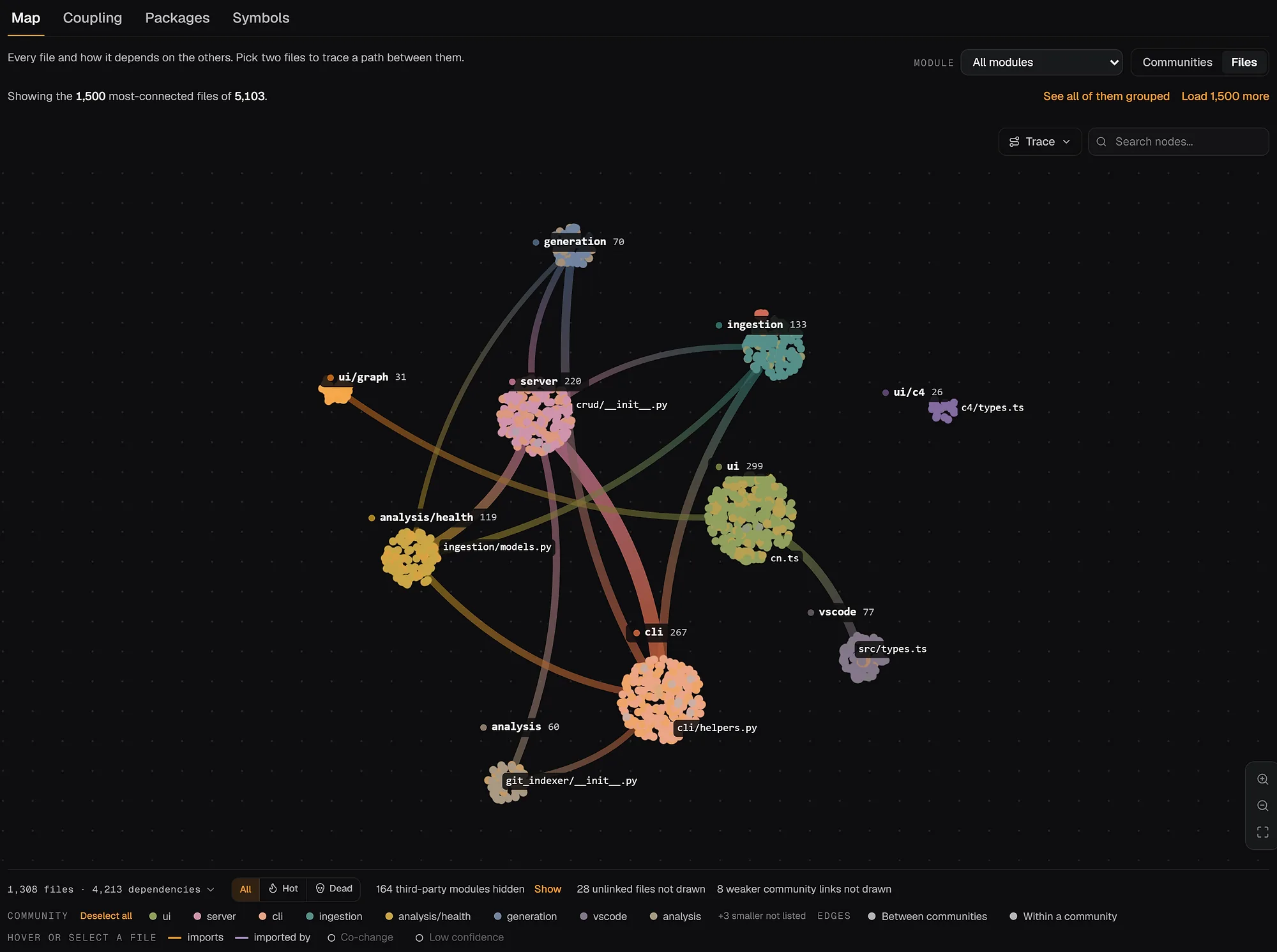
The generated model has clear limits. It will not draw your future state, it does not know the intent behind a service, its containers are the repo's packages (which may differ from the boxes an architect would choose), and it has no drag-and-drop editor for product managers. It is not a full IcePanel replacement: use it as the source for the "what exists" levels, and keep a hand-drawn tool for intent and future state. For more on this approach, see generating C4 diagrams from code automatically and the best architecture documentation tools.
How to choose
- Non-engineers need to edit diagrams, and the budget is there: stay on IcePanel, or try Ilograph.
- You want IcePanel's drill-down feel, open source, in git: LikeC4.
- You want the formal C4 reference model, open source, in git: Structurizr.
- You need one diagram in a README or PR: Mermaid, or C4-PlantUML on GitLab.
- The diagram keeps drifting from the code: generate the container and component levels, hand-draw the rest.
How we measured
In October 2026 I read each vendor's own pricing and documentation pages and pulled license and star counts from the GitHub API. I did not run a paid trial of IcePanel or Ilograph, so the features listed for them come from their docs and are untested. The langchain figures come from repowise's public Structurizr export of its latest snapshot of langchain-ai/langchain, from October 2026. Prices change; check the vendor's page before you buy.
FAQ
- Is there an open source alternative to IcePanel?
- Yes. Structurizr (Apache-2.0) and LikeC4 (MIT) are the two closest, because both keep a C4 model and draw several views from it, like IcePanel does. LikeC4 is nearer in feel, with interactive drill-down diagrams and a static site build. Neither has IcePanel's visual editor for non-engineers.
- How much does IcePanel cost?
- As of October 2026, IcePanel's free plan covers up to 100 model objects with unlimited viewers. Growth is $40 per editor per month and Scale is $80 per editor per month, both billed annually, and Enterprise is priced on request. Growth has a 14-day trial with no credit card.
- Is IcePanel self-hosted?
- IcePanel's pricing page lists no self-hosted plan. Enterprise offers custom data residency on GCP and a single-tenant environment. If you need it on your own machines, Structurizr's
server, LikeC4's static site build or draw.io can all be self-hosted. - What is the difference between IcePanel and Structurizr?
- Both are built on the C4 model and both keep a model with views. IcePanel is a hosted visual editor made for collaboration, including people who do not code. Structurizr is text in git, written by engineers, with free open source tooling and a licensed prebuilt server.
- Does LikeC4 support the C4 model?
- Yes. LikeC4 is built for C4-style architecture as code, though its DSL lets you define your own element kinds beyond the standard C4 ones. It can also generate Mermaid and PlantUML output if you need to publish diagrams elsewhere.
- Can IcePanel generate diagrams from code?
- Its documentation describes no repository sync. Its agent skills can turn code or a prompt into model objects and diagrams through its API, and it can import a YAML or JSON file you generate. Each of those is a one-time import that someone has to re-run, so the model does not rebuild itself as the code changes.