


On this page
The right Mintlify alternative depends on what you are documenting. For customer-facing product or API docs that people write, the closest alternatives are GitBook, ReadMe, Docusaurus, Fumadocs and Read the Docs. For documentation of the code itself, generated from the repository and refreshed on every commit, the option is repowise.
Mintlify is a docs-site platform: you write MDX, it renders a branded site with search, an AI assistant and an MCP server. That is a different job from describing how a codebase works, which is why the alternatives below split into two groups.
We build repowise, so weigh our entry accordingly. The measurements we publish about it, with their methods, are on the benchmarks page.
Mintlify alternatives at a glance
Seven options cover the realistic choices, from free open source to $450 a month. Prices are from each vendor's page on 15 November 2026 and change often.
| Tool | Kind | You write the docs? | Entry price (November 2026) | Paid tier |
|---|---|---|---|---|
| Mintlify | Hosted docs platform | Yes (MDX, Git) | Free Starter, 5 editors | Pro $450 a month annual, $540 monthly |
| GitBook | Hosted docs platform | Yes (editor, Git Sync) | Free for one user | Essential $65 per site a month annual; Ultimate $249 |
| ReadMe | Hosted API docs platform | Yes | Free Starter, 1 project | Pro $250 a month annual |
| Docusaurus | Open-source site generator | Yes (MDX) | Free, you host it | None |
| Fumadocs | Open-source React docs framework | Yes (Markdown) | Free, you host it | None |
| Read the Docs | Hosted Sphinx and MkDocs builds | Yes | Free for open source | Business $50, $150 or $250 a month |
| repowise | Docs generated from code | No, generated | Free open source (AGPL-3.0) | Hosted Pro for private repos |
Scroll the table sideways to see every column.
Hosted docs platforms
These platforms publish docs your team writes, and they compete on editor, theme, search and AI features. All of them assume a human author for every page.
Mintlify
Mintlify gives you a polished docs site from MDX files in Git, with an AI assistant and an MCP server for the published content. As of November 2026, per mintlify.com/pricing, Starter is $0 with 5 editors and an MCP server. Pro is $450 a month billed annually ($540 billed monthly) with unlimited editors, the AI assistant, and platform and agent analytics, plus 10,000 credits a month with overage at $0.01 per credit.
Pick it if you ship an API or SDK and want the best-looking public docs with the least design work.
GitBook
GitBook is the editor-first option: a block editor with Git Sync for GitHub and GitLab, aimed at teams where writers and engineers share one space. As of November 2026, per gitbook.com/pricing, Free covers one user. Essential is $65 per site a month billed annually ($79 monthly) plus $12 per extra user, and Ultimate is $249 per site ($299 monthly) with authenticated access and AI features.
Pick it if non-engineers write most of the docs, or you need gated internal and public spaces in one product.
ReadMe
ReadMe centers on API reference and developer-hub analytics. As of November 2026, per readme.com/pricing, Starter is free for 1 project and 1 admin. Pro is $250 a month billed annually with 5 admins, and the Ask AI feature is a $150 a month add-on on both plans.
Pick it if API usage metrics, per-request logs and a developer hub matter more than the editor.
Read the Docs
Read the Docs builds and hosts Sphinx and MkDocs projects from your repository, with versioned docs. As of November 2026, per about.readthedocs.com/pricing, Community is free for open-source software, Business is $50, $150 or $250 a month depending on tier, and Enterprise starts at $10,000 a year.
Pick it if your team already writes in reStructuredText or MkDocs, and you want versions per release without running a build server.
Open-source frameworks you host
Docusaurus and Fumadocs cost nothing to license and trade price for ownership of the build. Docusaurus builds static documentation and blog sites from Markdown and MDX. Fumadocs is a React docs framework that runs on Next.js, React Router, TanStack Start, Waku and Astro.
Pick one if you want full control of design and hosting, and your team is comfortable owning a React build.
Docs generated from code
Every tool above publishes what someone typed. None of them reads your source code to write the pages. For product docs that is correct: a quickstart needs an author. For the internal question, how does this codebase work and what depends on what, authoring does not scale, and the pages go stale when the code moves.
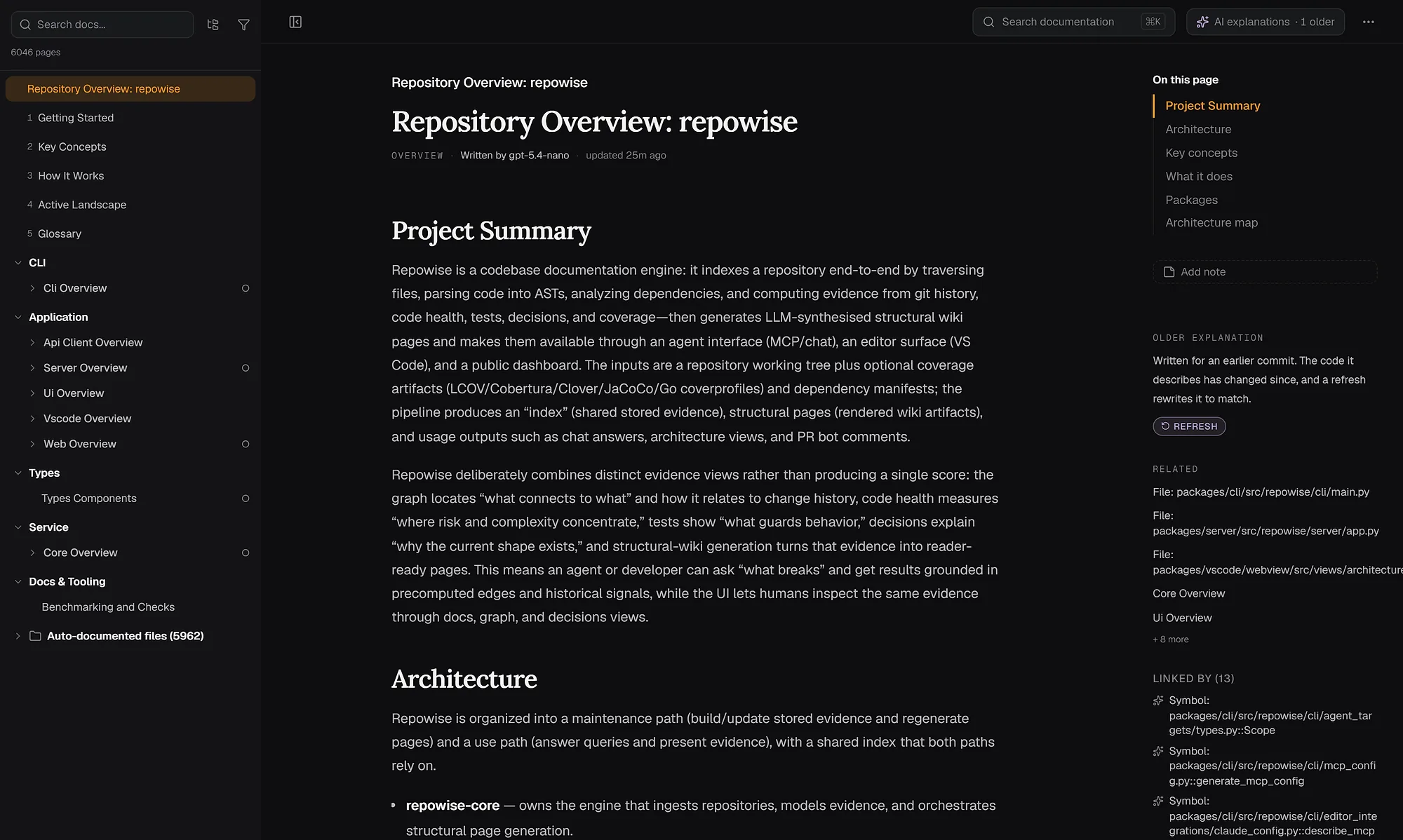
repowise builds that layer from the repository. It renders a wiki page for each source file, selected public symbol, subsystem, dependency cycle and API surface, plus a repository overview and an onboarding collection, and refreshes it incrementally on every commit (wiki layer docs).
- No model required:
repowise init --no-proserenders the wiki from the parse and import graph with no API key and no spend. A provider key adds prose to subsystem and overview pages. - Stays in sync:
repowise updatefinds the files changed since the last sync, walks the dependency graph to the affected pages and re-renders only those. Pages carry a freshness status offresh,stale,expiredorunknown. - Reads more than the files: the same index holds git ownership, hotspots, code health and decisions across 28 languages parsed to a full AST, served to agents through ten MCP tools.
pip install repowise
repowise init --no-prose            # keyless wiki, no model calls
repowise serve                      # browse it at localhost:3000
repowise update                     # after commits: re-render only what changed
repowise export --format markdown   # write the wiki out as files
The markdown export means generated pages can also feed a Docusaurus or Fumadocs site if you want them published next to hand-written docs. You can read a live example in the generated FastAPI docs.
For a wider comparison of generators, see best codebase documentation tools in 2026, and for drift in hand-written docs, best tools to keep docs in sync with code.
How to choose
Choose by audience: customers read a platform, engineers and agents read generated docs.
| You need | Use |
|---|---|
| Branded public API or SDK docs | Mintlify, ReadMe or GitBook |
| Writers and engineers in one editor | GitBook |
| Full control of design and hosting, no license cost | Docusaurus or Fumadocs |
| Versioned Sphinx or MkDocs docs | Read the Docs |
| An internal map of the codebase that stays current | repowise |
| Both customer docs and internal docs | A platform for the first, repowise for the second |
Scroll the table sideways to see every column.
Most teams that outgrow hand-maintained internal docs do not replace Mintlify. They add generated docs underneath it, so the platform holds what was authored and the wiki holds what the code says. The method for keeping any of it accurate is in stale documentation: how to detect and fix drift.
FAQ
- What is the best Mintlify alternative?
- For customer-facing docs, GitBook is the closest hosted alternative and Docusaurus is the free self-hosted one. For documentation generated from your code, repowise is the open-source option. They solve different problems, so the right one depends on who reads the docs.
- Is there a free alternative to Mintlify?
- Yes. Docusaurus and Fumadocs are open source and free to host yourself, Read the Docs Community is free for open-source projects, and GitBook has a free plan for one user. Mintlify's own Starter plan is also free for 5 editors, as of November 2026.
- How much does Mintlify cost?
- As of November 2026, per mintlify.com/pricing, Starter is $0 and Pro is $450 a month billed annually or $540 billed monthly. Pro includes unlimited editors, the AI assistant and analytics, with 10,000 credits a month and $0.01 per extra credit. Enterprise is custom.
- Can documentation be generated automatically from code?
- Yes. repowise generates a wiki from your repository with
repowise init --no-prose, using no model and no API key, and refreshes only the affected pages on each commit withrepowise update. API reference generators exist for single languages, but they document signatures, not how subsystems connect. - Does Mintlify generate docs from my codebase?
- No. Mintlify renders content you or an AI assistant write as MDX files. It publishes and searches documentation; it does not build a map of your source code. Pair it with a generated wiki if you want the internal view.