Codebase MCP server
Give your coding agent the whole repo.
repowise is a codebase MCP (Model Context Protocol) server. It indexes your repository once, updates it on every commit, and gives Claude Code, Cursor, Codex and Cline ten tools that return cited answers, callers, change risk and decisions instead of raw files. Every answer says how fresh it is.
Agents with Repowise open up to 99% fewer files, and every model we tested opened fewer.
Measured, not claimed
- 31.6%
- fewer output tokens, the most of five context tools
- n = 43 · p = <0.0001 · Codex (gpt-5.6-sol) · django/django at a single pinned commit · 2026-08
- Up to 99%
- fewer files opened (Sonnet 4.6); fewer on every model tested
- n = 72 · Claude Code (Sonnet 4.6) · 24 questions on three repositories created after every tested model's training cutoff (Python, Go, Rust) · 2026-11
- 48 of 48
- answers right on the newest flagship (Opus 5.5)
- n = 48 · Claude Code (Opus 5.5) · 24 questions on three repositories created after every tested model's training cutoff (Python, Go, Rust) · 2026-11
- 0.876
- gold-file coverage
- n = 42 · p = 0.00004 · ContextBench, 42 sealed instances, Python and Go · 2026-08
Sound familiar?
Your agent is smart. It is also flying blind.
- 01
It reads twenty files to answer one question.
- 02
It changes code it has never seen the callers of.
- 03
Every new session starts from zero.
What makes it different
The context it was guessing at, one call away.
- Cited answers
Ask anything, get the lines it came from.
One tool call returns the answer with its sources and how confident the retrieval was.
- Risk before the edit
Callers, co-changes and tests, before it touches a file.
The agent learns what a change reaches while it is still cheap to change course.
- Distill
Less to read, nothing lost.
Test and git output shrink by 61% to 89% with every error line kept.
- Context files
CLAUDE.md and AGENTS.md, written and kept current.
Architecture, entry points, hotspots and conventions, regenerated as the code moves.
How it works
One index. Ten tools. Any agent.
- 01 / Index
Index once, update per commit
Structure, history, tests and decisions are read from the repository and kept current. - 02 / Connect
Add the server in one command
Claude Code, Cursor, Codex, Cline and any MCP client point at the same endpoint. - 03 / Ask
The agent picks the tool that fits
Ask, search, risk, why, health: each question has a tool shaped for it, and every answer says how fresh it is.
On a real repository
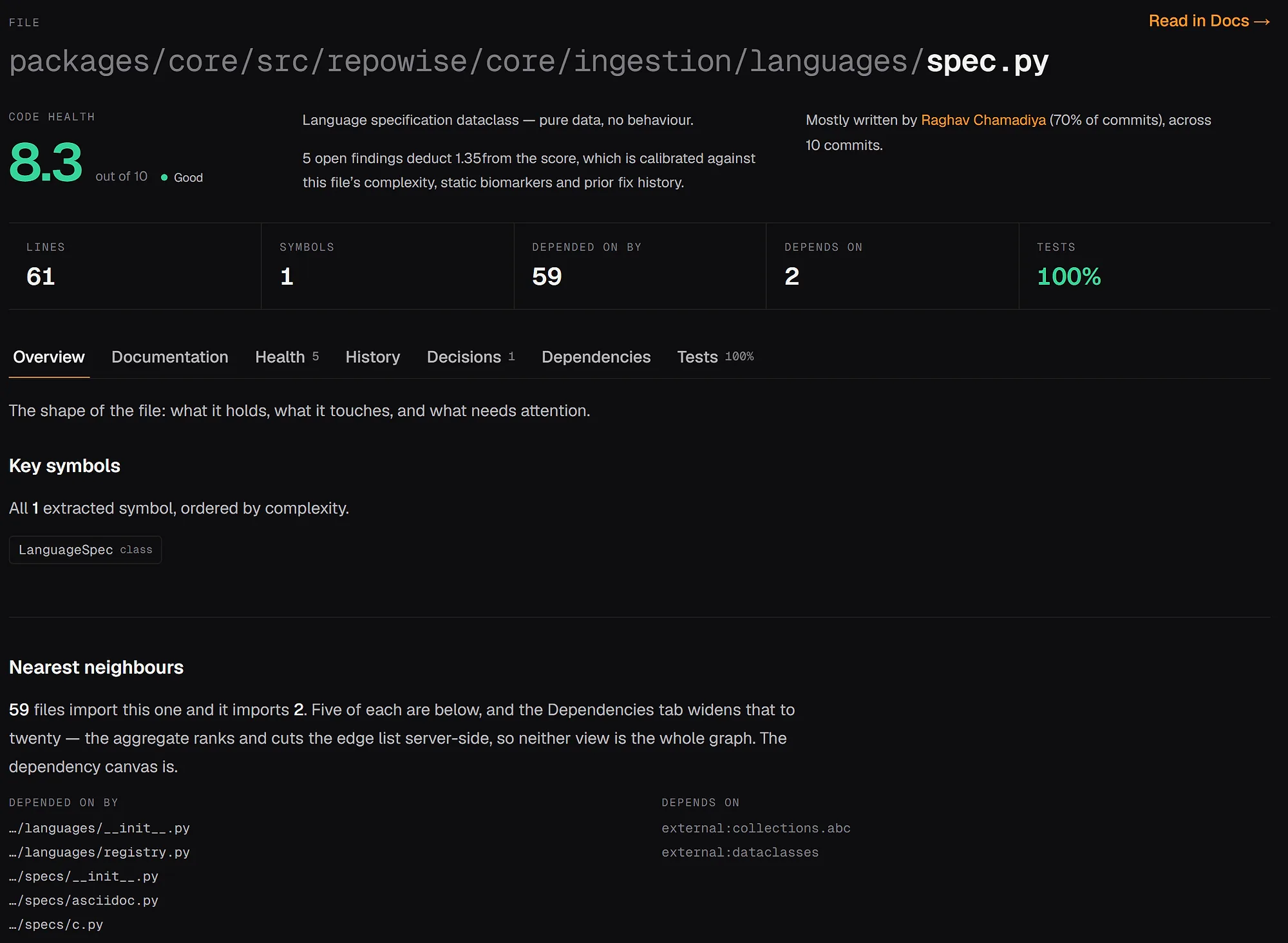
Everything the agent needs about a file, already joined.
A file page is the smallest useful proof of the index: bounded source, signatures, dependencies, owners, health and the decisions that govern it. The agent gets the same page through one MCP call instead of assembling it from five tools.
Questions
What people ask before they try it.
What is the best MCP server for Claude Code?
One that gives the agent the repository's structure instead of more files to read. repowise is a codebase MCP server: one call returns a cited answer, a file's callers, its change risk or the decisions behind it. In a real agent loop (Codex, django/django, 43 questions against a bare-agent control), repowise cut output tokens 31.6% and reached an answer in 3.8 tool calls instead of 7.2, opening 3.0 files instead of 7.2: the most work saved of five context tools. Across five models in Claude Code, every model opened fewer files with repowise: up to 99% fewer, with up to 51.2% less output and answers up to 47% faster (Sonnet 4.6). The newest flagship, Opus 5.5, got 48 of 48 answers right. Loading one commit's context takes 35.6x fewer tokens than reading every changed file.
How do I add repowise to Claude Code?
Run pip install repowise, then repowise init in your repository. It indexes the code, wires up the agents it finds, Claude Code included, and writes CLAUDE.md. Codex, Cursor and VS Code are set up the same way; Cline, Windsurf and any other MCP client take one pasted server entry. One MCP server serves every one of them, sized to how each loads tools: Claude Code lists all ten, and clients that send every schema with every request list five core MCP tools by default, ten with the standard profile.
Is the repowise MCP server free?
Yes. The MCP server ships in the open-source repowise package under AGPL-3.0, runs locally and needs no model key. Hosted repowise is free on public repos, and the same tools answer over a URL.
What are the ten tools?
get_overview (architecture map, module list, entry points), get_answer (a cited answer with calibrated retrieval_quality), get_context (a triage card for files, modules, or symbols), get_symbol (raw source bytes for one indexed symbol), search_codebase (semantic search over the wiki), get_risk (hotspot scores, dependents, and PR directives), get_change_risk (a pre-merge defect-risk score for a commit or diff range), get_why (architectural decision rationale and lineage), get_dead_code (unreachable code by confidence tier), and get_health (per-file code-health scores).
Does it generate context files like CLAUDE.md?
Yes. repowise auto-generates CLAUDE.md for Claude Code and a managed AGENTS.md for Codex, with architecture, entry points, hotspots, and conventions, and keeps them current as the codebase changes. Agents that read those files get accurate orientation before they make a single tool call.
Last reviewed: October 2026
Get started
Give your agent the context it was guessing at.
Index a public repository free, connect your agent in one command, and ask it something you already know the answer to.
Add it to Claude Code