On this page
The best Augment Context Engine alternatives are free local code graphs (CodeGraph, Graphify, Serena, GitNexus) when your agent runs on your laptop, and hosted indexes (repowise, Sourcegraph, Greptile) when it runs somewhere your laptop cannot be reached. Cost and license decide the local choice; where the agent runs decides everything else.
The short list, as of October 2026:
- CodeGraph: MIT, free, the strongest open-source local graph in our benchmark.
- Graphify: Apache-2.0, a local AST graph with no model calls.
- Serena: language-server lookups and edits, always current.
- GitNexus: local knowledge graph, free for noncommercial use only.
- Sourcegraph MCP server: cross-repo search for companies already on Sourcegraph Enterprise.
- Greptile MCP server: review history and rules for Greptile customers.
- repowise: graph, git history and health over MCP, self-hosted for free or hosted per repo.
We build repowise, so weigh our entry accordingly. The measurements we publish about it, with their methods, are on the benchmarks page.
How we evaluated
We read each vendor's own documentation, pricing page and repository on 12 October 2026, and compared on what a team decides on.
- Where the agent runs: laptop only, or reachable from Claude.ai and cloud agents.
- What it costs and what license it carries: per-query billing, seat plans, or free under a license you can use at work.
- Scope: one folder, or several repositories at once.
- What it knows: code structure only, or also git history, ownership and health.
Comparison table
| Tool | How it builds context | License and price | Private repos | Stays current | Browser agents (Claude.ai) |
|---|---|---|---|---|---|
| Augment Context Engine MCP | Semantic index, local (Auggie CLI) or hosted | Closed; usage-billed, about $0.03 to $0.06 per query, inside $20 or $100/month plans | Yes, hosted mode via GitHub App | Local: real time. Hosted: on push to default branch | Hosted mode is a remote MCP server |
| CodeGraph | Local code graph | MIT, free | Yes, local | Syncs on file changes | No, local only |
| Graphify | Local AST graph, no vector store | Apache-2.0, free | Yes, local | git hooks or watch mode | No, local only |
| GitNexus | Local knowledge graph of calls and flows | PolyForm Noncommercial, free for noncommercial use | Yes, local | Watch mode or scheduled sync | No, local only |
| Serena | Language servers for symbol lookup and edits | GPL-3.0 app, MIT LSP client, free | Yes, local | Live, reads the files | No, local only |
| Sourcegraph MCP server | Code, commit and diff search plus Deep Search across many repos | Enterprise plans | Yes | Sourcegraph's index | Yes, OAuth |
| Greptile MCP server | Review history, custom rules, generated knowledge base | Greptile plans | Yes | Greptile's index | Remote MCP with OAuth |
| repowise | Dependency graph, git history, generated docs, health | AGPL-3.0 free self-hosted; hosted Free (two public repos) and Pro | Yes (self-hosted, or hosted Pro) | Hosted Pro re-indexes on every push | Yes, one MCP URL per repo |
Scroll the table sideways to see every column.
Prices and licenses are from each vendor's page and repository on 12 October 2026. I build repowise; the other tools are described as their own documentation describes them.
What Augment's Context Engine is
Augment's Context Engine is a semantic index of your codebase, exposed as an MCP server so any compatible agent can ask it for relevant code. MCP, the Model Context Protocol, is the standard way an agent such as Claude Code or Cursor calls an outside tool.
It has two modes. Local mode runs Augment's Auggie CLI on your machine and indexes your working directory in real time. Remote mode is hosted by Augment, installs a GitHub App and re-indexes the default branch of selected repositories when commits land. Augment's docs list twelve clients, among them Claude Code, Codex, Cursor, GitHub Copilot, Zed, Gemini CLI, Kiro and OpenCode.
Pricing is the part to read closely. Queries are billed at the model provider's rate plus a 40% fee, which Augment's docs put at roughly $0.03 to $0.06 per query. The Standard plan is $20 a month and Business is $100, each flat for up to 50 seats and each including that amount of usage across models, the Context Engine and compute. An agent making 200 context queries in a day would spend roughly $6 to $12 at that average (our arithmetic from Augment's stated figure).
Augment's launch post reports agent results improving by 70% or more with the Context Engine attached. That is Augment's own evaluation on one repository, so expect your own gain to differ.
Where the agent runs decides most of this
A local MCP server can only serve an agent on the same machine; an agent in Claude.ai, ChatGPT or a cloud job needs a hosted index with a public address and sign-in. That one fact rules out every local tool in the table for browser agents, however good it is.
If your agent is Claude Code, Cursor or Codex CLI on your laptop, any local server works and nothing leaves your machine. The second question is scope: local graphs index the folder you are in, so an answer that spans your API, your frontend and a shared library needs something that indexes several repositories.
Free local alternatives
CodeGraph builds a code knowledge graph and keeps it synced as files change. It is MIT-licensed, has about 74,000 GitHub stars and integrates with Claude Code, Cursor, Codex, Copilot, Gemini CLI, Kiro and more. In our sealed retrieval benchmark it was the strongest open-source tool, with 0.610 file coverage. Pick it if you work alone, want a graph with no account and need the lowest setup cost.
Graphify runs as a /graphify skill inside your assistant. It parses code with tree-sitter into a graph with no model calls and no embeddings, tags every edge as extracted or inferred, and writes an HTML graph, a report and a JSON graph you can query. It is Apache-2.0.
Pick it if you want a graph you can read and audit, and no vector store.
Serena drives real language servers, the engines your IDE uses for go-to-definition and find-references, and gives the agent symbol-level reading and editing tools. It is precise for "where is this used" and always current because it reads live files. The application is GPL-3.0-or-later; its LSP client library is MIT. Pick it if your agent makes many symbol-level edits and you can accept GPL terms.
GitNexus indexes dependencies, call chains and execution flows into a knowledge graph and writes AGENTS.md and CLAUDE.md files. Its license is PolyForm Noncommercial 1.0.0, which does not allow commercial use without a separate agreement.
Pick it if the use is personal or noncommercial.
None of the four gives you git history (ownership, files that change together), a view across repositories, or access from a browser agent. For many solo developers those gaps do not matter.
Hosted alternatives
Sourcegraph's MCP server exposes Sourcegraph search to agents: keyword and natural-language code search, commit and diff search, go-to-definition, find-references and Deep Search, across every repository your instance indexes. It is supported on Enterprise plans, with OAuth 2.0 or access-token sign-in. See Sourcegraph alternatives for the wider picture. Pick it if your company already runs Sourcegraph.
Greptile's MCP server sits on Greptile's review product. Its tools list pull requests and reviews, search past review comments, manage custom review rules and read a generated knowledge base per repository. Code retrieval is secondary to review. Pick it if you already use Greptile and want your agent to see the same rules and history.
repowise parses code into a dependency graph, reads git history for hotspots, ownership and files that change together, writes a wiki on top, and serves it over ten MCP tools: get_overview, get_context, get_answer, search_codebase, get_symbol, get_risk, get_change_risk, get_why, get_health and get_dead_code. Self-hosted it is AGPL-3.0 and repowise init runs with no API key. Hosted, every repo has an MCP address (https://api.repowise.dev/mcp/OWNER/REPO) that works in Claude Code, Cursor, VS Code, Codex and as a connector in Claude.ai. Graph, git and health tools make no model call, so those queries carry no per-token fee.
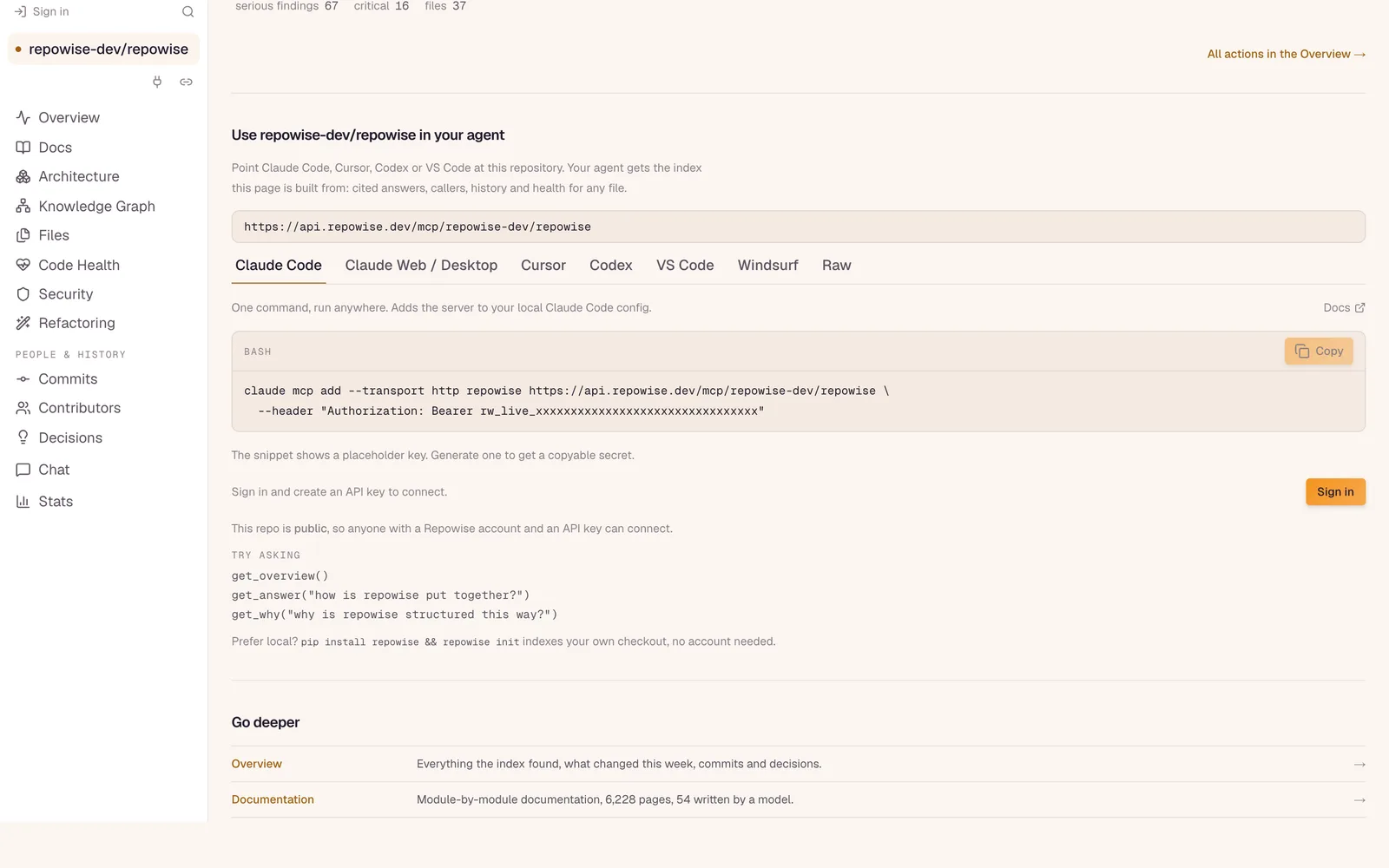
Pick it if you need context in Claude.ai or a cloud agent, across several repositories, with history, ownership and risk alongside the code. Try it free on any public repo.
How the open-source tools did on a retrieval benchmark
On 42 sealed ContextBench instances, repowise's get_answer found 0.876 of the needed files, against 0.610 for CodeGraph. The instances were pinned before tuning began and graded deterministically with no model judge; the benchmark measures which files each tool returns, as of August 2026.
File coverage on 42 ContextBench instances pinned before any of this work started and kept sealed until the final measurement. Grading is deterministic and no LLM judge is involved.
| Tool | File coverage | Precision | Files served |
|---|---|---|---|
| repowise (get_answer) | 0.876 | 0.087 | 19.2 |
| repowise (search_codebase) | 0.742 | 0.168 | 8.2 |
| CodeGraph | 0.610 | 0.093 | 14.0 |
| Graphify | 0.546 | 0.033 | 34.5 |
| code-review-graph | 0.445 | 0.240 | 5.4 |
| cocoindex | 0.361 | 0.092 | 7.1 |
Scroll the table sideways to see every column.
n = 42 sealed instances (41 for cocoindex, measured 2026-08-09 on the same instances and grading; one instance never answered and is excluded, not scored zero). Head to head against CodeGraph, get_answer wins 19, loses 1, ties 22, sign test p = 0.00004. The pooled 112-instance figure would be 0.835 and is deliberately not quoted: averaging the halves loses the only number that matters, which is how the tool does on instances it has never seen.
Augment, Sourcegraph and Greptile were not in this run, so it says nothing about them. Retrieval coverage is also one part of a good agent result: an agent can find the right files and still write the wrong fix. The method and the first-run result are in we benchmarked ourselves and came last, and the full set is on the benchmarks page.
How to choose
- Solo, agent on your laptop, cost matters: start with CodeGraph or Graphify. Add Serena if the agent edits symbols heavily.
- Commercial use: check licenses first. GitNexus is noncommercial, and Serena's GPL terms matter if you redistribute it.
- Already paying for Sourcegraph Enterprise or Greptile: use their MCP servers before buying anything new.
- Want Augment's semantic retrieval: the Context Engine is a reasonable choice. Cap usage per seat, since billing is per query.
- Context in Claude.ai or a cloud agent, across repos, with history and ownership: you need a hosted index, which is where repowise fits.
For a wider buyer's view, see the repository intelligence buyer's guide, and the CodeGraph, Graphify and Serena alternative pages.
FAQ
- What is the Augment Context Engine MCP?
- It is Augment Code's semantic code index exposed as an MCP server, so agents such as Claude Code, Cursor and Codex can ask it for relevant code. It runs locally through the Auggie CLI or as a hosted server that indexes your GitHub repositories' default branches.
- How much does Augment's Context Engine cost?
- Queries are billed by tokens at the model provider's rate plus a 40% service fee, averaging about $0.03 to $0.06 per query by Augment's own estimate. Standard is $20 a month and Business is $100, flat for up to 50 seats, each including that amount of usage.
- What is a free alternative to Augment's Context Engine?
- CodeGraph (MIT) and Graphify (Apache-2.0) build local code graphs for free and plug into Claude Code, Cursor and Codex over MCP. Serena (GPL-3.0) gives agents language-server lookups. GitNexus is free for noncommercial use only.
- Is there a context engine for Claude Code?
- Yes. Any MCP server that indexes code can act as one. Local options include CodeGraph, Graphify and Serena; hosted ones include Augment's remote mode, Sourcegraph's MCP server and repowise, which also works from Claude.ai.
- Can I use a context engine with Claude.ai or ChatGPT in the browser?
- Only a hosted one. Browser agents run on the vendor's servers and cannot reach an MCP server on your laptop. You need a remote MCP server with sign-in, such as Augment's hosted mode, Sourcegraph's MCP server on Enterprise, or a repo's MCP address on repowise.dev.