
On this page
The closest CodeSee alternative in 2026 depends on which CodeSee feature you used, because no single tool replaces all of them. Generated tools such as repowise, Emerge or GitDiagram cover whole-repo codebase maps, and dependency-cruiser or Madge cover dependency graphs in one JavaScript or TypeScript project. For pull request review maps, use a review bot that reads the dependency graph.
| Tool | Replaces which CodeSee feature | How the map is made | Languages | Open source | Price (12 Oct 2026) |
|---|---|---|---|---|---|
| repowise | Codebase maps, review context on PRs | Import graph plus git history, rebuilt as the code changes on paid plans (public repos refresh weekly with a badge), no LLM in the layout | 28 languages parsed to a full AST (list) | Core is AGPL-3.0 | Free for public repos; Pro $15 a month |
| GitDiagram | Quick architecture picture of a repo | An LLM reads the file tree and writes a Mermaid diagram | Any (reads the tree) | MIT | Free |
| Emerge | Interactive dependency and file maps | Static scan, force-directed graph with Louvain clustering, local web app | C, C++, Groovy, Java, JavaScript, TypeScript, Kotlin, ObjC, Ruby, Swift, Python, Go | MIT | Free |
| dependency-cruiser | Dependency maps plus rules in CI | Static analysis, outputs DOT, Mermaid, D2, HTML reports and more | JavaScript, TypeScript, CoffeeScript | MIT | Free |
| Madge | Module graphs and circular imports | Static analysis, Graphviz for images | JavaScript, TypeScript (CommonJS, AMD, ES6) | MIT | Free |
| Sourcetrail (community fork) | Exploring code by symbol, offline | Indexes the code into a local database | C, C++, Java | GPL-3.0 | Free source; binaries for $10 a month sponsors |
Scroll the table sideways to see every column.
What happened to CodeSee Maps?
On 14 May 2024, GitKraken announced that it had acquired CodeSee and launched its DevEx platform. The announcement said CodeSee's visualizations, automations and AI would be integrated into GitKraken's platform.
This is what the CodeSee and GitKraken sites showed on 6 October 2026, rechecked on 12 October 2026:
- www.codesee.io does not load. Both a browser and
curlfailed at the TLS handshake, the step where a browser and a server set up a secure connection. - app.codesee.io redirects to a login page for a Cloudflare Access team, which is not a public sign-in.
- The Internet Archive's last successful capture of codesee.io is from June 2026, and it still showed "Limited-time offer, try Maps for Teams, 6 months, no cost". Captures from late July 2026 onward return 404, including the pricing page.
- docs.codesee.io still answers (it redirects to /docs), last modified in May 2025, with no notice about the product's status.
- GitKraken's homepage and pricing page don't mention CodeSee or codebase maps.
Neither GitKraken nor CodeSee has published a shutdown notice, so this post does not claim Maps is officially discontinued. The public site and sign-up are, however, not reachable today. If you relied on CodeSee, contact GitKraken directly about your account and data. The sections below cover a replacement for each part of what CodeSee did.
What CodeSee did, and what to replace each part with
CodeSee's docs describe several products, and it helps to take them one at a time, because the alternatives split the same way.
Codebase maps were auto-generated, interactive diagrams of a repository's structure, with arrows for file-to-file dependencies, that you could annotate and comment on. Supported languages were JavaScript, TypeScript, Python, Java, Rust, .NET, C#, Kotlin and Go. Replacements: repowise, Emerge, GitDiagram.
Review maps were generated on each pull request and posted in GitHub to show what the change touches. Replacements: a review bot that reads the repository's graph, or dependency-cruiser rules in CI (continuous integration, the checks that run on every push).
Code tours let someone walk a newcomer through the code step by step. None of the tools below copies code tours directly, though generated docs and a reading order get you part of the way.
The alternatives
repowise
repowise indexes a repository and builds its map from the import graph, package manifests and git history, with no LLM call in the layout and no API key needed for the graph. It parses 28 languages to a full AST, and the map is built by repowise init and kept current by repowise update.
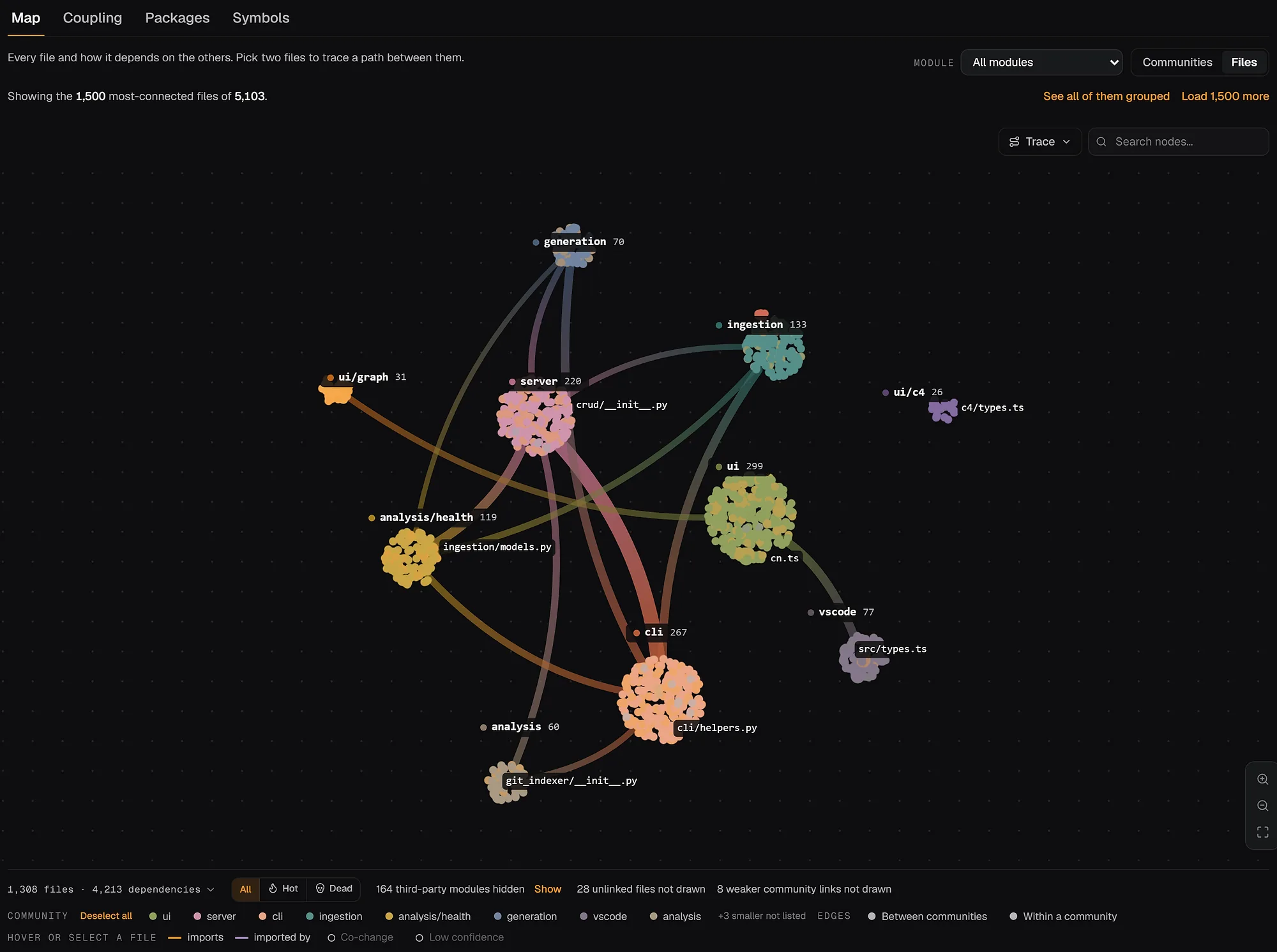
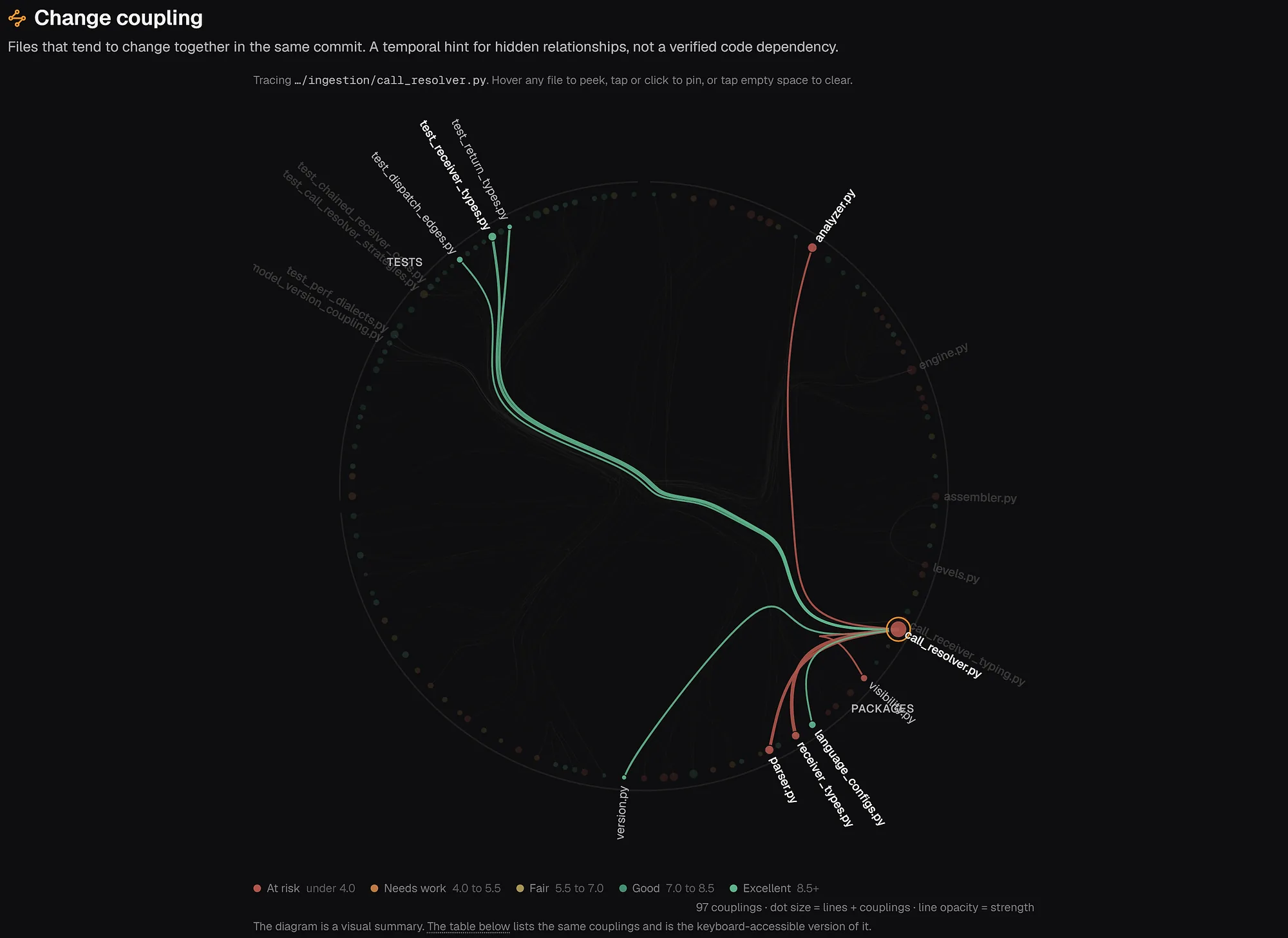
The Map tab draws every file and how it depends on the others, and lets you pick two files and trace the path between them. The Coupling tab shows files that tend to change together in the same commit, a link a static import map misses.
The knowledge graph groups files into layers you can open one at a time, and you can browse a live map of langchain-ai/langchain without an account. The architecture exports as Structurizr DSL for your own diagram tooling.
For the review-map side, the repowise PR bot comments on a pull request with the callers outside the PR that a signature change affects, files that usually change together but are missing from the PR, and the test files that import what changed.
Pick it if you want a whole-repo map that stays current, plus PR review context, from one install. Public repositories are free; private repositories need Pro ($15 a month) or a self-hosted install.
GitDiagram
GitDiagram turns a GitHub repository into an interactive architecture diagram: replace hub with diagram in the URL. An LLM (large language model) reads the file tree and writes the diagram. You can click components to jump to their files, export a PNG or copy the Mermaid source. It works on private repos with a GitHub token, and it has a free MCP server (MCP, the Model Context Protocol, is the standard way an AI agent calls an outside tool) so agents can read the diagrams. It is MIT licensed.
Pick it if you want a fast, readable first picture of an unfamiliar repo. Because a model writes it, the diagram summarizes the structure and does not draw every import, and two runs can differ.
Emerge
Emerge is a Python tool that scans a codebase and generates a local, interactive web app with a dependency graph and a filesystem graph. It clusters files with Louvain modularity, colours them, and computes metrics such as fan-in, fan-out and lines of code, with some experimental git metrics like change coupling. It parses 12 languages, listed in the table above.
Pick it if you want the closest open source match to CodeSee's "open the whole map and explore it" feel, running entirely on your machine. You run it again to refresh it; nothing keeps it current for you.
dependency-cruiser
dependency-cruiser validates and visualizes dependencies in JavaScript, TypeScript and CoffeeScript. It can write the graph as DOT, Mermaid, D2, JSON, CSV or an HTML report, and its main strength is rules: you can forbid certain imports and fail the build when someone adds one.
Pick it if you are replacing review maps for a JS or TS project with something stricter. A rule in CI catches a bad dependency before it merges, which a picture never did.
Madge
Madge creates graphs from CommonJS, AMD or ES6 module dependencies, and finds circular dependencies. Graphviz is only needed if you want an image. With over 10,000 GitHub stars, it is the quick answer to "draw me this project's imports" in JavaScript land.
Pick it if you want a one-command graph or a circular-import check. It does not attempt the whole-codebase, multi-language map CodeSee offered.
Sourcetrail (community fork)
Sourcetrail was a free, offline source explorer that showed a symbol's callers and dependencies as a graph next to the code. Its original authors archived it at the end of 2021. A community fork keeps it building, with a release in October 2026, for C, C++ and Java. The source is GPL-3.0; prebuilt binaries go to sponsors at $10 a month.
Pick it if you are navigating a large C++ or Java codebase symbol by symbol, offline.
How to choose
- You used CodeSee to onboard people onto a whole repo: start with a generated map (repowise, Emerge or GitDiagram) and add docs on top.
- You used review maps: put a dependency-aware bot on the PR, or write dependency-cruiser rules if the project is JS or TS.
- You need one picture for a slide or a README: GitDiagram, or hand-draw it in a C4 tool. See IcePanel alternatives for the hand-drawn options.
- You need the map to keep matching the code after today: pick something that rebuilds when the code changes.
For a broader survey that includes Structurizr and C4 tools, see the best codebase visualization tools.
How we measured
On 6 and 12 October 2026 we checked CodeSee's domains with curl and a browser, read the Internet Archive's capture list for codesee.io, and read GitKraken's 2024 press release, homepage and pricing page. Tool features, languages and licenses come from each project's own README or docs and the GitHub API. We did not run every tool on the same repo, so this post compares what each tool does and does not judge the quality of their output.
FAQ
- Is CodeSee still available?
- On 12 October 2026, the public site www.codesee.io did not load and app.codesee.io sent visitors to a login page that is not a public sign-in. The documentation site was still online. GitKraken acquired CodeSee in May 2024, and there is no public shutdown notice, so existing customers should ask GitKraken about their accounts.
- What is the best free codebase visualizer?
- For a whole repository, Emerge runs locally and is free and open source, and GitDiagram gives a free LLM-written diagram of any public repo. repowise is free for public repositories and builds the map from the import graph. For JavaScript or TypeScript only, dependency-cruiser and Madge are free and run in CI.
- What is a code graph visualizer?
- A code graph visualizer draws your code as a graph: files, modules or functions as nodes, and imports or calls as edges. Good ones let you filter, cluster and trace a path between two nodes, because a full graph of a large repo is unreadable otherwise.
- Did GitKraken replace CodeSee Maps?
- GitKraken's 2024 announcement said CodeSee's visualizations would be integrated into its DevEx platform. On 6 October 2026, GitKraken's homepage and pricing page did not mention CodeSee or codebase maps. GitKraken Desktop and GitLens visualize Git history, which is a different job from mapping the code's structure.
- What can replace CodeSee review maps on pull requests?
- Two kinds of tool can replace them. A review bot that reads the repository's dependency graph can name the callers and co-changing files a PR affects. Dependency rules in CI, such as dependency-cruiser for JS and TS, fail the build when a PR adds a forbidden import.