On this page
- repowise vs DeepWiki at a glance
- What DeepWiki does well
- What repowise adds
- The code, the index and the model calls stay on your infrastructure
- A complete wiki with no API key
- Git history the wiki cannot show
- Code health, dead code and decisions on the same index
- Your hand-written docs, checked against the code
- Structured tools for coding agents
- Self-hosting a DeepWiki-style wiki
- Which one to pick
- Try it on your repo
- FAQ
Pick DeepWiki to read a public GitHub repository in the next five minutes; pick repowise when the documentation has to run on your own infrastructure and do more than describe the code. DeepWiki, from Cognition (the company behind the Devin coding agent), is a hosted AI wiki. repowise is an open-source engine that builds the wiki from your code graph, then adds git ownership, hotspots, code health, dead code and decisions, and serves all of it to coding agents through ten MCP tools.
To see DeepWiki on any public repository, swap github.com for deepwiki.com in its URL. DeepWiki details below are as of October 2026, from Cognition's DeepWiki documentation and DeepWiki MCP documentation. repowise details are from release 0.59.
repowise vs DeepWiki at a glance
DeepWiki is a hosted wiki and chat; repowise is a self-hostable index whose wiki is one of several views.
| DeepWiki | repowise | |
|---|---|---|
| What it is | AI-generated wiki and "Ask Devin" chat, by Cognition | Open-source codebase intelligence engine |
| Where it runs | Cognition's hosted service | Your machine or CI; also hosted at repowise.dev |
| Licence | Proprietary service | AGPL-3.0 |
| Public repositories | Free at deepwiki.com, no account | Free to index locally; free to read on repowise.dev |
| Private repositories | Through a Devin account. Low effort wikis are free; medium about 5 to 10 ACUs, high about 20 to 40 | Free when self-hosted; hosted private repositories on Pro |
| Wiki | Generated pages, architecture diagrams, source links; steered by .devin/wiki.json (up to 30 pages, 80 on Enterprise) | A page per file, selected public symbol, subsystem, dependency cycle, infrastructure file and API surface, rendered from the code graph |
| Model needed | Chosen and run by Cognition | None for the full wiki; optional prose from Anthropic, OpenAI, Gemini, OpenRouter, LiteLLM or local Ollama |
| Git history | Not part of the product | Ownership, bus factor, churn, hotspots, co-change, bug-fix history |
| Code health and dead code | Not part of the product | Per-file health scores, a Fix first queue, dead code by confidence tier |
| Your own docs checked | Not part of the product | Paths, links, anchors, commands and symbols checked on every update |
| Agent access | Free MCP server for public repos; Devin MCP with an API key for private | Ten MCP tools on your local index |
| Languages | Not listed in the docs | 28 parsed to a full AST, 15 at the Full tier |
| Git hosts | GitHub | Any git repository locally; GitHub, GitLab, Azure DevOps and Bitbucket recognised |
Scroll the table sideways to see every column.
What DeepWiki does well
DeepWiki is one of the fastest ways from a GitHub URL to a structured, browsable explanation of a public codebase. Swap github.com for deepwiki.com in a repository URL and you get a wiki with architecture diagrams, links back to source and an "Ask Devin" chat grounded in the generated pages. No install, no account, no configuration.
A .devin/wiki.json file in the repository lets maintainers steer which pages get written, with notes and a page hierarchy, per the DeepWiki docs. The DeepWiki MCP server at https://mcp.deepwiki.com/mcp is free and needs no authentication for public repositories. Its three tools, read_wiki_structure, read_wiki_contents and ask_question, are a convenient way to let a coding agent read the docs of an open-source library you depend on.
For teams already on Devin, the same wiki is available for private repositories inside the Devin app, alongside the agent they already use.
What repowise adds
repowise indexes a repository once into a local graph and its git history, then reads that one index as a wiki, a health report, an ownership map and a set of agent tools. The graph, git, health and dead-code layers make no model calls.
The code, the index and the model calls stay on your infrastructure
repowise is AGPL-3.0 and installs with pip install repowise. repowise init writes the index to .repowise/ next to the repository, and raw source is parsed in memory, never persisted. Model calls are optional and go to the provider you configure, including a local Ollama model, so a fully offline setup sends nothing outside your network.
A complete wiki with no API key
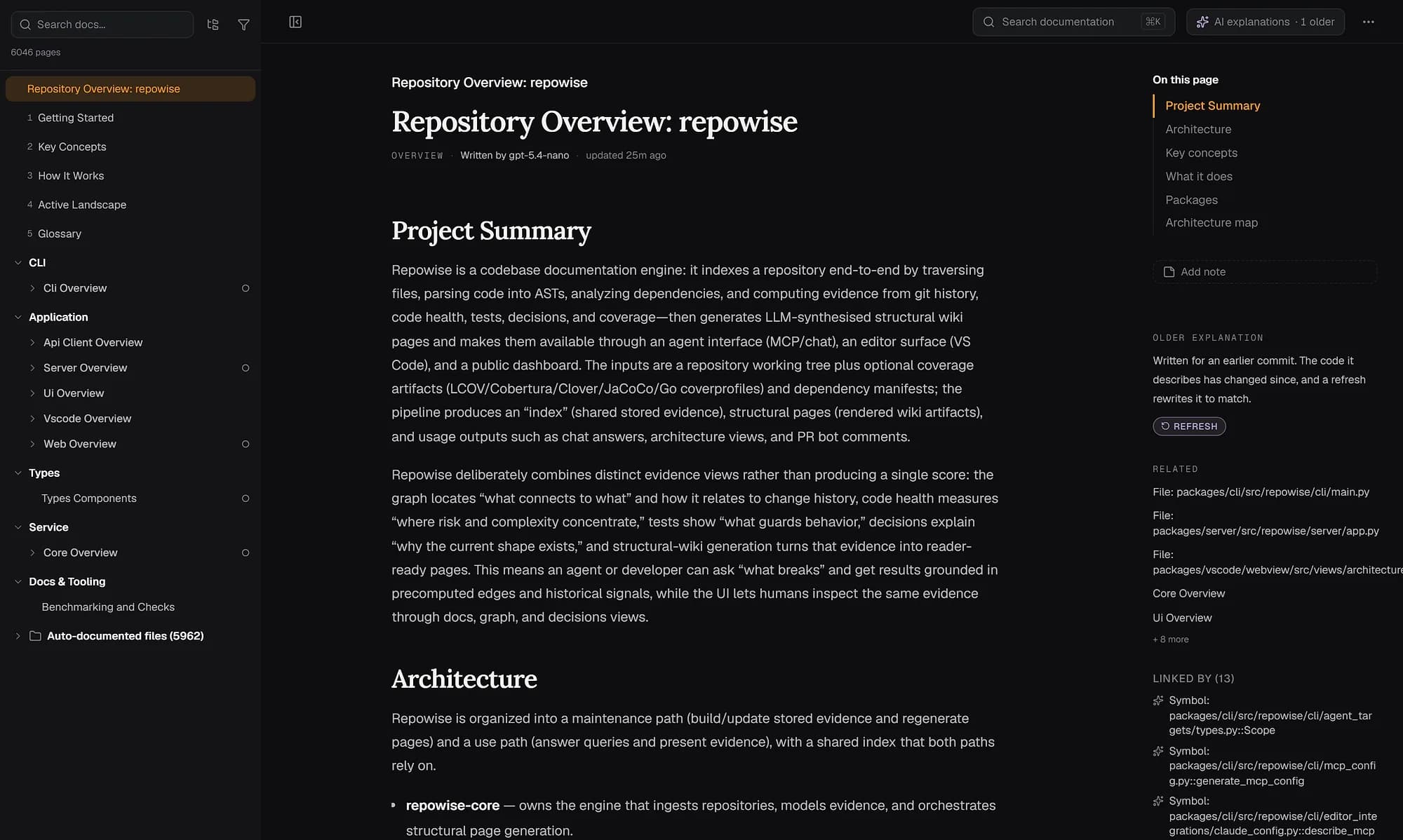
repowise renders most of its wiki from the code's structure: a page per source file, per selected public symbol, per subsystem, per dependency cycle, per infrastructure file (Dockerfile, CI, IaC) and per API surface, plus a repository overview and onboarding pages. repowise init --no-prose builds all of it with no key and no spend. A provider key adds model-written prose to the subsystem and overview pages; it never switches the wiki on.
Pages refresh incrementally. repowise update re-renders only the pages your commits touched, and each page carries a freshness status of fresh, stale, expired or unknown. repowise restyle re-renders the whole wiki in another voice (repowise wiki-styles lists them), and repowise export --format markdown writes it out as files. See the wiki feature page for the page types.
Git history the wiki cannot show
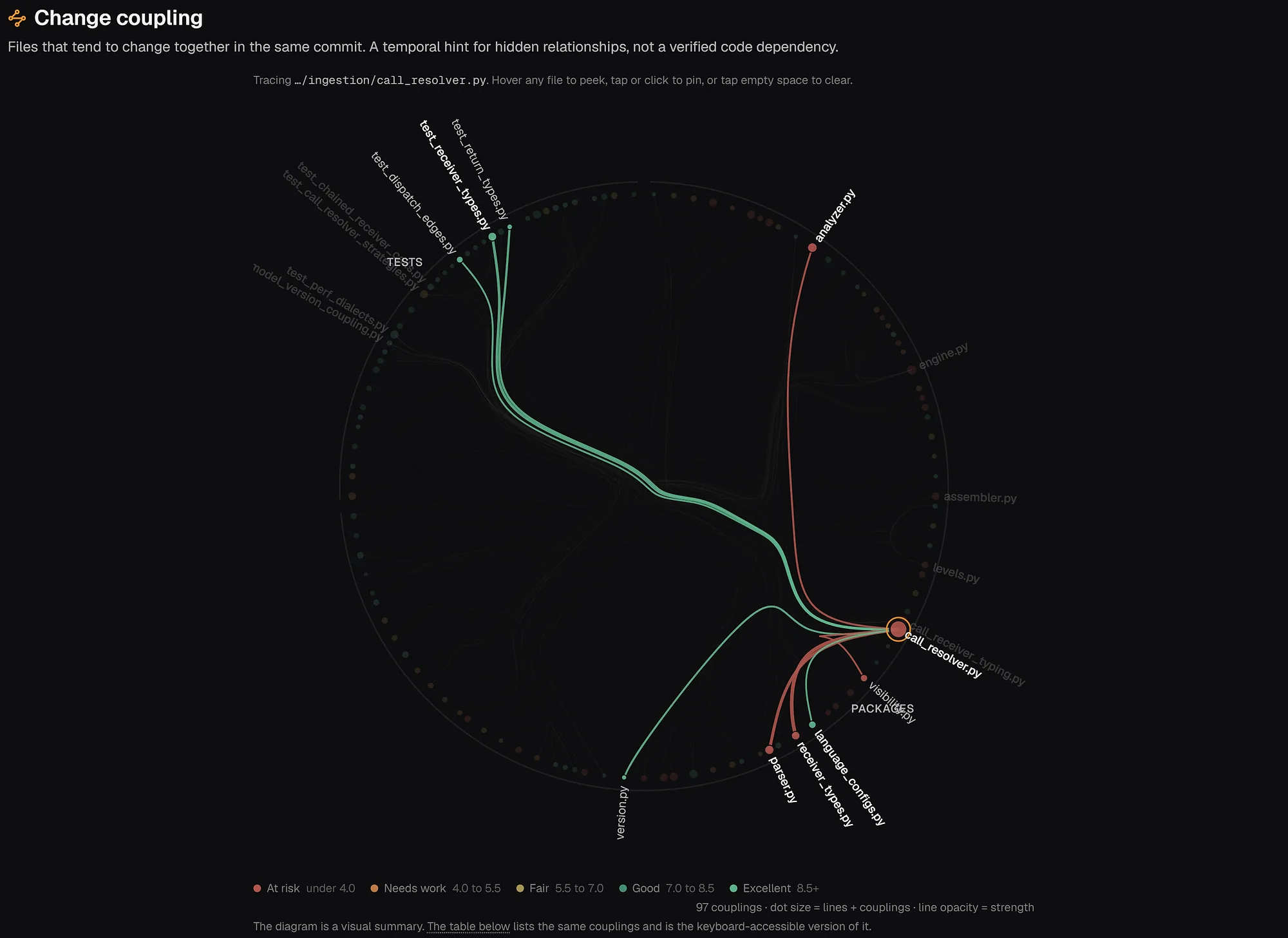
A wiki describes the tree as it is today; repowise also reads how it got there. From git log and git blame, with no model and no network, it records who owns each file and module, the bus factor behind it, which files are hotspots (complex and often changed) and which files change together with no import between them. The FastAPI ownership map shows the result on a live public index.
Code health, dead code and decisions on the same index
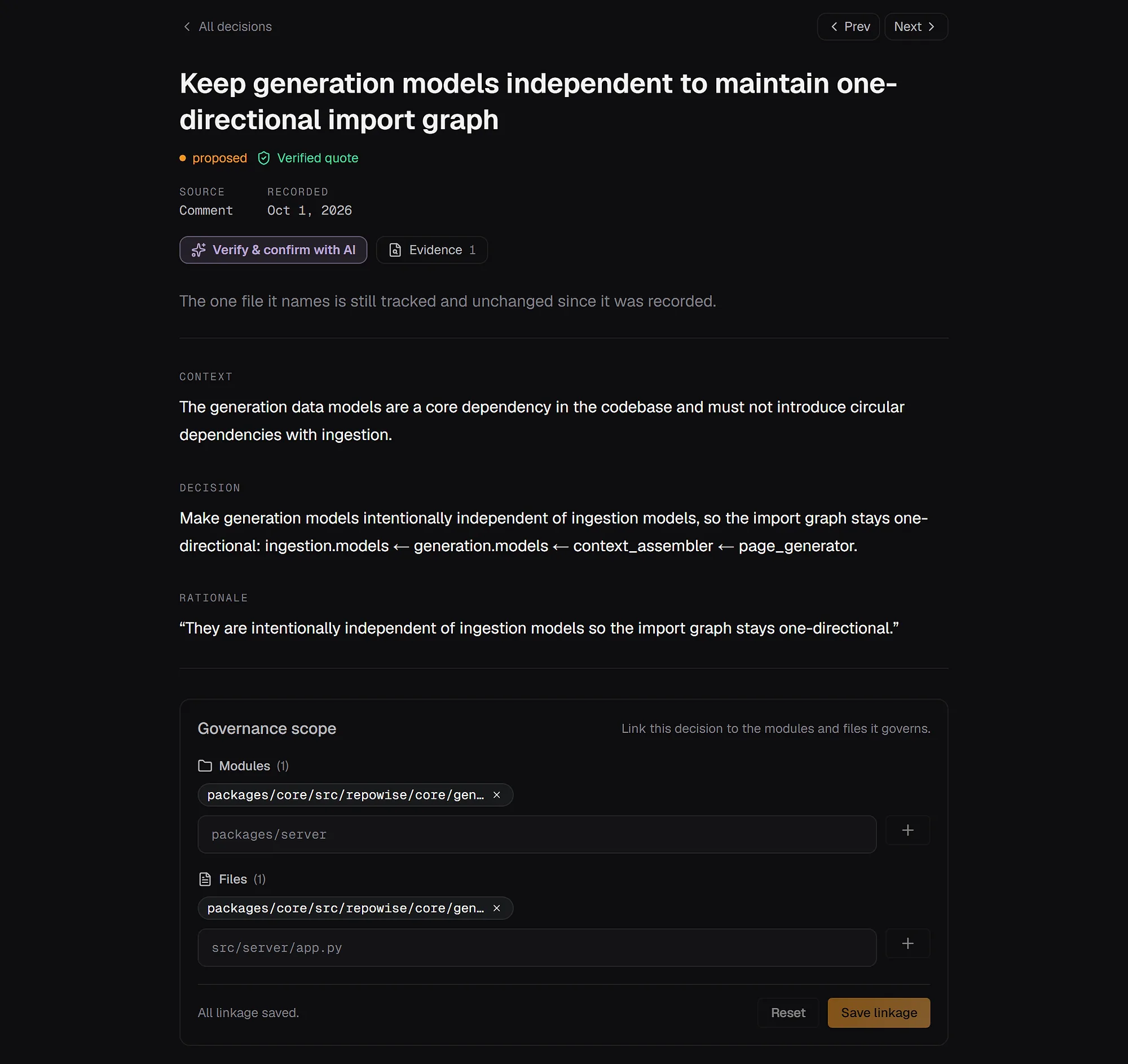
repowise scores every file from 1 to 10 for defect risk, maintainability and performance with deterministic detectors, and ranks a Fix first queue of what to change, where and which tests to run. Scored before the bug window, the defect score predicts which files get bug-fixed over the next six months with a ROC AUC of 0.74 across 21 repositories, per our published benchmarks. Dead code is reported by confidence tier, and the decisions layer ties architectural decisions from ADRs, # WHY: comments and PR history to the code they govern. The FastAPI code health page shows all of it live.
Your hand-written docs, checked against the code
Doc drift is the half of documentation a generator does not touch. On every init and update, repowise checks your own markdown against the graph: file paths that no longer exist, links to missing documents, anchors to renamed headings, commands the manifest no longer declares, and function or class names that git proves were defined when the line was written and are defined nowhere now.
Structured tools for coding agents
repowise serves the index over MCP as ten tools: get_answer, get_context, get_symbol, search_codebase, get_risk, get_change_risk, get_why, get_overview, get_health and get_dead_code. Where DeepWiki's MCP server returns wiki pages and answers, these return callers with confidence, ownership, risk, health findings and the decision behind a file, on private code, from a local process. repowise init registers the server with Claude Code; repowise mcp starts it for any other MCP host. repowise for AI agents covers what each tool returns.
Self-hosting a DeepWiki-style wiki
Cognition documents no self-hosted edition of DeepWiki. The project people find when they search for one is DeepWiki-Open by AsyncFuncAI, an independent MIT-licensed project with about 18,000 GitHub stars as of October 2026. It generates a wiki for GitHub, GitLab and Bitbucket repositories using OpenAI, Gemini, OpenRouter, Ollama and other providers, and it is a good fit when a self-hosted wiki is the whole requirement.
repowise is the self-hosted option when the wiki is one view among several: ownership, health, dead code, doc drift, decisions and MCP tools come from the same repowise init. Our guide to DeepWiki for private repositories compares every private-repo route on cost, data handling and freshness.
Which one to pick
Pick DeepWiki if:
- You want to read a public GitHub repository now, with nothing to install.
- A hosted wiki and a chat over it are the whole requirement.
- Your team already works in Devin and wants the wiki next to the agent.
Pick repowise if:
- Code, index and model calls must stay on infrastructure you control.
- You want ownership, hotspots, code health and dead code next to the docs.
- Your coding agents should call structured tools on private repositories, locally.
- Your hand-written docs should be checked against the code on every commit.
Use both if you read open-source dependencies through DeepWiki and keep your own repositories indexed in repowise. Both are MCP servers, so one agent can query the DeepWiki server for a library's docs and repowise for your code.
Try it on your repo
The fastest evaluation is the same repository in both tools. For DeepWiki, open https://deepwiki.com/<owner>/<repo>. For repowise, paste the same public URL on the repowise.dev homepage, or index it locally:
pip install repowise
repowise init --no-prose        # graph, git history, wiki, MCP registration; no API key
repowise serve                  # browse the wiki and dashboards at localhost:3000
repowise context src/auth/session.py --include ownership
repowise init parses the code, mines git history, renders the wiki and registers the MCP server with Claude Code. Drop --no-prose once a provider is configured to add model-written prose. The repowise repository has the full quickstart.
FAQ
- What is DeepWiki?
- DeepWiki is Cognition's generated wiki for GitHub repositories: pages on the architecture and modules, diagrams, links back to the source and an "Ask Devin" chat over the result. Pricing and private access are covered in the next answers.
- Does DeepWiki update when the repository changes?
- Cognition's DeepWiki docs say a wiki is generated when a repository is connected, and that you regenerate it after changing
.devin/wiki.json; they do not describe a refresh on every commit. repowise re-renders only the pages a commit touched through a post-commit hook and marks every pagefresh,stale,expiredorunknown. - Is DeepWiki free?
- DeepWiki is free for public GitHub repositories at deepwiki.com, with no account. Private repositories go through a Devin account: low effort wikis cost nothing extra, medium effort wikis about 5 to 10 ACUs and high effort about 20 to 40, per the DeepWiki docs as of October 2026.
- Does DeepWiki work with private repositories?
- Yes, through the Devin app with a Devin account, and through the authenticated Devin MCP server with an API key. The public deepwiki.com site and its free MCP server cover public repositories only. Private code is processed on Cognition's service.
- Is DeepWiki open source, and can I self-host it?
- No. DeepWiki is a hosted service from Cognition and has no documented self-hosted edition. DeepWiki-Open is an unrelated MIT-licensed project that reproduces the wiki idea, and repowise is an AGPL-3.0 engine you can self-host that adds git, health and agent tooling to the wiki.
- Does DeepWiki have an MCP server?
- Yes. The free server at
https://mcp.deepwiki.com/mcpexposesread_wiki_structure,read_wiki_contentsandask_questionfor public repositories with no authentication. Private repositories use the Devin MCP server with an API key. - What is the best DeepWiki alternative for private code?
- For a wiki alone on your own machines, DeepWiki-Open. For a wiki plus ownership, code health, dead code and MCP tools from one local index, repowise. If your team already pays for Devin, DeepWiki inside the Devin app keeps everything in one place.
- Is repowise free, and does it need an API key?
- repowise is open source under AGPL-3.0 and free to self-host, and
repowise init --no-prosebuilds the full index and wiki with no API key. On repowise.dev, the Free plan covers two of your own public repositories and ten AI answers a month; private repositories are on Pro. - Does repowise keep the wiki current?
- Yes.
repowise initinstalls a post-commit hook, so each commit runs an incrementalrepowise updatethat re-renders only the affected pages. Every page carries a freshness status offresh,stale,expiredorunknown, so a reader can see how current it is.