On this page
The best SonarQube alternative depends on which part of SonarQube you use. For rule-based security checks, pick Semgrep (free up to 10 contributors) or its open fork Opengrep. For a hosted quality dashboard on a small team, pick Qlty, Codacy or DeepSource. For history-based prioritisation (which files keep breaking), pick CodeScene or repowise.
The short list, as of October 2026:
- Semgrep and Opengrep: pattern-based security scanning, hosted or fully open.
- Snyk Code: SAST bundled with dependency and container scanning.
- Qlty: one config wrapping your linters, with coverage and maintainability checks.
- Codacy: hosted quality and security with merge gates and an AI reviewer.
- DeepSource: static analysis where findings arrive with an autofix.
- CodeScene: code health scored against git history.
- repowise: git history, health score and dependency graph, open source.
- Plain linters: the free baseline most small teams under-use.
We build repowise, so weigh our entry accordingly. The measurements we publish about it, with their methods, are on the benchmarks page.
How we evaluated
We compared each tool on what a team decides on, using only vendor pricing pages and docs fetched on 12 October 2026.
- Job: rules, security, quality trends or history-based risk. These are different jobs.
- Licence and hosting: open source, source-available or hosted only, and whether you can self-host.
- Free tier: what a small private team gets for nothing.
- Price model: per contributor, per line of code or per analysis minute, at list price.
We did not run a findings benchmark across these tools. Counting issues found mostly measures how noisy a scanner is, not how useful.
Comparison table
| Tool | Main job | Licence and hosting | Free tier | Paid from |
|---|---|---|---|---|
| SonarQube Community Build | Rules, quality gates | Self-managed, free | Free, one branch | Server editions priced by lines of code |
| SonarQube Cloud | Rules, quality gates, hosted | Hosted | Up to 50k private lines of code | Team from $34/month |
| Semgrep | Security rules (SAST, SCA, secrets) | Engine LGPL-2.1; platform hosted | Up to 10 contributors | $30/contributor/month |
| Opengrep | Security rules, fully open | LGPL-2.1; self-host | Free | Free |
| Snyk Code | SAST plus SCA, IaC, containers | Hosted | 100 Snyk Code tests/month, 5 projects | Team from $25/month (up to 10 developers) |
| Qlty | Linting, coverage, maintainability | Hosted; CLI source-available | Unlimited contributors, 1,000 analysis minutes/month | $20/contributor/month |
| Codacy | Quality and security dashboard, AI reviewer | Hosted | IDE plugin; free for open source | $18/developer/month annual |
| DeepSource | Static analysis with autofix, AI review | Hosted; self-host on Enterprise | Free for open source | $24/user/month annual |
| CodeScene | Code health and git history | Hosted or on-prem | Community edition for open source | €18/active author/month |
| repowise | Git history, health, graph, wiki | AGPL-3.0; self-host or hosted | Free hosted for public repos | Pro for private repos |
Scroll the table sideways to see every column.
Prices are list prices from each vendor's page on 12 October 2026 and change often, so confirm before you buy. I build repowise; every other tool is described the way its own pages describe it.
Why teams look for a SonarQube alternative
Three reasons come up most, and each points to a different replacement.
- The free build stops at one branch. SonarQube Community Build analyses a single branch, normally main, so findings do not appear on pull requests. Branch and pull request analysis start at the Developer edition (Sonar's edition guide) or on SonarQube Cloud.
- Upkeep. A self-hosted server needs a database, a scanner step in every pipeline and upgrades. For a five-person team that is real part-time work.
- Price tracks code size. Sonar prices Cloud and Server by analysed lines of code, so a monorepo or vendored code raises the bill without adding people.
If SonarQube already runs well for you, the case for switching is weak: its rule set is deep and its quality gate model is well understood. This list is for teams that have not adopted it yet or pay for parts they do not use.
Which job do you need?
SonarQube bundles four jobs, and most alternatives do one or two of them well.
- Rules on current code: bugs, smells, complexity, duplication.
- Security rules: injection, taint flows, secrets, vulnerable dependencies.
- A pull request gate: pass or fail before merge.
- Prioritisation: which files are getting worse, and which to fix first.
The first three need only today's code. The fourth works far better with git history, because a complex file nobody has touched in two years and a complex file changed forty times last quarter look identical to a scanner.
Semgrep and Opengrep
Semgrep is a pattern-based scanner where rules look like the code they find, which makes custom rules far easier to write than in most analysers. The platform is free for up to 10 contributors with Code and Supply Chain scanning; Teams starts at $30 per contributor per month for Code, Supply Chain or Secrets (pricing).
Opengrep is a community fork of Semgrep v1.100.0 under LGPL-2.1, backed by security vendors including Aikido and Endor Labs, created after Semgrep moved some features behind a commercial licence (repository). It keeps compatibility with Semgrep rules.
Pick it if security findings are your main SonarQube use. Choose Opengrep to self-host something nobody can relicense, Semgrep for the managed rule library and dashboard.
Snyk Code
Snyk Code is SAST sold alongside dependency, container and infrastructure scanning in one account. The free plan allows 100 Snyk Code tests a month across 5 projects; Team starts at $25 a month for up to 10 developers with 1,000 tests (plans).
Pick it if you want one vendor for code and dependency security and your test volume fits the monthly limits.
Plain linters: the free baseline
Language linters in CI cover most of what code-smell rules do, for free. Ruff or Pylint for Python, ESLint for TypeScript, PMD for Java and golangci-lint for Go, run with a fail-on-error flag, take minutes to set up. You give up the dashboard and the history of findings.
Pick it if you are under about fifteen engineers and want gates before you want dashboards.
Qlty
Qlty wraps dozens of linters and formatters behind one config and adds coverage and maintainability checks. It grew out of Code Climate Quality. Free includes unlimited contributors and repositories and 1,000 analysis minutes a month; Pro is $20 per contributor per month and adds trends, hotspots and a year of history (pricing).
Pick it if you want one tool around your linters with a pull request check, at no cost to start.
Codacy
Codacy is a hosted all-in-one: quality analysis, SAST, SCA and secrets detection, coverage and an AI reviewer. Team is $18 per developer per month annual ($21 monthly) for up to 30 developers and 100 private repositories, and free forever for open source. Business adds DAST, license scanning and custom pricing (pricing).
Pick it if you want SonarQube's breadth without running a server.
DeepSource
DeepSource pairs static analysis with an autofix for many findings. Team is $24 per user per month billed yearly with unlimited repositories and pull request reviews, and AI review is billed by lines processed beyond bundled credits. Self-hosting, bring-your-own AI keys and air-gapped deployment are on Enterprise (pricing).
Pick it if you want each finding to arrive with a proposed patch.
CodeScene
CodeScene scores code health and combines it with git history: hotspots, knowledge distribution and delivery metrics. Standard is €18 and Pro €27 per active author per month, where an author is anyone who committed in the past three months; open source projects get the community edition (pricing). We broke down what CodeScene costs at 10, 50 and 200 developers.
Pick it if you want a mature commercial tool to decide what to refactor first and can pay per author.
repowise
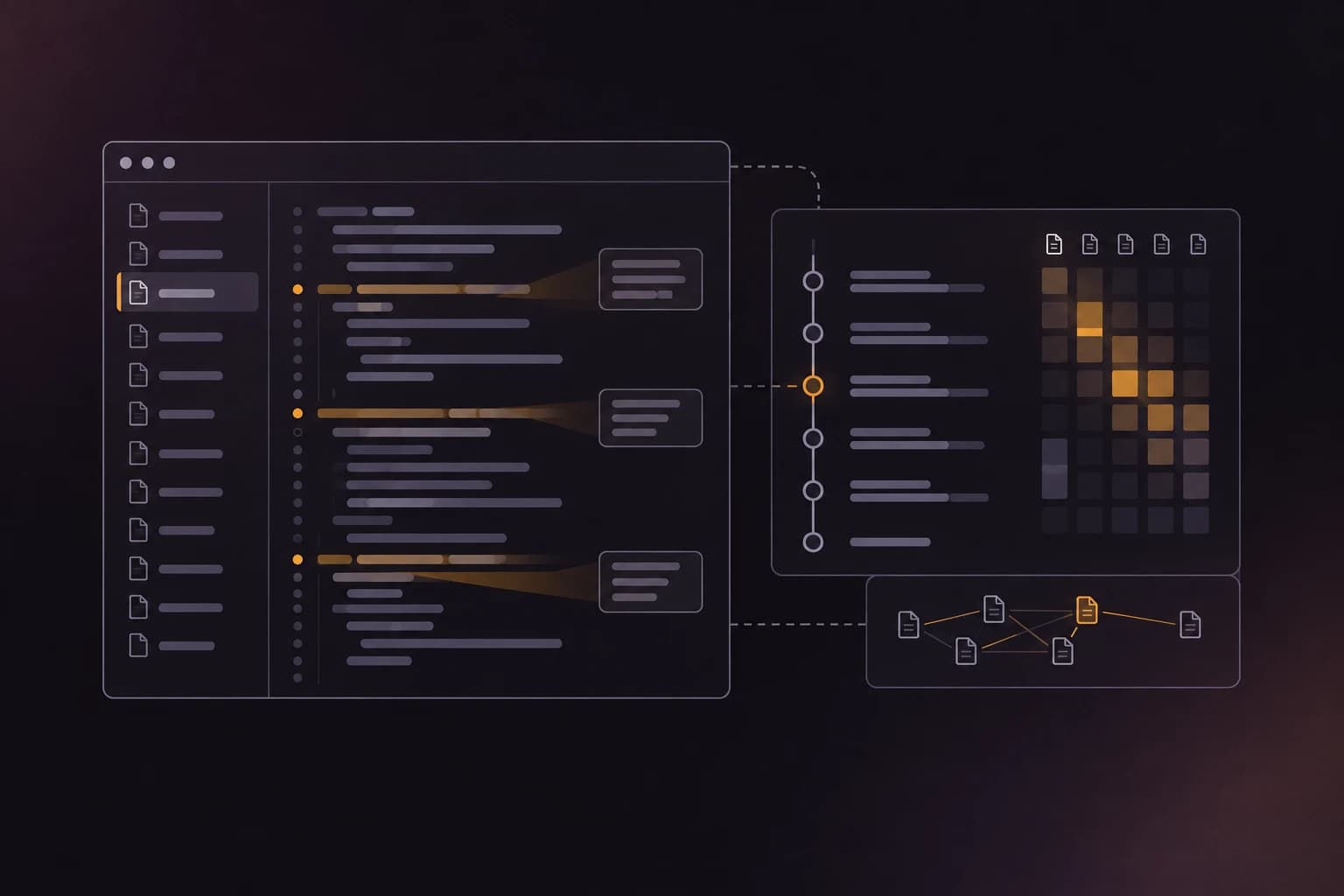
repowise adds the part a scanner cannot see: hotspots from git history, files that change together, ownership and bus factor, and a dependency graph. It scores every file from 1 to 10 on defect risk, maintainability and performance from 25 defect markers plus churn and ownership, with no model calls (code health docs).
We tested the score against six months of later bug fixes across 21 repositories (the validation study). It reached a ROC AUC of 0.74, and ranks later-fixed files +0.10 AUC above ranking by recent churn.
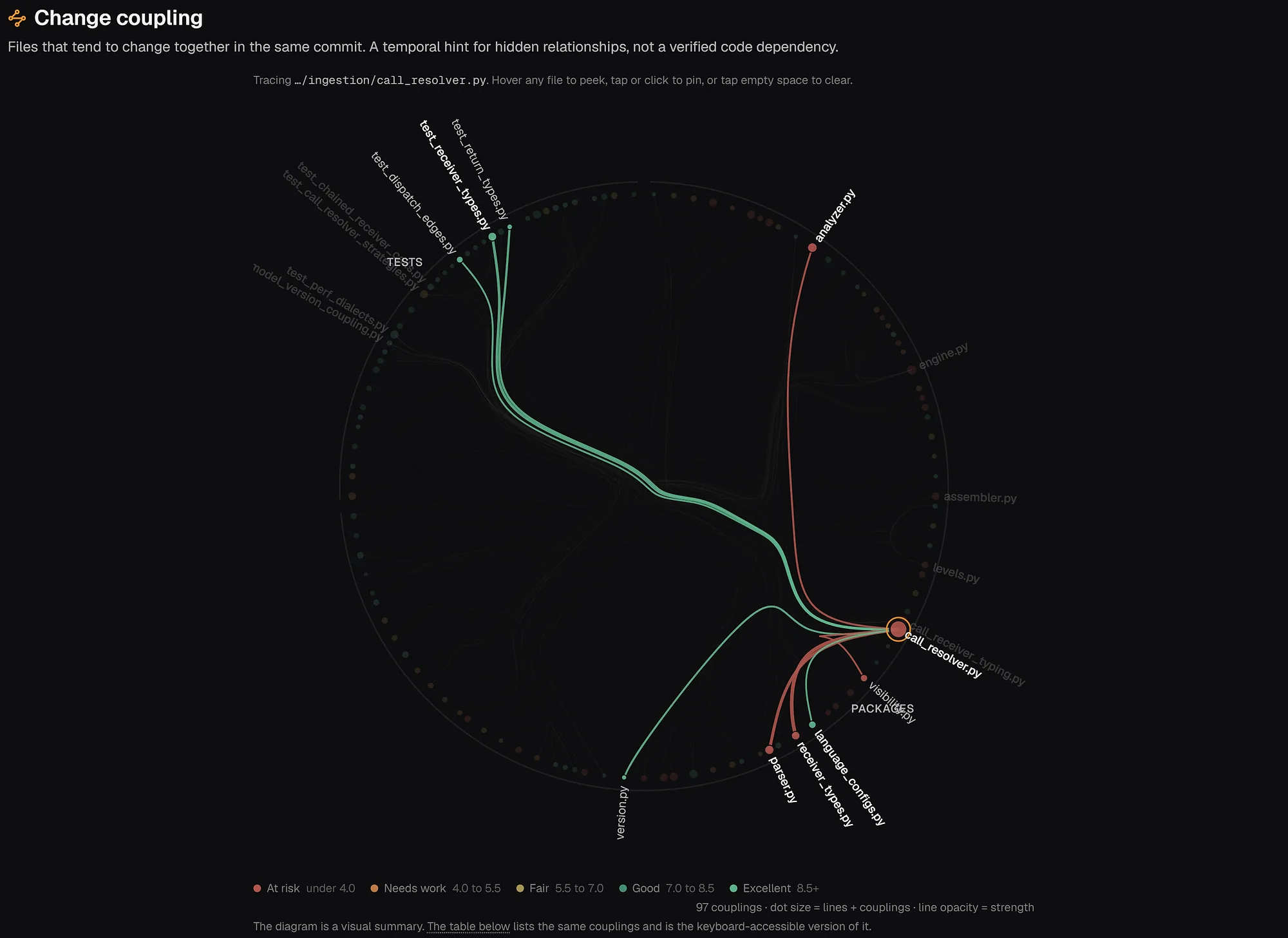
Setup is repowise init locally or a pasted GitHub URL on the hosted site, with no server and no CI step. The engine is AGPL-3.0. The PR bot comments on pull requests that touch hotspots or miss a usual co-change partner, deterministically. Coding agents get the same analysis through ten MCP tools. For security, repowise records pattern signals and scans history for leaked secrets and works beside a SAST scanner such as Semgrep.
Pick it if you already run linters and want to know where the risk is, or want CodeScene-style history analysis in an open source engine.
How to choose
For five to fifteen engineers with no SonarQube today, assemble three layers.
- Linters in CI that fail the build. Free, minutes to set up.
- Semgrep free tier (or Opengrep to self-host) for security rules.
- A history-based view to decide what to clean up: CodeScene for a mature commercial product, repowise for open source.
If you need one vendor, one dashboard and an audit trail, Codacy or SonarQube Cloud Team is less work than assembling three. If you are already in Snyk for dependencies, add Snyk Code. Run a candidate on one real repo for a week and keep the one whose findings your team acts on.
FAQ
- What is the best open source alternative to SonarQube?
- For security scanning, Opengrep (LGPL-2.1) or Semgrep Community Edition. For general quality, language linters such as Ruff, ESLint, PMD and golangci-lint in CI. For history-based prioritisation, repowise is AGPL-3.0.
- What are SonarQube's main competitors?
- Codacy, DeepSource, Qlty, Semgrep and Snyk Code compete on static analysis and security. CodeScene and repowise compete on code health and prioritisation using git history.
- Is there a free SonarQube alternative for small teams?
- Yes. Semgrep is free for up to 10 contributors, Qlty's free plan has unlimited contributors with 1,000 analysis minutes a month, and Codacy and DeepSource are free for open source. repowise is free for public repositories.
- Does SonarQube Community Build analyse pull requests?
- No. It analyses one branch, normally main. Branch and pull request analysis come with the Developer edition and above, and with SonarQube Cloud.
- How is SonarQube priced?
- By analysed lines of code. SonarQube Cloud is free up to 50,000 private lines and Team starts at $34 a month. Server editions are priced per instance annually by lines of code (Sonar pricing).
- Can I run a SonarQube alternative alongside SonarQube?
- Yes. A scanner reports rule violations in the current code; a history-based tool shows which of those files change often and break, so you know which findings to fix first.