On this page
- Codacy alternatives at a glance
- Why teams look for a Codacy alternative
- SonarQube: the closest like-for-like swap
- DeepSource: hosted analysis with AI review
- Qlty: maintainability and coverage, generous free tier
- Semgrep: when security is the part you need
- CodeScene: technical debt from code and history
- repowise: open source technical debt prioritisation
- Which Codacy alternative should you choose?
- How we checked
- FAQ
The best Codacy alternative depends on which part of Codacy you use. For pull request quality gates and a dashboard, the closest swaps are SonarQube Cloud, DeepSource and Qlty. For security scanning, Semgrep. For technical debt, meaning which code to fix first, pick a tool that reads git history: CodeScene, or repowise if you want it open source and deterministic.
Codacy's own positioning has moved. Its homepage leads with "Code Quality & Security for AI-Assisted Engineering", names its products AI Guardrails, AI Reviewer and AI Risk Hub, and does not use the words "technical debt"; its metrics page lists only issues, complexity, duplication and coverage. We build repowise, one of the six tools below.
We build repowise, so weigh our entry accordingly. The measurements we publish about it, with their methods, are on the benchmarks page.
Codacy alternatives at a glance
Prices and plans as listed on each vendor's pricing page on October 29, 2026.
| Tool | Best replacement for | Entry paid price | Free option | Self-hosted | Reads git history for debt |
|---|---|---|---|---|---|
| Codacy | (baseline) | Team: $18/dev/month annual, $21 monthly; up to 30 devs | Developer (IDE) plan; Team free for open source | Separate Self-hosted product | No |
| SonarQube | Quality gates, broad rule set | Cloud Team from $34/month for 100k LOC | Cloud Free up to 50k LOC; Server Community Build | Yes (Server) | Not documented |
| DeepSource | Hosted analysis plus AI review and autofix | Team: $24/user/month annual | Free for open source | Enterprise | Not documented |
| Qlty | Maintainability, duplication, coverage | Pro: $20/contributor/month | Free: unlimited contributors and repos, 1,000 analysis minutes | CLI runs locally | Hotspots on paid plans; method not stated |
| Semgrep | SAST, supply chain, secrets | Teams: Code $30/contributor/month | Free up to 10 contributors | Engine is open source | Not documented |
| CodeScene | Technical debt prioritisation | Standard: €18/active author/month annual | Free for open source | Yes, every plan | Yes |
| repowise | Technical debt prioritisation, agents | Hosted Pro for private repos (pricing) | Open source CLI; hosted public repos free | Yes, AGPL-3.0 | Yes |
Scroll the table sideways to see every column.
Why teams look for a Codacy alternative
Codacy fits a team of up to 30 developers on cloud Git that wants quality, security, coverage and AI review on one bill, with a free IDE plan and a free Team plan for open source. Four limits show up on Codacy's own pricing and docs pages:
- The Team plan stops at 30 developers and 100 private repositories. Past that, the Business plan is quote-only, so a growing team moves from a public price to a sales call.
- Hosting. Codacy Cloud supports GitHub, GitLab and Bitbucket in their cloud versions; its pricing FAQ says it does not support on-premise Git. A separate Codacy Self-hosted product still ships (v16.0.0 in January 2026), sold through sales.
- Per-developer pricing on everything. Teams that only want security scanning, or only want coverage gates, pay for the bundle.
- The grade does not answer "where do we start?" Codacy grades code A to F as a weighted average of issues, complexity, duplication and coverage (Codacy docs). It does not know which complex file changes every week and which has not been touched since 2021, and that is the question a technical debt budget turns on.
SonarQube: the closest like-for-like swap
SonarQube covers the same ground as Codacy's quality side. It comes as SonarQube Cloud, priced by lines of code, and SonarQube Server, which you run yourself.
SonarQube Cloud's Free plan analyses private projects up to 50,000 lines of code, and Team starts at $34 a month for up to 100,000 lines and is aimed at teams under 50 developers. SonarQube Server's Community Build is free and open source; the paid Developer, Enterprise and Data Center editions are priced per instance per year by lines of code, through sales. The Developer edition is the one that shows quality gate status on pull requests.
Pricing by code size instead of by seat is the practical difference. Codacy Team for 30 developers is $540 a month, $6,480 a year at the annual rate. SonarQube Cloud Team starts at $34 a month for up to 100,000 lines whatever the headcount, though it is aimed at teams under 50 developers and a larger codebase moves up the price table.
Pick SonarQube if you want quality gates on new code, pricing by code size, and the option to self-host on your own Git server. Our SonarQube alternatives post covers the reverse move.
DeepSource: hosted analysis with AI review
DeepSource overlaps Codacy most on features: static analysis, SAST, IaC and coverage on every tier, with AI review and autofix on top. Team costs $24 per user per month billed yearly, with unlimited repositories and a $100 annual credit per user for AI review and autofix. Open source projects get a free plan with 1,000 reviewed pull requests a month. Self-hosted deployment is an Enterprise feature.
Pick DeepSource if you like Codacy's model of one hosted tool for quality, security and AI review, and want an AI review credit included in the seat price.
Qlty: maintainability and coverage, generous free tier
Qlty is the spin-out of Code Climate Quality, and its free plan has no contributor or repository cap, with 1,000 analysis minutes a month. It reports maintainability, duplication, complexity and coverage, and includes linting. Pro is $20 per contributor per month and adds trends; Enterprise is $30, and the pricing page lists hotspots on the paid plans.
The CLI runs locally, but it is not open source: it is under the Business Source License 1.1, which converts to GPL-3.0 on December 10, 2028, and its use grant forbids using it for a competing code quality service.
Pick Qlty if you mainly used Codacy for maintainability grades and coverage gates, and a free tier with no seat cap matters.
Semgrep: when security is the part you need
If you kept Codacy for SAST, SCA and secrets, a dedicated security scanner is the more direct replacement. Semgrep's Free edition covers up to 10 contributors and 10 private repositories. On Teams, Semgrep Code is $30 per contributor per month, Supply Chain another $30 and Secrets $15. The scanning engine (Semgrep Community Edition) is open source under LGPL-2.1.
Semgrep does not grade maintainability or track debt, so pair it with one of the quality or debt tools in this list if you need those.
Pick Semgrep if security findings are what you act on and the quality grade is not.
CodeScene: technical debt from code and history
CodeScene scores files for Code Health and combines that with change frequency to find hotspots, so a messy file people edit every week ranks above a messy file nobody touches. Its Standard plan includes technical debt management with hotspots and refactoring targets, pull request quality gates, a Code Health MCP server and 30+ languages.
Standard is €18 and Pro €27 per active author per month on yearly billing, where an active author is anyone who committed in the last three months. Every plan can run in CodeScene's cloud or on your own servers, and a Community Edition is free for open source.
Pick CodeScene if you want a mature, commercial technical debt product with on-premises deployment and team-level reporting. repowise vs CodeScene compares the two in detail.
repowise: open source technical debt prioritisation
repowise scores every source file from 1 to 10 from deterministic markers in the code and its git history, and turns the result into a short "Fix first" list. It needs no LLM key, runs locally with repowise init, and is open source under AGPL-3.0. Across our published study of 21 repositories in 9 languages, the score reached ROC AUC 0.74 at predicting which files get bug fixes in the following six months.
To show what that looks like on a codebase we did not write, we ran it on the Excalidraw monorepo (commit e7b5346, October 28, 2026):
uv tool install repowise
repowise init
repowise health
Fix first (3 of 84 eligible items, 35 due; 302 in the inventory, tests, tooling and history-only files left out)
...
    packages/excalidraw/wysiwyg/textWysiwyg.tsx:250
    textWysiwyg has many paths; easier to read and change once split; function changed in 91 commits;
    its file is imported by 2 files, changed 12 times in 90 days.
...
Does the score find the bugs? 18/20 lowest-health files had a bug fix in the last 6 months, 5.97x the 15% baseline (90% vs 15%).
The first item on the list is to break up textWysiwyg (cyclomatic complexity 142, 830 lines), rated effort M. The headline scores were 6.27 out of 10 for the repository (Fair), 4.9 for production code and 3.82 for hotspots.
The last line of that output is a check repowise runs against the repository's own history on every run. Indexing Excalidraw took 160 seconds.
For CI, repowise health check origin/main...HEAD fails a pull request only when the change itself adds complex, deeply nested, oversized or duplicated code, and it reads its rules from the base branch so a pull request cannot loosen its own gate (CI docs). The same findings reach coding agents through get_health, one of repowise's ten MCP tools.
Pick repowise if technical debt is the reason you are leaving Codacy and you want the scoring open and reproducible on your own history. Pair it with Semgrep or SonarQube if you also need a broad SAST rule set.
Which Codacy alternative should you choose?
- You want the same thing, cheaper or bigger: SonarQube Cloud if pricing by code size suits you, Qlty if you want a free tier with no seat cap, DeepSource if you want AI review in the same tool.
- You need it on your own Git server: SonarQube Server, CodeScene, DeepSource Enterprise or repowise, all of which run on your infrastructure. Codacy Self-hosted is also an option through its sales team.
- Security is what you use: Semgrep, and keep a lighter quality tool alongside it.
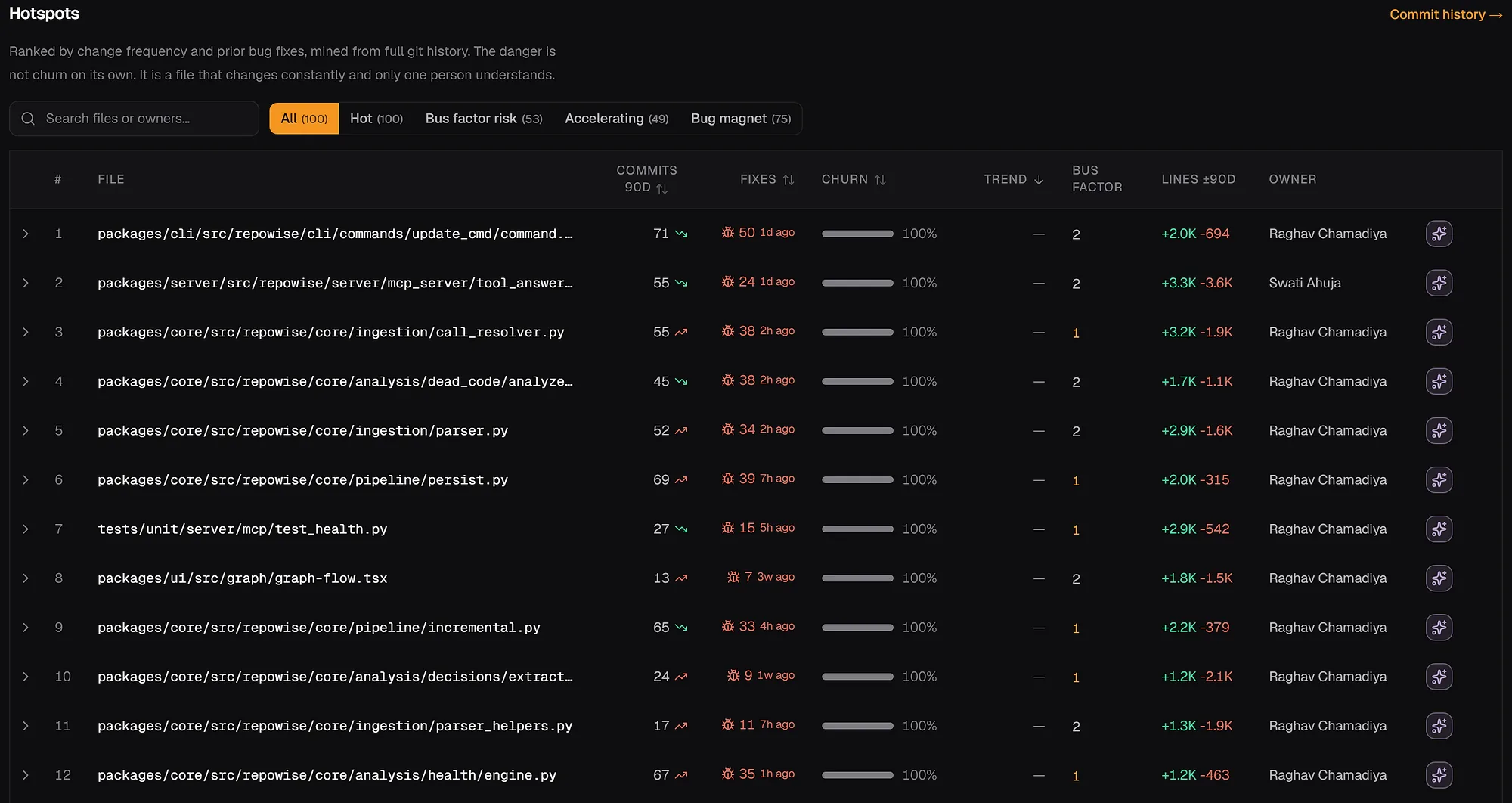
- You are tracking technical debt: CodeScene or repowise, which both weigh a file by how often it changes.
- You need both gates and prioritisation: a quality gate (SonarQube, Qlty or DeepSource) blocks new violations, and a history-aware score ranks the code you already have. The two lists answer different questions, so running both is normal.
If you want the deeper story on how each vendor turns code into a debt number, technical debt measurement tools compared breaks down debt ratios, letter grades and health scores, and which have evidence behind them.
How we checked
Every price and plan detail comes from the vendor's own pricing page or documentation, read on October 29, 2026; follow the links in the table for the current numbers. We did not run Codacy, SonarQube, DeepSource, Qlty, CodeScene or Semgrep on a shared repository, so this post compares what each product offers and how it measures, not the accuracy of its findings. The repowise output above is from repowise 0.59.0 on excalidraw/excalidraw at commit e7b534668a60add7f725531f3c9abf32508c7b4e, run on October 29, 2026; the 21-repository figure comes from our published code health study.
FAQ
- What are the best alternatives to Codacy?
- SonarQube, DeepSource and Qlty for quality gates and a dashboard, Semgrep for security scanning, and CodeScene or repowise for technical debt.
- What are good Codacy alternatives for tracking technical debt?
- CodeScene and repowise. CodeScene combines Code Health with change frequency to find hotspots; repowise scores each file 1 to 10 from code and history markers and checks the ranking against past bug fixes. The technical debt measurement comparison explains how each score is built.
- How much does Codacy cost in 2026?
- As of October 2026, the Developer plan for individuals is free, Team is $18 per developer per month billed yearly ($21 monthly) for up to 30 developers and 100 private repositories, and Business is priced by quote. Open source projects get Team free.
- Is there a free, open source alternative to Codacy?
- SonarQube Server Community Build and Semgrep Community Edition are open source and free to self-host, covering quality rules and security rules respectively. repowise is open source under AGPL-3.0 for code health, technical debt and dead code. Qlty's free hosted plan has no contributor or repository cap, though its CLI is source-available, not open source.
- Codacy vs SonarQube: which should I use?
- SonarQube if you want a self-hosted server or pricing by lines of code. Codacy if you want one hosted bill covering quality, security, coverage and AI review for a team under 30 developers.
- Can Codacy run on-premises?
- Codacy Cloud only connects to cloud-hosted GitHub, GitLab and Bitbucket. Codacy sells a separate Self-hosted product, with release notes listing v16.0.0 in January 2026, through its sales team.