repowiserepowise
Features
Code health
A defect-validated 1 to 10 score per file. Zero LLM.
Agent provenance
See how much of your code AI wrote, and whether it is healthy.
AI context (MCP)
Ten MCP tools that give your agent real codebase context.
Change risk
A 0 to 10 defect-risk score for any commit or PR.
Security
Reachability-aware CVE triage on your dependency graph.
Auto wiki
A documented wiki of your codebase that rebuilds itself.
Git intelligence
Hotspots, ownership, hidden coupling, and bus factor.
Architecture (C4)
C4 system context, containers, and components.
Decisions
Architectural decisions mined from eight sources.
Solutions
developers
Give Claude Code, Cursor, and any MCP client a queryable model of your repo.
teams
One shared index, one credit pool, one org install. The whole team on the same brain.
team leads
Flag the risky PRs, the hotspots, and the hidden coupling, on every pull request.
engineering leaders
See how much of your code AI wrote, whether it is healthy, and who owns it.
security
CVE triage that knows whether you actually call the vulnerable code.
enterprise
Self-hosted, air-gapped, and commercially licensed for the whole org.
Book a demo →
Guides
Code healthAI context & MCPGit intelligenceChange riskArchitectureAuto-wikiDecisions & ADRsAgent provenanceSecurityAll guides →
Compare
vs CodeScenevs DeepWikivs Sourcegraphvs Cursorvs GitClearvs SonarQubeAll comparisons →
PricingExploreBlogDocs
Star—Sign in
Start free
  1. Home
  2. Blog
  3. Engineering
BLOG / ENGINEERING

Engineering

Technical deep dives into dependency graphs, semantic search, and architecture

Index your repo freeAll posts
AllComparisonsGuidesMCP & AI AgentsEngineeringUse CasesConceptsIndustryAI Coding
engineering8 min read

35x or 16%? we published both, and they measure different things

The same tool on the same codebase gives 35.6x fewer tokens on one measurement and 15.9% on another. Both are correct, and they measure different things.

2026-08-06Read →
engineering7 min read

a tool that did nothing came out 43% cheaper than the bare agent

A tool that never called its own server measured 43% cheaper than a bare agent. Prompt caching explains it, and it shows why dollar-cost benchmarks mislead.

2026-08-06Read →
engineering12 min read

how to benchmark a codebase tool so the number survives a rerun

JetBrains reran two token-saving claims and both collapsed. Here is the eight-part methodology we used to build a benchmark that survives an independent rerun.

2026-08-06Read →
engineering10 min read

we benchmarked ourselves against four open source tools and came last

We ran a sealed retrieval benchmark against four open source tools, scored last at 0.228, published it, found the bug, fixed it, and reran the sealed half once.
2026-08-06Read →
engineering11 min read

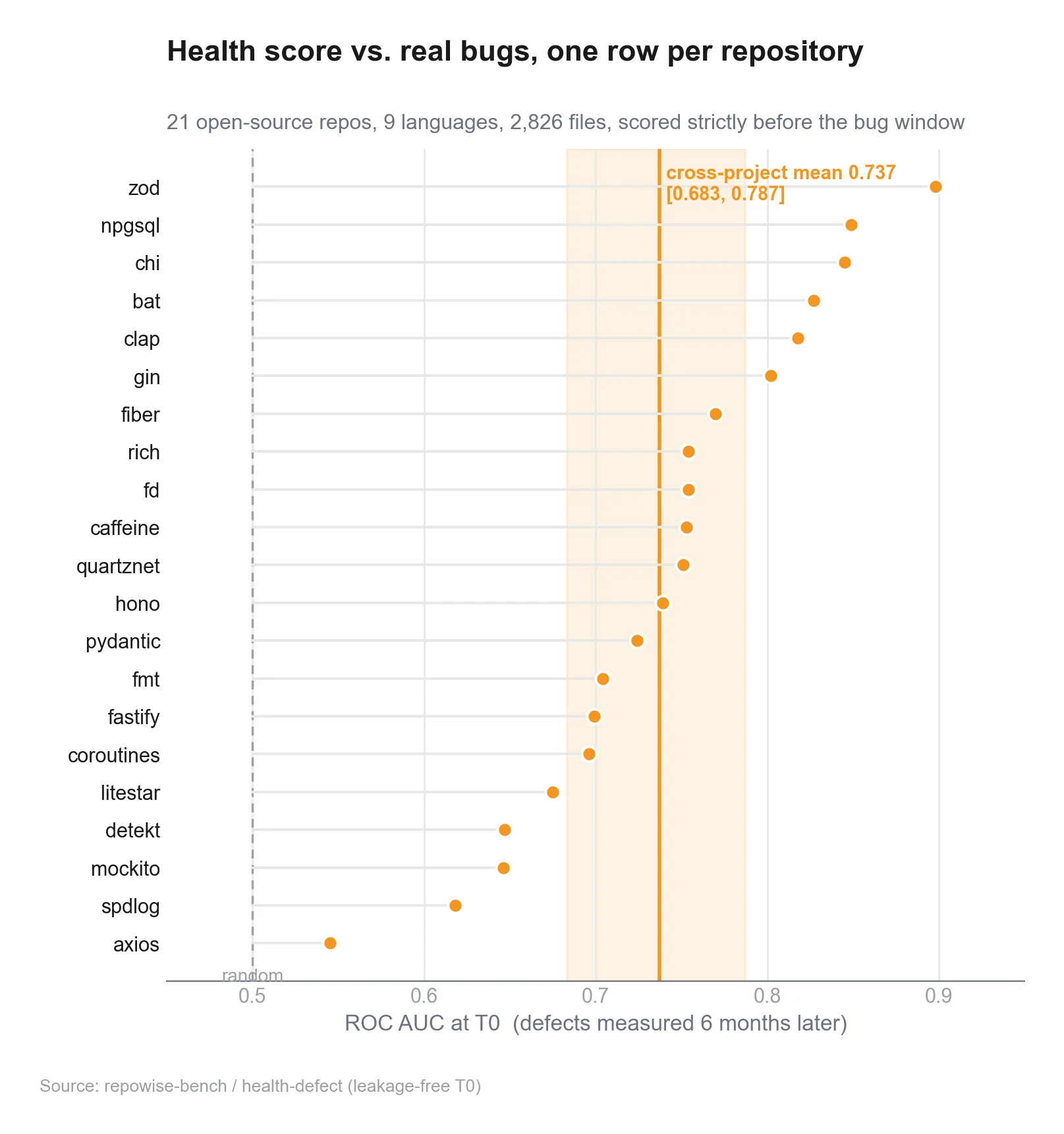
Does Code Health Predict Bugs? 21 Repos, 9 Languages, ROC AUC 0.74

A reproducible defect-prediction study: 21 repos, 9 languages, 2,770 labeled files, ROC AUC 0.74, and 2.3x more defects caught under a fixed review budget.
2026-06-26Read →
Is AI-written code buggier than human code? We blamed 112,000 commits to find out
engineering11 min read

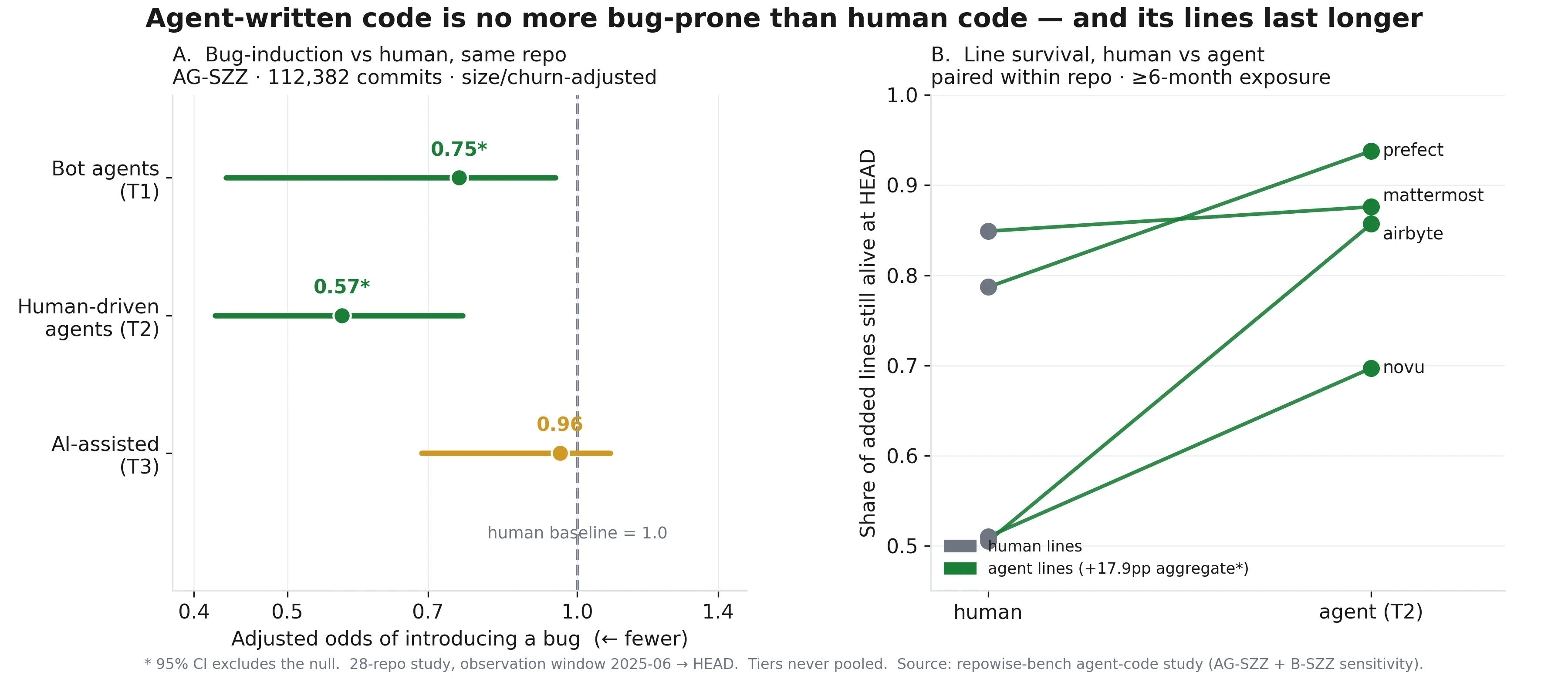
Is AI-written code buggier than human code? We blamed 112,000 commits to find out

We git-blamed 112,382 commits across 28 repos to test if AI-agent code is buggier than human code. Controlled for size, it isn't, and its lines last longer.
2026-06-09Read →
Does our code-health score actually predict bugs? A leakage-free benchmark
engineering14 min read

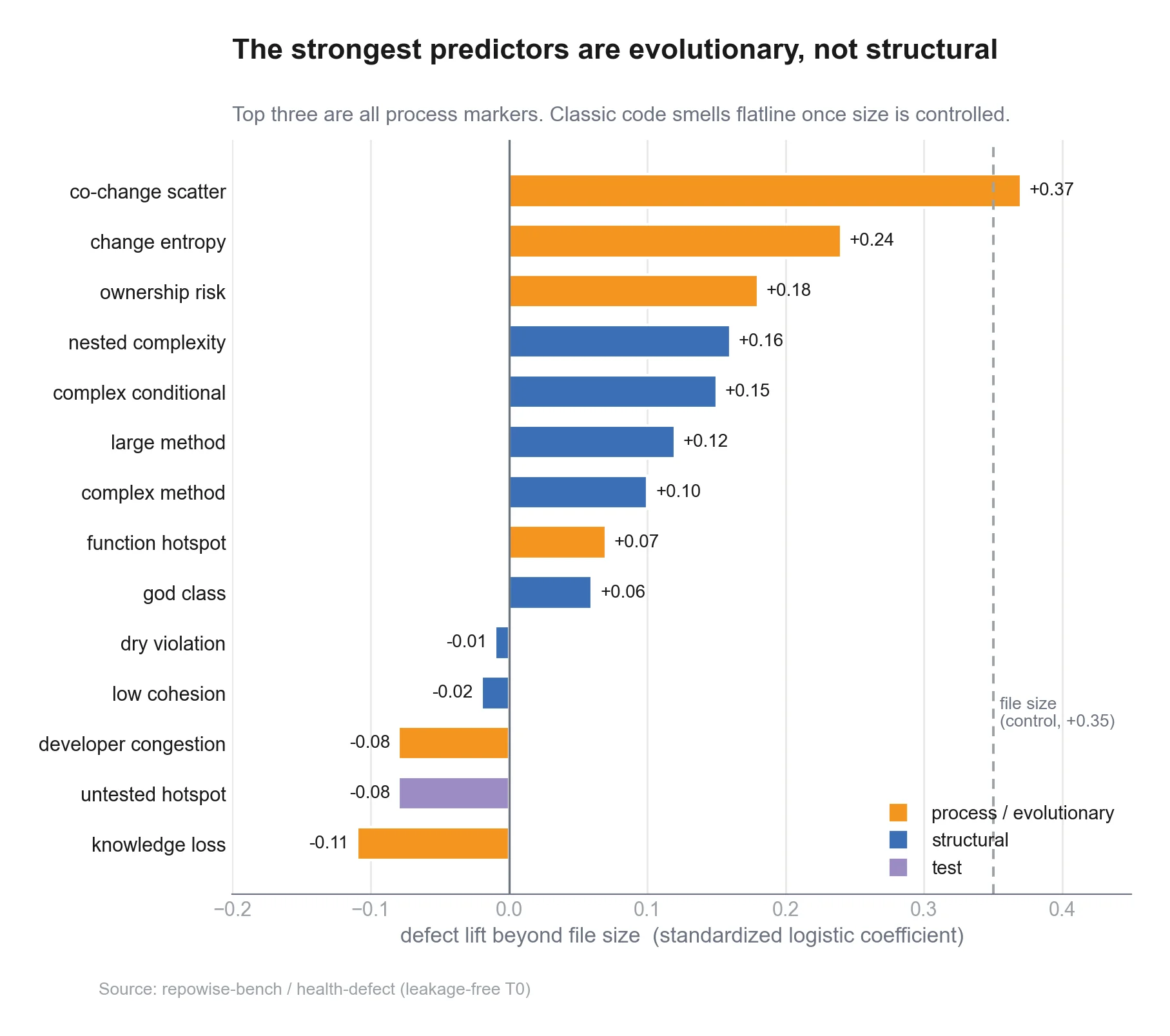
Does our code-health score actually predict bugs? A leakage-free benchmark

I scored 21 repos six months before their bugs landed to test whether a deterministic code-health score predicts defects. AUC 0.737, and the honest caveats.

2026-06-03Read →
Process metrics beat structural metrics for predicting defects
engineering12 min read

Process metrics beat structural metrics for predicting defects

Complexity and code smells get attention. Across 21 defect-risk markers and 21 repos, the strongest predictors were evolutionary, not structural, size controlled.

2026-06-03Read →
engineering15 min read

How a 21-Marker Code Health Scorer Actually Works

A code health scorer works because one number is only useful if it is built from signals that map to real maintenance cost. A file can look clean and still…

2026-05-20Read →
engineering13 min read

Building a Deterministic PR Review Bot With Zero LLM Calls

A deterministic PR review bot can do useful review work without calling an LLM once. That sounds odd until you break “review” into smaller jobs: parse the…
2026-05-20Read →
Why vector-only retrieval misses co-change clusters in monorepos
engineering9 min read

Why vector-only retrieval misses co-change clusters in monorepos

Co-change analysis git shows which files move together, who owns them, and what breaks next. See why vector-only retrieval misses refactor signals.
2026-05-19Read →
Our git co-change model failed on a monorepo refactor
engineering10 min read

Our git co-change model failed on a monorepo refactor

Why co-change analysis git overfit a monorepo refactor, and the guardrails we added after 500 commits of history pointed at the wrong coupling.
2026-05-17Read →
The dead-code detector we shipped with Pagerank and git history
engineering11 min read

The dead-code detector we shipped with Pagerank and git history

Code hotspot detection as ranking, not a linter: Pagerank plus git history sorted quiet files from risky ones, so you can ignore the right 3.

2026-05-08Read →
engineering10 min read

Architectural Decision Records: Capture Why Your Code Is the Way It Is

Every seasoned engineer has experienced the 'archaeology phase' of a project. You’re looking at a specific abstraction, perhaps a custom implementation of a m...

2026-04-01Read →
engineering10 min read

Building a Dependency Graph for Any Codebase (Python, TS, Go, Rust, Java)

Every software engineer has experienced the 'wall of code' phenomenon. You join a new project, clone the repository, and find yourself staring at 100,000 lin...

2026-04-01Read →
engineering9 min read

How We Built repowise: Architecture of a Codebase Intelligence Platform

Most software engineers spend upwards of 70% of their time reading code rather than writing it. Yet, the tools we use to navigate these complex systems have ...

2026-04-01Read →
engineering9 min read

Self-Hosting a Codebase Intelligence Platform with Docker

As engineering teams scale, the primary bottleneck isn't usually writing code, it's understanding it. Between technical debt, architectural drift, and the 'bu...

2026-04-01Read →
engineering10 min read

Semantic Search Over Your Codebase: LanceDB + pgvector in Practice

Every developer has experienced the 'grep fatigue.' You’re navigating a 100k+ LOC codebase, trying to find where a specific business logic, say, the grace per...

2026-04-01Read →

Index your repo free

Index your repo freeRead the docs
repowiserepowise

Codebase intelligence for AI agents. Open source under AGPL-3.0, hosted SaaS for teams.

Features
  • Code health
  • Agent provenance
  • AI context (MCP)
  • Change risk
  • Security
  • Auto wiki
  • Git intelligence
  • Architecture (C4)
  • Decisions
Solutions
  • For developers
  • For teams
  • For team leads
  • For engineering leaders
  • For security
  • For enterprise
Compare
  • vs CodeScene
  • vs DeepWiki
  • vs Sourcegraph
  • vs Cursor
  • vs GitClear
  • vs SonarQube
  • vs Snyk Code
  • vs Codacy
  • vs Code Climate / qlty
  • vs Qodo
  • vs Greptile
  • vs Swimm
  • vs CodeRabbit
  • vs CodeGraph
  • vs Graphify
  • vs Serena
  • vs code-review-graph
  • All comparisons
Guides
  • Code health
  • AI context & MCP
  • Git intelligence
  • Change risk
  • Architecture
  • Auto-wiki
  • Decisions & ADRs
  • Agent provenance
  • Security
  • All guides
Product
  • Pricing
  • PR Bot
  • Browse indexed repos
  • Health leaderboard
  • Book a demo
Resources
  • GitHub
  • Docs
  • Benchmarks
  • Blog
  • Discord
About
  • Founder
  • Architecture
  • Contact
Legal
  • Privacy
  • Terms
  • Security
© 2026 repowise. AGPL-3.0.hello@repowise.dev
Featured on Aura++