On this page
- How much does AI code review cost for agent-generated PRs?
- What happens to seat pricing at agent volume?
- What do seat plus credit plans cost with agents?
- What does per-run billing cost? Cursor Bugbot
- What does token-billed deep review cost? Claude Code Review
- What did reviewing every agent PR actually cost us?
- Per-seat or per-review pricing: which fits agents?
- How should you review agent-generated PRs without a runaway bill?
- How we checked
- FAQ
AI code review costs from a few cents to about $25 per pull request, and agent volume decides which end you land on. At 1,000 agent PRs a month and 1.6 review passes per PR, that is 1,600 reviews: 1,000 PRs at about 20 to 35 cents each on repowise credits, roughly $1,600 to $2,400 at Cursor Bugbot's average run price, and $24,000 to $40,000 at Anthropic's reported average for Claude Code Review. Seat plans sit in between and depend on how many seats you buy and how fast the agents push.
Seat pricing was built for a developer who opens about ten pull requests a month. A coding agent can open that many before lunch, and it pushes follow-up commits to each one. This post prices five billing models at that volume, using each vendor's own pricing and docs checked on 15 October 2026, and adds our own measured numbers from a week when coding agents drove most of a release.
We build repowise, so weigh our entry accordingly. The measurements we publish about it, with their methods, are on the benchmarks page.
How much does AI code review cost for agent-generated PRs?
The cost is the number of review passes times the price of one pass. A pass is one review run on one push. With humans, passes per month track headcount. With agents, they track how many tasks you hand out, and each task can open a PR and push to it more than once.
We use 1,000 PRs a month and 1.6 passes per PR, the ratio we measured on a busy repository (below). That is 1,600 passes. The table prices the same month under each model. Where a vendor charges per seat, we assume a team of 10 human seats that own the agents, because a seat plan has to be bought for someone.
| Tool | How it charges (checked 15 Oct 2026) | Cost for 1,600 passes a month |
|---|---|---|
| repowise Full AI review | Pay-as-you-go credits per pass; no per-seat review fee; per-repo spend limit | 1,000 PRs at about 20 to 35 cents each, re-reviews included |
| CodeRabbit Essentials | $24 a seat annual, $30 monthly; 5 reviews an hour per developer; past that, usage at $0.25 per reviewed file | $240 to $300 for 10 seats, plus overage if agents burst past the hourly allowance |
| Greptile Pro | $30 a seat with 50 credits a seat; $1 per extra credit; base review 1 credit, Plus 3, Apex 10 | $300 seats + $1,100 overage = about $1,400 at base depth; about $4,600 at Plus depth |
| GitHub Copilot Business | $19 a seat with 1,900 AI credits a user; each review spends AI credits and Actions minutes | $190 in seats, plus about $400 to $8,000 of AI credits at GitHub's $0.25 to $5 Balanced (default) estimate, or $80 to $1,600 at Lite, plus Actions minutes |
| Cursor Bugbot | Usage-based; average run $1.00 to $1.50 | About $1,600 to $2,400 if every push runs; $1,000 to $1,500 if limited to one run per PR |
| Claude Code Review | Token-billed; average $15 to $25 a review | $24,000 to $40,000 reviewing every push; $15,000 to $25,000 once per PR |
Scroll the table sideways to see every column.
These are list prices and vendor averages, not a benchmark of the same pull requests. The point of the table is the shape of each bill as volume rises.
What happens to seat pricing at agent volume?
Seat pricing stays flat while volume rises, which favors the buyer until a hidden limit appears. CodeRabbit Essentials costs $24 per developer a month on annual billing and, per its pricing page, has no total limit on pull requests or repositories. The limit is an hourly allowance per developer: 5 reviews an hour on Essentials, 8 on Team, 10 on Advanced and 12 on Enterprise. Reviews past it can continue as usage-based reviews at $0.25 per reviewed file when an admin turns that on and sets a monthly cap.
For 1,600 passes a month, the average is only about 2 an hour, so 10 seats are comfortably inside the allowance on paper. The risk is burst: an agent fleet that finishes a batch of tasks at once can push dozens of PRs inside an hour. That is when the allowance, or the overage rate, matters more than the seat price.
Greptile is a seat that includes credits. Pro is $30 a seat a month with 50 credits included per seat and $1 per additional credit. A base review is 1 credit, Plus is 3 and Apex is 10. Ten seats include 500 credits, so 1,600 base passes use 1,100 overage credits: $300 plus $1,100. At base depth, Greptile is $0.88 a pass all in at this volume, and the review depth you choose moves the bill more than the seat count does.
What do seat plus credit plans cost with agents?
GitHub Copilot is the clearest seat-plus-credits case. Copilot Business is $19 per granted seat a month with 1,900 AI credits per user, and a credit is worth $0.01. The Copilot code review docs say a review has two cost components: AI credits for the model, and GitHub Actions minutes for the agentic work of gathering context and using tools. GitHub's estimate is $0.25 to $5 of AI credits per review on the default Balanced setting and $0.05 to $1 on Lite, not counting Actions minutes. Self-hosted runners do not use Actions minutes.
Priced at that range, 1,600 reviews are about $400 to $8,000 of AI credits on Balanced, or $80 to $1,600 on Lite. The seats' own credits also cover chat, agents and the CLI, so agent-volume review competes with everything else the allowance pays for. Watch the credit meter in the first week of agent volume.
What does per-run billing cost? Cursor Bugbot
Per-run billing prices each push. In its May 2026 Bugbot update, Cursor says the average Bugbot run costs $1.00 to $1.50, depending on PR size and complexity, and that it is removing seat fees for Bugbot in favor of purely usage-based billing. Users can also set how hard Bugbot works, with deeper reviews that Cursor says find 35% more bugs.
The unit is the run, so cost follows pushes. At 1,600 runs, Bugbot is about $1,600 to $2,400 a month. If a team limits Bugbot to one run per PR, 1,000 runs cost about $1,000 to $1,500. We could not find a Bugbot rate on Cursor's pricing page or docs beyond that average, so we use the blog's figure as published.
What does token-billed deep review cost? Claude Code Review
Token-billed review prices depth. Anthropic's Claude Code Review docs describe a fleet of agents that analyze the diff and the surrounding code in parallel, then verify candidates against actual code behavior before posting findings. Pricing is per token: "Each review averages $15-25 in cost, scaling with PR size, codebase complexity, and how many issues require verification."
The trigger setting is the cost lever, and the docs say so directly: "once after PR creation" runs once per PR, "after every push" multiplies cost by the number of pushes, and "manual" runs only when someone comments @claude review. Owners can set a monthly spend cap for the service. For 1,000 agent PRs, once per PR is $15,000 to $25,000, and every push at 1.6 passes is $24,000 to $40,000.
At that price the tool fits the pull requests where a deep, verified review of a risky change pays for itself, and the manual trigger exists for exactly that split.
What did reviewing every agent PR actually cost us?
Between 10 and 14 October 2026, a release sprint driven largely by coding agents produced about 370 pull requests on the repowise repository (repowise-dev/repowise). The bot ran 614 review passes in five days, about 1.6 passes per PR, and the credit ledger put the cost per pull request at about 20 to 35 cents.
That matches the longer measurement behind our price, taken on 291 PRs over 30 days. A busy repository, in a week with agents opening PRs around the clock, had every pull request reviewed inside that range.
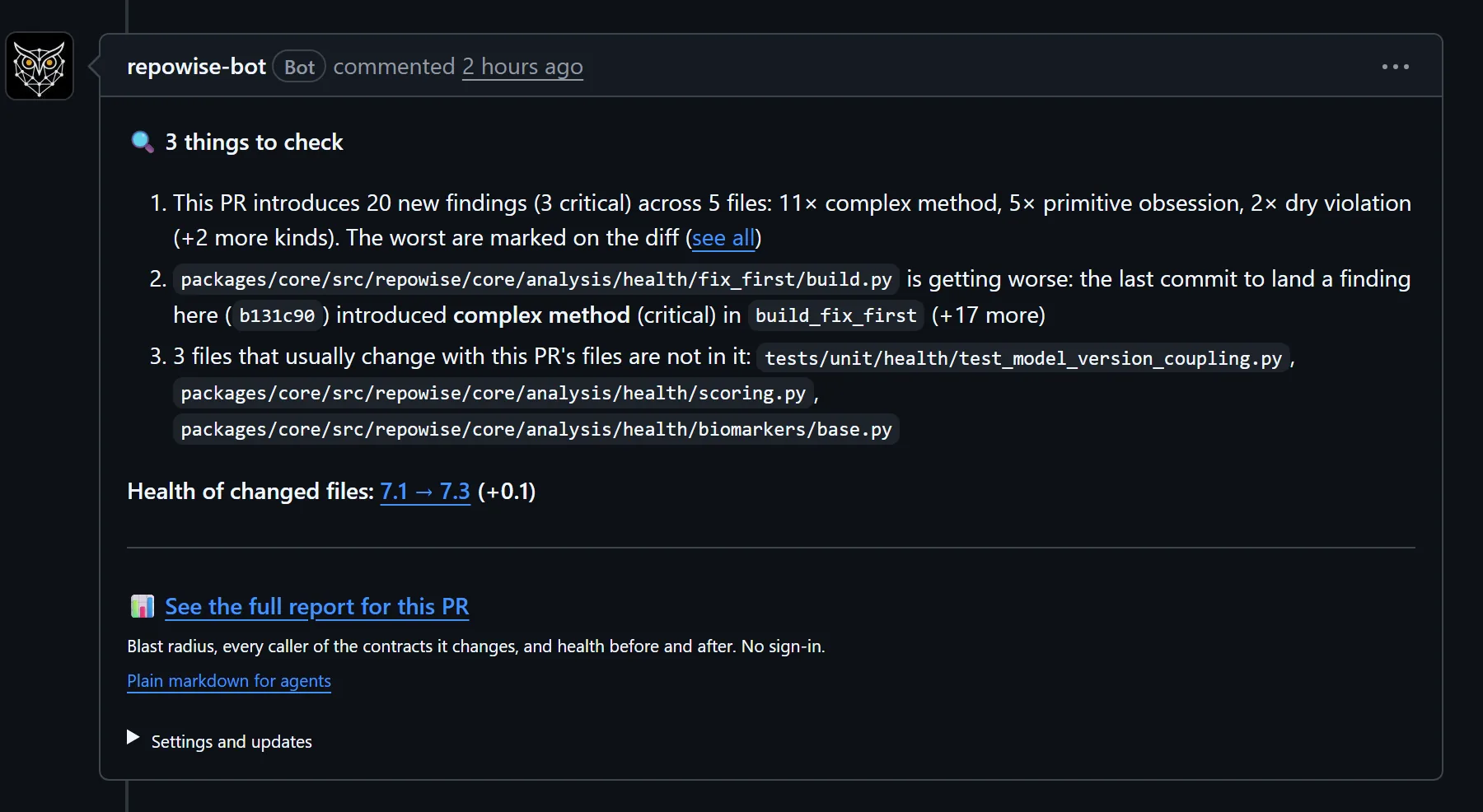
Two things kept that number predictable. Each repository has a monthly AI spend limit that the owner sets, so the worst case was a number we chose in advance, not a surprise on an invoice. And when a repository reaches its limit, the bot falls back to the free Signals comment and says so on the PR, so nothing goes unreviewed in silence.
Per-seat or per-review pricing: which fits agents?
Per-review pricing fits agents better, because the thing that grows is reviews, and the seat count does not move. A seat plan charges for the people who own the agents. A per-pass plan charges for the work the agents create. When agents double the PR count, a seat bill stays the same and a per-pass bill doubles, which is how it should work if the review is the product.
The trade-off is predictability, and the answer is a cap. Seat plans are predictable because the price is fixed. Usage plans become predictable when you set a spend limit: Anthropic offers a monthly cap on Code Review, CodeRabbit lets admins cap overage, Greptile caps overage in dollars, and repowise has the per-repo monthly limit. Set one before agents start, not after the first invoice.
For the wider price comparison across human-sized teams, see AI code review pricing compared. For feature differences between bots, see the best GitHub PR review bots in 2026.
How should you review agent-generated PRs without a runaway bill?
Use tiers, and spend model money only where it changes an outcome. Agent PRs have a long tail: many are small, mechanical and well covered by tests, and a few touch the code that breaks production. One review price for all of them overpays on the first group and may underpay on the second.
- Every push: free deterministic signals. The repowise bot's Signals mode uses no model. It posts callers a change breaks, files that usually change with it but are missing from the PR, tests to run first and who to ask, and it posts nothing on a clean PR. It is free on public repositories and does not scale with pushes. See deterministic vs LLM code review for what that tier catches.
- Most PRs: cheap AI review. At about 20 to 35 cents a pull request, Full AI review can run on every PR in a busy repository, and AI triage at 1 to 2 cents a PR can decide which ones deserve it.
- Risky PRs: deep review on demand. Reserve the $1 to $25 reviews for changes to auth, billing, migrations and other code where a missed bug is expensive. Manual triggers (
@claude reviewon Claude Code Review, run-once settings on Bugbot) keep that spend to the PRs you choose.
Whatever mix you pick, put a spend limit on each repository, and review the ledger weekly for the first month. The number that matters is passes per PR, and you can only see it once agents are running.
How we checked
On 15 October 2026 we fetched CodeRabbit's pricing page, Greptile's pricing page, GitHub's Copilot plans and code review docs, Cursor's pricing page, docs and its May 2026 Bugbot blog post, and Anthropic's Claude Code Review docs. Every vendor figure in the table comes from those pages. Cursor's pricing page and Bugbot docs do not list a per-run rate, so the $1.00 to $1.50 average is from Cursor's blog post. GitHub's docs give per-review credit estimates but no per-review price, so our Copilot range is arithmetic on those estimates.
The table assumes 1,000 PRs a month, 1.6 passes per PR and, for seat plans, 10 seats, and it assumes each push counts as a chargeable pass on every tool, which you should confirm on your own plan. The repowise figures are from our own credit ledger on repowise-dev/repowise, 10 to 14 October 2026: about 370 PRs and 614 passes. We did not run the other tools on the same pull requests, so this post compares cost and does not compare review quality.
FAQ
- How much does AI code review cost per pull request?
- It ranges from a few cents to about $25, depending on the billing model. repowise Full AI review measured about 20 to 35 cents a PR on a busy repository in October 2026, Cursor reports an average Bugbot run of $1.00 to $1.50, and Anthropic reports an average of $15 to $25 for Claude Code Review. Seat plans like CodeRabbit ($24 a developer a month annual) and Greptile ($30 a seat) price the seat, so cost per PR depends on volume.
- How do you review pull requests from AI coding agents?
- Run a free deterministic check on every push, an inexpensive AI review on most pull requests, and a deep review only on risky changes. Agents open many PRs and push to each repeatedly, so the review has to be cheap per pass and bounded by a spend limit. Keep a human reviewer on changes to security-sensitive and high-churn code.
- Why does seat pricing break down for agent-generated PRs?
- Seat plans assume a human opens about ten PRs a month, so the seat price covers a small, steady stream. An agent fleet opens far more and in bursts, which meets hourly allowances (CodeRabbit's is 5 an hour per developer on Essentials) and credit allowances (Greptile Pro includes 50 credits a seat). The bill then moves to overage rates, which is a usage bill in practice.
- Is per-review pricing cheaper than per-seat at high PR volume?
- It depends on the price per review. At about 20 to 35 cents a PR, per-review pricing is cheaper than a seat plan for 1,000 PRs a month. At $1 to $25 a review, per-review pricing costs more than most seat plans at the same volume. Compare the price per pass, not the pricing model.
- Does re-reviewing every push multiply the cost?
- Yes, on every tool that charges per pass. Anthropic's docs say reviewing after every push multiplies cost by the number of pushes, and Cursor prices each Bugbot run. We measured 1.6 passes per PR on repowise, so a month of 1,000 PRs is 1,600 passes. Measure passes per PR on your own agent workflow before you forecast.
- How do I cap AI code review spend?
- Set a monthly limit per repository or per service. Anthropic lets owners cap Code Review spend, CodeRabbit admins can cap usage-based overage, and repowise lets the repo owner set a monthly AI spend limit; at the limit the bot falls back to the free Signals comment. A cap changes the worst case from open-ended to a number you chose.