On this page
- Why one number isn’t enough
- The 21 markers and why each is on the list
- How code health is calculated at file level
- A practical normalization path
- Example
- Per-file aggregation
- 1. Weighted average
- 2. Max-risk bias
- 3. Hybrid aggregation
- Why file size is usually a weight, not a hard rule
- Why normalization is repo-specific
- Module rollup
- A good rollup formula
- Why centrality matters
- Trend computation
- The basic trend model
- What to track
- Why trend beats raw score in review
- What we deliberately did NOT include
- 1. Style-only lint rules
- 2. Commit message quality
- 3. Subjective labels
- 4. Raw lines changed in a single PR
- 5. Generic repository popularity
- Tradeoffs vs SonarQube SQALE and CodeScene Code Health
- SonarQube SQALE
- CodeScene Code Health
- How the tradeoffs look in practice
- Open-source implementation walkthrough
- Step 1: Parse the codebase
- Step 2: Compute the 21 markers
- Step 3: Normalize against the repo
- Step 4: Aggregate to file and module scores
- Step 5: Store history
- Step 6: Expose it through tools
- FAQ
Why one number isn’t enough
A code health scorer works because one number is only useful if it is built from signals that map to real maintenance cost. A file can look clean and still sit at the center of churn. Another file can be ugly but stable enough that it should stay low on your list. A useful score needs to account for structure, ownership, change history, and the parts of the codebase that people actually touch. That is the point of the 21-marker model behind repowise's headline defect-risk score (49 markers in total once you count the separate maintainability and static-performance pillars): reduce a messy set of maintenance signals into one score without pretending the score is magic. CodeScene’s public product docs make a similar argument, saying its Code Health is an aggregated metric built from 25+ factors and that a single KPI is not enough on its own. (codescene.com)
That framing also fits how the Model Context Protocol is used in agent tools today: MCP servers expose structured capabilities and let clients ask for exactly the data they need, rather than stuffing a model with a blob of text. MCP’s spec defines tools as named actions with schemas, and current spec pages describe versioned protocol identifiers and tool discovery. (modelcontextprotocol.io)
For a repo intelligence system like repowise, that matters. If you want the score to be useful in code review, architecture work, or refactoring triage, you need the score to be explainable at file level, roll up cleanly at module level, and change in a predictable way over time. See what repowise generates on real repos in our live examples, or check repowise’s architecture if you want to see how the data flows end to end. For the full picture, see the complete code-health guide.
 Code Health Score Pipeline
A note on structure before the marker list: repowise's current code health model does not collapse everything into one blended number. It reports three co-equal signals, defect risk, maintainability, and performance, and keeps them separate rather than averaging them into a single score. The per-file and per-module aggregation described below still applies within each signal; it just is not the final word across all three.
The 21 markers and why each is on the list
The 21 markers behind the defect-risk score are not random code smells. They are chosen because each one can be measured automatically and each one tends to correlate with maintainability pain or bug density. A good code health algorithm avoids subjective labels like “messy” and instead asks concrete questions: how complex is this file, how much does it depend on others, how many paths does it expose, how often does it change, and how old is the last cleanup?
Here is repowise's actual defect-risk detector list.
| Marker | What it measures | Why it matters |
|---|---|---|
| 1. Complex method | Cyclomatic complexity ≥ 9 | Harder to reason about, harder to test |
| 2. Nested complexity | Max nesting depth > 4 | Deep nesting correlates with defect density |
| 3. Bumpy road | Several medium-depth nesting humps side by side | Distinct from one deep block or one long branch list |
| 4. Large method | Function length once it carries real branching | Length-with-substance, not a raw line count |
| 5. God class | Large class, 15+ methods, containing a brain method | Size backed by concentrated logic, not a flat data holder |
| 6. Complex conditional | 3+ boolean operators glued into one branch guard | The noisy end of a branch's lifetime |
| 7. Function hotspot | A complex function that is also frequently modified | Catches the one hot, ugly function inside a stable file |
| 8. Hidden coupling | Files that co-change without importing each other | Behavioral coupling invisible to import analysis |
| 9. Co-change scatter | A file coupled to many distinct co-change partners | Shotgun-surgery risk on every edit |
| 10. Knowledge loss | Primary owner gone, bus factor of 1 | Institutional knowledge for the file is gone |
| 11. Untested hotspot | Churning, central file with no test coverage | Highest-risk combination: central and unguarded |
| 12. Coverage gap | Significant uncovered surface with real coverage data | Flags where tests are thin, not just absent |
| 13. Coverage gradient | Continuous deduction by uncovered fraction | Stays useful on well-tested repos, unlike hard thresholds |
| 14. Large assertion block | 15+ consecutive assertions in one test | A failure points at a line, not a cause |
| 15. Duplicated assertion block | Copy-pasted assertion sequences across tests | Copies drift because they are rarely all updated |
| 16. Churn risk | Rewrite volume normalized by file size | Stronger defect predictor than raw churn |
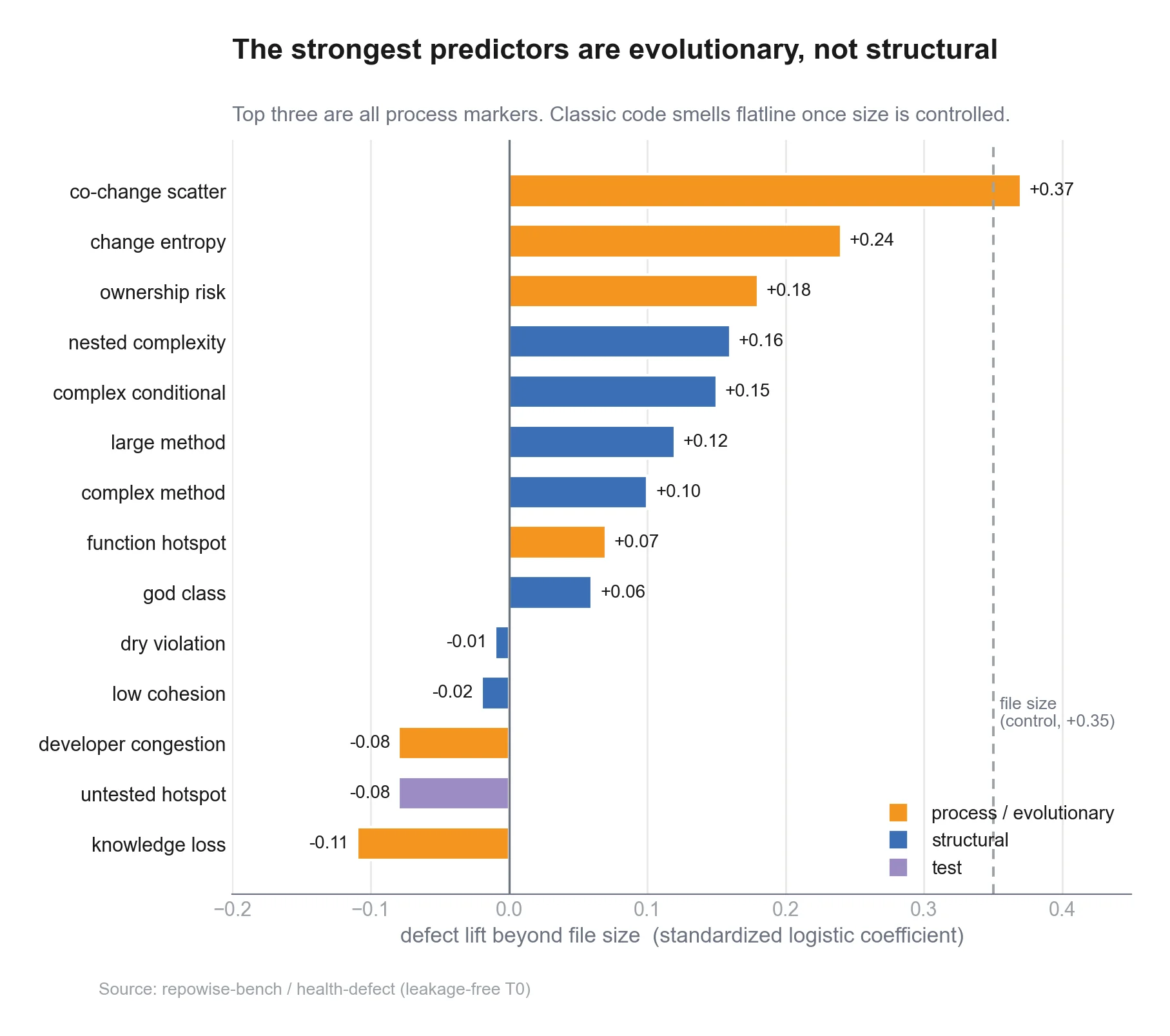
| 17. Change entropy | Scattered, chaotic commit history | Predicts faults independently of raw churn |
| 18. Code age volatility | Dormant code suddenly being modified again | One of the strongest defect predictors in the literature |
| 19. Developer congestion | Many active contributors, no clear owner | Coordination cost explodes |
| 20. Ownership risk | Many drive-by authors, each under 5% of commits | The strongest single defect correlate Bird et al. measured |
| 21. Prior defect | Recent bug-fix history on the file | The cheapest, strongest predictor of a future fix |
Scroll the table sideways to see every column.
A scorer can use more than one signal per marker. For example, coupling can come from dependency edges, call graphs, or co-change history. Ownership signals come from git authorship and recent commit windows. Test signal can be a real coverage report if the repo has one, or a paired-test-file heuristic when it does not. This 21-marker set is what feeds repowise's headline defect-risk pillar; a further 28 markers (20 performance, 8 maintainability) feed the two co-equal pillars covered separately.
The key design choice is this: each marker should be individually explainable. If a file scores poorly, the report should say why. “High coupling out” is useful. “Bad vibes” is not.
CodeScene’s public docs describe Code Health as an aggregated metric built from a set of factors scanned from source code, and their product pages note that Code Health is weighted and normalized across codebases. That is the same shape of problem, even if the factor set differs. (codescene.com)
How code health is calculated at file level
A file-level score is usually the first place people look, so the formula needs to be stable and boring. The common pattern is:
- Measure each marker on a normalized scale.
- Convert each marker into a risk contribution.
- Weight the contributions.
- Aggregate to one file score.
- Clamp the result to a fixed range, often 0–100.
A simple version looks like this:
file_health = 100 - Σ(weight_i × risk_i)
Where risk_i is already normalized. That normalization step matters more than the formula. A raw cyclomatic complexity of 18 means very different things in a 40-line helper versus a 2,000-line orchestration file. Good scoring systems normalize against file type, language, and sometimes repository baseline.
A practical normalization path
For each marker:
- Map raw values to a percentile or z-score against the repo.
- Apply thresholds for “safe,” “watch,” and “risk.”
- Convert the score to a penalty curve.
- Cap extreme penalties so one bad metric does not drown everything else.
That last part is important. If a scorer punishes one giant file too hard, the score becomes a size detector. If it punishes too softly, it hides real risk. The curve needs to be nonlinear enough to catch outliers and smooth enough that a small change in a function does not swing the score by 30 points.
Example
Imagine a 420-line TypeScript file:
- Complexity: high
- Duplication: moderate
- Coupling out: high
- Change frequency: high
- Ownership concentration: one person
- Tests: weak
A file like that should score poorly even if it has decent formatting. Formatting is not maintainability. That is why the markers include structural and historical signals, not just lint-style checks.
If you want to see this kind of output on a real codebase, the FastAPI dependency graph demo shows how structural context feeds later scoring, and the hotspot analysis demo shows why churn belongs in the same conversation as complexity.
 File Score Breakdown
Per-file aggregation
A code health scorer is only as good as its file aggregation. If the per-file score is noisy, everything above it becomes noise too.
There are three common ways to aggregate:
1. Weighted average
The simplest approach is to average marker penalties with weights. This works if you want transparency and easy debugging.
2. Max-risk bias
Some scorers intentionally bias toward the worst marker. That makes sense for files with one glaring issue, such as extreme coupling or extreme size.
3. Hybrid aggregation
This is usually the best choice. Use a weighted average, then add a penalty for any marker that crosses a critical threshold.
A hybrid model lets the scorer say:
- “This file is mostly fine.”
- “This file has one severe issue.”
- “This file is structurally unhealthy across several dimensions.”
That last category matters because maintenance pain is often cumulative. A file with moderate complexity, moderate churn, and weak tests can be more expensive than a file with one obvious smell.
Why file size is usually a weight, not a hard rule
Large files are not always bad. Generated code is large by design. Parsing logic can be large and still manageable. That is why file size should affect the score, but not dominate it. It is a contributor, not a verdict.
Why normalization is repo-specific
A 150-line function might be huge in one repo and normal in another. A scorer should compare a file against its neighbors first. Absolute thresholds can still exist, but they should be a guardrail, not the whole model.
Module rollup
Once you have file scores, you can roll them up to module, package, or service level. This is where a health score internals view becomes more useful than a dashboard number.
A good module rollup should answer three questions:
- Which files dominate the module score?
- Is the module score dragged down by one hotspot or by broad decay?
- Is the module score hiding a critical dependency hub?
A good rollup formula
A simple average is not enough. You want the larger and more central files to matter more.
A practical rollup might use:
- file score
- file size
- dependency centrality
- churn
- internal fan-in
That gives you something like:
module_health = weighted_mean(file_health, file_weight)
Where file_weight is influenced by both size and centrality.
Why centrality matters
A small file at the center of many dependencies can be more important than a large leaf file. If that file changes, many callers can break. If it is unhealthy, the blast radius is high. That is one reason a module rollup should include dependency graph data, not just averages.
This is also where code intelligence platforms help more than plain linters. repowise parses dependency graphs across 16 languages, which lets a module score reflect actual structure instead of directory shape. If you want to see the underlying data model, check our architecture page or see the ten flagship MCP tools in action on a real codebase, including get_change_risk, which scores the pre-merge defect risk of a commit or diff range from its diff shape alone.
Trend computation
A static score is fine for a snapshot. A trend is what makes the score operational.
Trend computation should answer:
- Is the score improving?
- Is it flat but unstable?
- Is it degrading slowly?
- Did a recent change cause a cliff drop?
The basic trend model
At minimum, keep a time series per file and per module.
trend = score_t - score_(t-n)
But that is too coarse by itself. Better systems smooth the line with a rolling average or exponential moving average, then compare current value to baseline.
What to track
- last 7 days
- last 30 days
- last 90 days
- since last release
- since ownership change
That gives both short-term and medium-term views. A file that dipped yesterday after a refactor should not be treated the same as a file that has been declining for six months.
Why trend beats raw score in review
A PR that drops health from 84 to 81 may be fine if the repo was at 20 last month and climbing. A PR that drops from 84 to 81 after three weeks of decline is different. The trend turns the score into a management tool instead of a badge.
What we deliberately did NOT include
A serious code health algorithm should exclude signals that are easy to measure but hard to defend.
1. Style-only lint rules
Formatting issues can be fixed by automation. They are useful for consistency, but they do not tell you much about long-term maintenance cost.
2. Commit message quality
Interesting for process hygiene. Weak as a code health signal.
3. Subjective labels
Words like “clean,” “messy,” or “ugly” do not help. They are impossible to audit and hard to tune.
4. Raw lines changed in a single PR
Big PRs are not always bad, and tiny PRs are not always safe. What matters is where the change lands and how often that area already moves.
5. Generic repository popularity
Stars, forks, and contributor count may matter for project health, but they do not say much about maintainability inside the codebase.
That last point matters in open source. repowise is AGPL-3.0 licensed, and the AGPL is designed for network software where users interact with a modified version over a network. That keeps the code available to the community in the server setting. (gnu.org)
Tradeoffs vs SonarQube SQALE and CodeScene Code Health
There are two useful comparison points here: SonarQube’s SQALE-style maintainability model and CodeScene’s Code Health.
SonarQube SQALE
SQALE is centered on technical debt and remediation effort. It gives teams a maintainability view that maps issues to estimated effort, which is useful if your main question is “how much work is behind this issue set?” SonarQube’s public docs organize maintainability around debt ratios, remediation estimates, and quality gates. (codescene.com)
CodeScene Code Health
CodeScene’s Code Health is more opinionated about code-level risk. The product says the metric is aggregated from 25+ factors and is used alongside hotspots to prioritize refactoring candidates. It also stresses that the score is weighted and normalized, not just a raw issue count. (codescene.com)
How the tradeoffs look in practice
| Dimension | SQALE-style debt | CodeScene-style Code Health | 21-marker scorer |
|---|---|---|---|
| Main question | How much effort to fix issues? | How healthy is this code, structurally and historically? | How healthy is this file or module across 21 measurable signals? |
| Strength | Clear remediation framing | Strong prioritization with hotspots | Easier to explain and implement in-house |
| Weakness | Can become issue-count heavy | Can feel proprietary or opaque | Needs careful calibration |
| Best use | Quality gates and technical debt accounting | Refactoring prioritization | Repo intelligence, PR review, and internal dashboards |
Scroll the table sideways to see every column.
The practical choice is not “which is perfect.” It is “which model matches the decisions your team needs to make.” If you need a lightweight internal system that you can audit and extend, a 21-marker scorer is a good fit.
Open-source implementation walkthrough
Here is how I would build the scorer in an open-source repo intelligence platform.
Step 1: Parse the codebase
Walk the repo, parse files, and build symbol indexes. For supported languages, extract imports, declarations, and references. repowise already supports Python, TypeScript, JavaScript, Go, Rust, Java, C++, C, Ruby, and Kotlin, so the same pipeline can feed the score in mixed-language repos.
Step 2: Compute the 21 markers
For each file:
- complexity metrics from AST traversal
- duplication from token or block similarity
- coupling from import and call edges
- churn from git history
- ownership from author concentration
- test proximity from file path and coverage data
Step 3: Normalize against the repo
Use repo baselines, not fixed global thresholds. A scorer should learn the shape of the repository it is judging.
Step 4: Aggregate to file and module scores
Combine the markers into a file score, then roll that score upward with dependency-aware weights.
Step 5: Store history
Persist score snapshots so you can chart trends, spot regressions, and show before/after deltas in PRs.
Step 6: Expose it through tools
This is where MCP helps. MCP servers expose tools with defined schemas, and the current spec defines tool discovery and versioned protocol behavior. That makes it a good fit for agent-facing score lookups, risk summaries, and dependency paths. (modelcontextprotocol.io)
If you want a concrete starting point, try repowise on your own repo: the MCP server is configured automatically, or use pip install repowise && repowise init.
 Module Rollup and Trend View
FAQ
How is code health calculated?
A typical code health scorer calculates a file score by normalizing several markers, weighting them, and converting the result into a fixed score range such as 0–100. The important part is not the exact formula. It is the calibration: the same raw metric can mean different things in different repos.
What are the 21 markers in a code health scorer?
repowise's 21-marker defect-risk set spans complexity (complex method, nested complexity, bumpy road, large method, god class, complex conditional, function hotspot), coupling (hidden coupling, co-change scatter, knowledge loss), test signal (untested hotspot, coverage gap, coverage gradient, large assertion block, duplicated assertion block), and churn signal (churn risk, change entropy, code age volatility, developer congestion, ownership risk, prior defect). Each marker is measurable and explainable on its own.
Why not use only cyclomatic complexity?
Because one metric misses too much. A file can have moderate complexity and still be high risk if it changes often, sits at the center of the graph, and has weak tests. A useful scorer combines structural and historical signals.
How does a module score differ from a file score?
A file score looks at one unit. A module score rolls multiple file scores together, usually with weights for size, centrality, and churn. This helps surface hidden risk in a package that looks fine at the file level but is unhealthy overall.
How do trends help more than a single score?
Trends show direction. A flat score can hide decay, while a slightly lower score may still be acceptable if the repo is improving. Trend lines make the scorer useful for PR review and release tracking.
How does this differ from SonarQube or CodeScene?
SonarQube’s maintainability model is centered on technical debt and remediation effort, while CodeScene’s Code Health emphasizes aggregated code-level health and hotspot-aware prioritization. A 21-marker scorer can borrow the useful parts of both ideas while staying smaller, more transparent, and easier to adapt. ([codescene.com](https://codescene.com/product/code-health))
Is the Model Context Protocol relevant here?
Yes. MCP gives you a standard way to expose tool-backed repo intelligence to AI agents. The spec defines tools, discovery, and versioned protocol identifiers, which makes it a good fit for code health lookups and dependency queries. ([modelcontextprotocol.io](https://modelcontextprotocol.io/specification/2025-06-18/server/tools))
Can I build this in an open-source repo?
Yes. AGPL-3.0 is a common choice for server software that you want to keep open over the network, and repowise uses that license. The practical benefit is simple: if the scorer becomes a shared internal service, the implementation remains inspectable and modifiable. ([gnu.org](https://www.gnu.org/licenses/agpl-3.0.html.en)) If you want to see the outputs before installing anything, start with the [live examples](/explore) and the [auto-generated docs for FastAPI](/repo/tiangolo/fastapi/docs).