On this page
The best DeepWiki alternatives in 2026 are Google Code Wiki for fresh wikis of public repos, OpenWiki for Markdown docs your coding agent maintains in your repo, OpenDeepWiki or deepwiki-open for a self-hosted site, and repowise when you want the wiki built on a dependency graph and git history. We opened the same three public repos in each hosted tool on 6 October 2026 and counted how far behind HEAD each wiki was.
The short list, as of October 2026:
- Google Code Wiki: hosted, free for public repos, the freshest on our check.
- OpenWiki (LangChain): MIT, writes a linked Markdown wiki into your repo through the coding agent you already use.
- deepwiki-open: MIT, the lightweight self-hosted web app, with local Ollama support.
- OpenDeepWiki: MIT, a multi-user self-hosted platform with scheduled updates and MCP.
- repowise: a parsed dependency graph, git history, health and MCP behind the wiki, self-hosted or hosted.
We build repowise, so weigh our entry accordingly. The measurements we publish about it, with their methods, are on the benchmarks page.
What is DeepWiki?
DeepWiki is a free service from Cognition, the company behind the Devin coding agent, that generates a wiki-style documentation site for a public GitHub repository. Cognition announced it on 5 May 2025 as the free public version of Devin Wiki and Devin Search, and said it had already indexed over 50,000 of the top public repos. To use it, replace github.com with deepwiki.com in a repo's URL.
Per Cognition's DeepWiki documentation (read 29 October 2026), a wiki holds summaries of the codebase with links to source, plus architecture diagrams, and you can ask questions answered from the wiki and code search. The free version covers public repositories only; private repos need a Devin account. Agents can read the same wikis through a free MCP server at mcp.deepwiki.com/mcp. The rest of this post compares the tools you can use instead of, or next to, it.
How we evaluated
- Freshness: how many commits behind the default branch each hosted wiki was on the day we opened it.
- Access: private repositories, self-hosting, and what leaves your network.
- Update trigger: what makes a page refresh, and whether you can see when it last did.
- Agent access: whether your coding agent can read the wiki over MCP.
Comparison table
| Tool | Type | License / price | Private repos | Keeps docs updated automatically | Agent access (MCP) |
|---|---|---|---|---|---|
| DeepWiki (baseline) | Hosted by Cognition | Free for public repos | Through a Devin account | Badge repos refreshed; otherwise on request | Public MCP server, no auth |
| Google Code Wiki | Hosted by Google | Free, public repos | Gemini CLI extension, waitlisted | Yes, on our three repos it was 0 to 1 commit behind | Not documented |
| OpenWiki (LangChain) | Runs inside your coding agent | MIT, uses your agent's model | Yes, it runs locally | You run an update; it re-checks facts that changed | Yes, local read-only search tools |
| deepwiki-open | Self-hosted web app | MIT, your model bill or local Ollama | Yes, with an access token | No, you regenerate | Not documented |
| OpenDeepWiki | Self-hosted platform | MIT, your model bill | Yes, GitHub App import | Scheduled incremental updates | Yes, per-repo endpoints |
| repowise | Self-hosted CLI or hosted site | AGPL-3.0 free; hosted Free / Pro $15/mo | Yes (self-hosted, or hosted Pro via GitHub App) | repowise update re-renders what each commit touched; hosted Pro re-indexes on push | Yes, ten MCP tools, local and hosted |
Scroll the table sideways to see every column.
We build repowise, so it is one row here, and Google Code Wiki was the freshest on the test below. Tool details are from each project's own README or site, read on 29 October 2026.
How fresh is each wiki? The test on three repos
I read a lot of "DeepWiki alternatives" lists while preparing this, and most were a paragraph per tool copied from each README. None of them measured the thing I care about as an engineer, which is how out of date the wiki is on the day you open it. A generated wiki that describes the code as it was six months ago reads with exactly the same confidence as one built this morning, and nothing on the page warns you unless you go looking for the date.
So on 6 October 2026 we opened the public wiki for the same three repositories in each hosted tool, wrote down the commit or date each wiki says it was built from, and counted how many commits the repository's default branch had gained since then, using GitHub's compare API.
The three repos were pallets/flask (Python, small and well documented), gin-gonic/gin (Go, a busy web framework) and psf/requests (Python, mature, few commits). Three repos is a small sample and all three are popular, so treat this as a spot check of one day and not as a ranking.
| Repo (HEAD on 6 Oct) | DeepWiki | Google Code Wiki | repowise.dev |
|---|---|---|---|
pallets/flask (d73fa1c, 8 Sep) | Indexed 5 Apr 2026, 33 commits behind | Updated 7 Sep, 1 commit behind | Indexed 13 Aug, 2 commits behind |
gin-gonic/gin (43fe48e, 29 Sep) | Indexed 14 May 2026, 29 commits behind | Updated 30 Sep, current | Indexed 17 Sep, 9 commits behind |
psf/requests (611c616, 21 Sep) | Indexed 25 Aug 2026, about 3 commits behind | Updated 13 Sep, 1 commit behind | Indexed 21 Sep, current |
Scroll the table sideways to see every column.
Google Code Wiki was the freshest of the three hosted tools on these repos, and DeepWiki was months behind on two of the three. repowise was within days on all three and current on requests, which is set to re-index on push, while the other two are refreshed by hand.
The table cannot tell you whether the content is correct. A wiki built from last week's commit can still be wrong, and one built in April can still be right if the code barely moved. Flask only gained 33 commits in six months, so DeepWiki's April flask wiki is still mostly accurate, and it even reports the current development version, 3.2.0.dev. Gin moved more, so the lag matters more there.
We noticed two other details in the same session. DeepWiki shows a "Refresh this wiki" button that asks for an email address, which means a visitor can request a refresh. Code Wiki prints "Gemini can make mistakes, so double-check it" under every page, and that warning applies fairly to every tool in this post.
We did not run OpenWiki, deepwiki-open or OpenDeepWiki on the three repos. All three need either our own model API key or a coding agent's paid session to generate a wiki, and we wanted this comparison to stay free to reproduce, so everything below about those three comes from their READMEs and repository metadata.
The alternatives, one by one
Google Code Wiki
Google's Code Wiki generates a wiki and a Gemini chat for public GitHub repos. On our spot check it was the freshest by a wide margin, which matches Google's own description of wikis that update as the code changes. Its limits are about access. It covers public repositories, and Google has announced a Gemini CLI extension for private, internal repos with a waitlist and no general availability date that I could find. There is also no documented MCP endpoint for your own coding agent. If you want to read about a popular open-source project before you depend on it, Code Wiki is a very good first stop.
OpenWiki (LangChain)
OpenWiki is MIT licensed, was created in June 2026 and already has around 17,000 stars. It runs no model of its own. It plugs into the coding agent you already use (Claude Code, Codex, Cursor, OpenCode, Copilot CLI and others), and that agent writes a linked Markdown wiki into an openwiki/ folder in your repo. OpenWiki records which source lines each fact came from, so an update can focus on facts whose evidence changed, and your agent then reads the wiki back through local, read-only search tools.
That design has two consequences. The wiki is plain files in your repo, so there is nothing to export, and nothing leaves your machine except what your agent already sends to its model. Generation also spends your agent's tokens, so a large repo costs real money to document the first time. If your main reader is a coding agent and you want docs under version control, OpenWiki is the strongest open option right now.
deepwiki-open
deepwiki-open (MIT, about 18,000 stars) is the original open re-implementation of DeepWiki. It is a Next.js front end and a Python back end in Docker: you paste a GitHub, GitLab or Bitbucket URL, and it builds a wiki with diagrams and a chat. Private repos work with an access token. It supports Gemini, OpenAI, OpenRouter, Azure OpenAI and local Ollama models, so it can run fully offline. It does not refresh on its own, so you regenerate. Before you start, know that the English README now mostly points to the author's successor, a local-first Mac desktop app called Grok-Wiki, and the full setup steps live in the translated READMEs.
OpenDeepWiki
OpenDeepWiki (MIT, about 3,600 stars, C# and TypeScript) is the most complete self-hosted platform of the group. It has an admin console with users, roles and API keys, GitHub App imports, background workers that run scheduled incremental updates, and MCP endpoints per repository (/api/mcp/{owner}/{repo}). If you want a DeepWiki-style site for a whole company on your own servers, this is the one to evaluate, and the cost is operating a database, workers and a model provider.
repowise
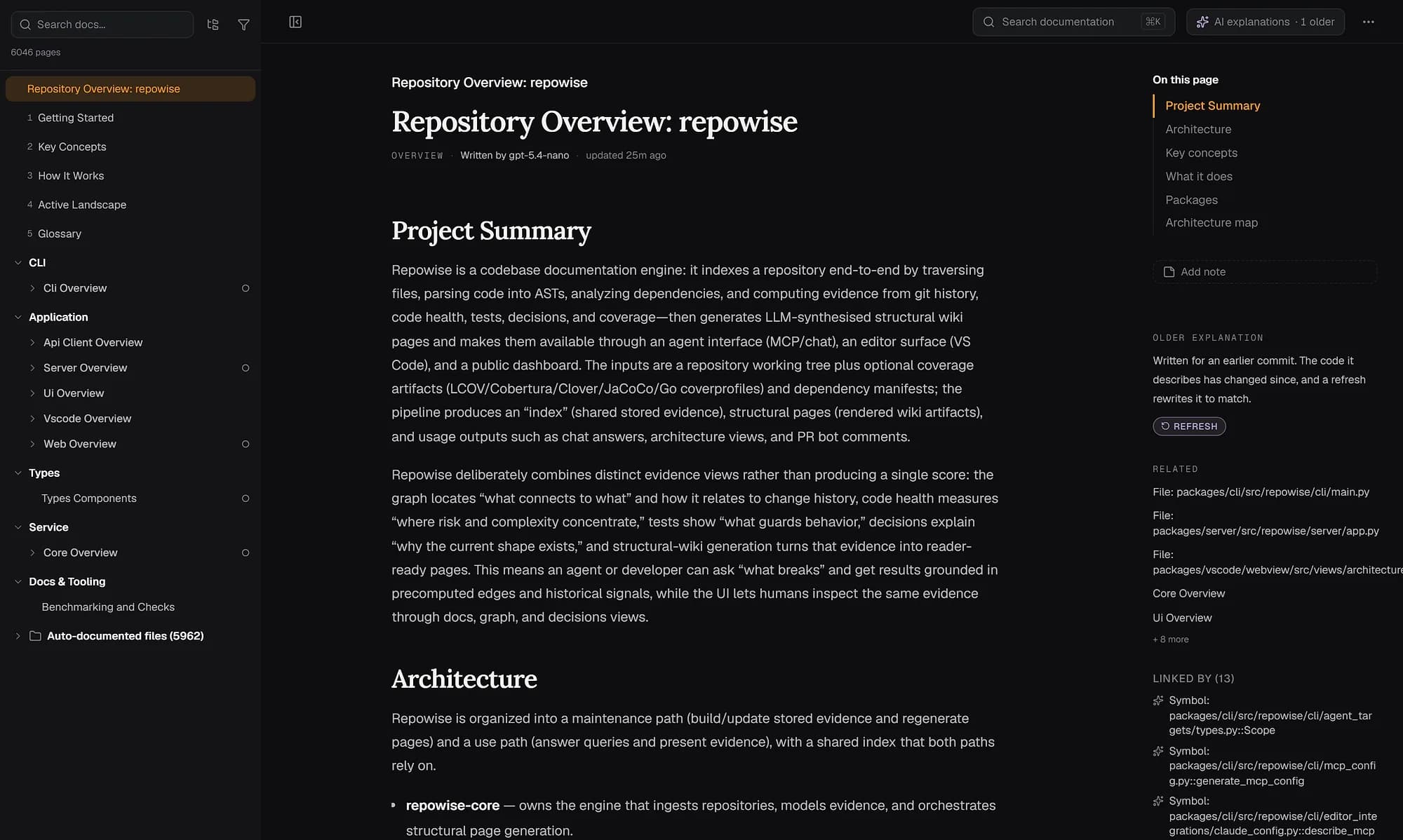
repowise is the pick when you want the wiki to start from a parsed dependency graph and git history instead of from the text alone. It writes a page per source file, selected public symbol, subsystem, dependency cycle and API surface, plus a repository overview and an onboarding collection, and it adds hotspots, ownership, files that change together, dead code and a health score. Most pages are rendered from structure with no model, so repowise init --no-prose gives a complete wiki with no API key and no spend, and a provider key (Ollama works) adds prose to the subsystem and overview pages. It is AGPL-3.0 and serves MCP (ten tools) to your coding agent, covering 28 languages parsed to a full AST.
Self-hosted, repowise update re-renders only the pages your commits touched, and the docs tree flags a page written for an earlier commit with a refresh button. Hosted, any public repo has a free page, and Pro re-indexes private repos on every push. Public pages on the hosted site refresh weekly when the repo shows our badge, or when someone asks, so the freshness numbers above reflect that cadence. Pricing is on the pricing page.
Pick it if your agent should read a graph and history alongside the docs, or you need private repos on your own machine.
How to choose a DeepWiki alternative
- If you are reading a popular public repo before you adopt it, start with Google Code Wiki for freshness, or DeepWiki if the repo is already indexed there and moves slowly. Check the date on the page either way.
- If you want docs for your own repo that your coding agent reads, use OpenWiki for Markdown in the repo, or repowise if you also want the graph, history and health data over MCP.
- If you want a company-wide self-hosted wiki site, use OpenDeepWiki, or deepwiki-open if you want something lighter and are fine regenerating by hand.
- If you need private repos with no ops work, read DeepWiki for private repos, which compares the price and data handling of each route.
Whatever you pick, ask in the demo what makes a page update and where you can see when it last did. Every tool here answers that differently, and the answer predicts how much you will trust the wiki in six months.
Related: repowise vs DeepWiki, repowise vs Google Code Wiki, the DeepWiki alternative page, and the broader codebase documentation tools of 2026.
How we measured
On 6 October 2026, for each hosted tool, we opened the public wiki page for each repo and recorded the date and commit shown ("Last indexed" on DeepWiki, "Updated on" on Code Wiki, and for repowise the latest ready snapshot's commit). We fetched each repo's current default-branch HEAD from the GitHub API and used GitHub's compare endpoint to count commits between the wiki's commit and HEAD. DeepWiki's requests wiki showed a date but no short commit we could resolve, so for that one we counted commits since the date. We also read the DeepWiki wiki contents through its public MCP server to check which version numbers it reports. We did not judge content quality, and we did not run the three self-hosted tools.
Freshness changes daily, so these numbers describe one day, and if you check again next week, look at the date on the page first.
FAQ
- What is DeepWiki?
- DeepWiki is Cognition's free service that turns a public GitHub repository into a generated wiki with architecture diagrams and a question-and-answer chat. Swap
github.comfordeepwiki.comin the repo URL to open it. Private repositories need a Devin account. - What are the best DeepWiki alternatives in 2026?
- Google Code Wiki for fresh wikis of public repos, LangChain's OpenWiki for Markdown docs your coding agent writes and maintains, deepwiki-open and OpenDeepWiki for a self-hosted DeepWiki-style site, and repowise if you also want a dependency graph, git history and MCP access. The right one depends on whether code can leave your network and how fresh the docs must be.
- Is there an open-source DeepWiki I can self-host?
- Yes. deepwiki-open (MIT) is the closest re-implementation, OpenDeepWiki (MIT) is a fuller multi-user platform, OpenWiki (MIT) runs inside your coding agent, and repowise is AGPL-3.0. All four run on your own machines, so check which model each one calls, because that is where your code excerpts go.
- Which DeepWiki alternative keeps docs updated automatically?
- Of the tools we checked, Google Code Wiki was the freshest on public repos. OpenDeepWiki runs scheduled incremental updates, and hosted repowise Pro re-indexes private repos on every push. deepwiki-open and OpenWiki update when you run them.
- What is an OpenWiki alternative?
- If you like OpenWiki's idea of docs that agents read but want a web UI and a parsed dependency graph in place of agent-written pages, look at repowise or OpenDeepWiki. If you want a hosted reader instead of files in your repo, look at Google Code Wiki or DeepWiki. Our OpenWiki alternatives post compares them in depth.
- Is Google Code Wiki a good DeepWiki alternative?
- For public repositories, yes, since it was the freshest tool on our three-repo check. For private code, its Gemini CLI extension is still waitlisted, and it has no documented MCP endpoint for your own agent.
- Does DeepWiki update when the repo changes?
- Not on every push. Third-party guides quoting DeepWiki's FAQ say repos that carry the DeepWiki badge are refreshed automatically, and the site has a "Refresh this wiki" button. On our check, two of three popular repos were 29 to 33 commits behind.