On this page
- What OpenWiki is
- Why teams look for an OpenWiki alternative
- OpenWiki alternatives compared
- OpenWiki vs DeepWiki
- The alternatives, one by one
- DeepWiki: a hosted wiki for public repositories
- Google Code Wiki: a hosted reader that tracked HEAD closely
- OpenDeepWiki: a self-hosted wiki site for a whole company
- deepwiki-open: the lightweight self-hosted option
- repowise: a wiki built from the code graph, with no model required
- Other tools that generate a codebase wiki
- How to choose an OpenWiki alternative
- Compare the two on one repository
- FAQ
Which OpenWiki alternative fits depends on what you want instead of agent-written Markdown in your repo. For a hosted reader of public code, use DeepWiki or Google Code Wiki. For a wiki website on your own servers, use OpenDeepWiki or deepwiki-open. To stop paying a model to write the docs, repowise renders a wiki from a parsed code graph with no model calls.
OpenWiki here means langchain-ai/openwiki, the AI codebase wiki LangChain first published in June 2026, not a wiki engine such as MediaWiki or DokuWiki. We build repowise. Everything else below comes from each project's repository or docs as they stood on 29 October 2026.
We build repowise, so weigh our entry accordingly. The measurements we publish about it, with their methods, are on the benchmarks page.
What OpenWiki is
OpenWiki is an MIT-licensed command-line tool that has a coding agent research your repository and write a linked Markdown wiki into an openwiki/ folder, then keeps that wiki current from the source evidence behind each fact. It plugs into Claude Code, Codex, Cursor, OpenCode, GitHub Copilot CLI, Kiro, IBM Bob, Antigravity, Pi and Oh My Pi, and uses that agent's model session, so there is no separate provider to configure. A standalone mode runs LangChain's own Deep Agents documentation agent against any of fourteen model providers.
Each factual statement on a page is a Grounded Claim that points to versioned evidence such as repo://src/server.ts#L40-L82, stored in openwiki/.claims/. On openwiki --update, only facts whose evidence changed are sent back to the model, and a clean update skips model work entirely. Agents read the result through openwiki_search and openwiki_read, which are local, read-only and make no model calls.
The latest release is 0.7.2, from 9 October 2026. openwiki link joins several repositories into one workspace, and the repository ships example CI workflows for GitHub Actions, GitLab CI and Bitbucket Pipelines that open a docs pull request when the wiki changes.
Why teams look for an OpenWiki alternative
Four properties of OpenWiki decide whether it suits a team:
- Generation spends model tokens. The first
openwiki --initon a large repository is a full agent run over the code, billed to your agent subscription or API key. Clean updates skip model work; the first wiki does not. - The output is files, not a shared site. OpenWiki writes Markdown into the repo, and
openwiki visualizeopens a graph and reader locally. There is no hosted reader with search for teammates who never run the CLI. - The wiki says what the agent understood. Claims cite source lines, but the pages are still prose an agent chose to write. Some teams want docs derived from the import graph and git history.
- Toolchain: it needs Node.js 22.22 or newer, and the visualizer loads its libraries from a public CDN, which an air-gapped machine cannot reach.
OpenWiki alternatives compared
| Tool | How pages get written | Runs where | License / price (Oct 2026) | Private repos | Stays current | Agent access |
|---|---|---|---|---|---|---|
| OpenWiki (baseline) | Your coding agent's model, grounded in source claims | Your machine or CI | MIT; you pay for model tokens | Yes, local | You run an update or schedule it in CI | Local openwiki_search and openwiki_read |
| DeepWiki | Cognition's model | Cognition's hosted service | Free for public repos; private through Devin | Through a Devin account | Regenerated by Cognition; each wiki shows its last indexed date | Free public MCP server |
| Google Code Wiki | Gemini | Google's hosted service | Free, public repos | Gemini CLI extension waitlisted | Regenerates as code changes | Not documented |
| OpenDeepWiki | Your configured model | Self-hosted (.NET and Next.js) | MIT; your model bill | Yes, GitHub App import | Scheduled incremental updates | Per-repo MCP endpoints |
| deepwiki-open | Your configured model, Ollama included | Self-hosted (Docker) | MIT; your model bill | Yes, with a token | Manual regeneration | Not documented |
| repowise | Rendered from the parsed code graph; a model only adds optional prose | Your machine, CI, or hosted at repowise.dev | AGPL-3.0, free to self-host; hosted Free (2 public repos) and Pro | Yes, self-hosted or hosted Pro | repowise update on each commit; hosted Pro on each push | Ten MCP tools |
Scroll the table sideways to see every column.
OpenWiki vs DeepWiki
OpenWiki is for documenting your own repository as files your agent maintains; DeepWiki is for reading someone else's public repository in a browser right now.
DeepWiki, from Cognition, hosts a generated wiki and an "Ask Devin" chat for any indexed public GitHub repository: swap github.com for deepwiki.com in the URL. Public wikis are free. Private repositories run through a Devin account, where low effort wikis are free and medium and high effort wikis cost about 5 to 10 and 20 to 40 ACUs per wiki, per Cognition's docs. A .devin/wiki.json file steers up to 30 pages (80 on Enterprise). Its free MCP server at https://mcp.deepwiki.com/mcp exposes read_wiki_structure, read_wiki_contents and ask_question for public repositories.
OpenWiki never hosts anything. The wiki lives in your repo, goes through code review with everything else, and runs on whichever model your agent uses. One agent session can use both: DeepWiki's MCP server for the libraries you depend on, OpenWiki's local search tools for your own code.
For a broader look at DeepWiki's field, see our DeepWiki alternatives comparison, which measured how many commits behind HEAD each hosted wiki was on three public repositories on 12 October 2026.
The alternatives, one by one
DeepWiki: a hosted wiki for public repositories
DeepWiki turns a public GitHub URL into a structured explanation with diagrams, links to source and a chat grounded in the generated pages, with nothing to install. Freshness depends on when Cognition last regenerated the wiki, so check the "Last indexed" date before trusting a detail.
It suits reading open-source code you do not own; it does nothing for docs that should live in your repository.
Google Code Wiki: a hosted reader that tracked HEAD closely
Google Code Wiki generates a wiki and a Gemini chat for public GitHub repositories and regenerates as the code changes. When we compared hosted wikis on three public repositories on 12 October 2026, Code Wiki was 0 to 1 commit behind HEAD on all three. Private repositories wait on a Gemini CLI extension that Google lists behind a waitlist, and there is no documented MCP endpoint for your own agent.
Use it when the freshness of a public project's wiki matters more than agent access. Our repowise vs Google Code Wiki post goes deeper.
OpenDeepWiki: a self-hosted wiki site for a whole company
OpenDeepWiki is MIT licensed and built on ASP.NET Core (.NET 10) and Next.js 16, with SQLite or PostgreSQL behind it. It starts with docker compose up -d --build, talks to any OpenAI-compatible endpoint or Ollama, runs background workers for scheduled incremental updates, and serves an MCP endpoint per repository at /api/mcp/{owner}/{repo}. The admin console manages users, roles, departments, API keys and GitHub App imports.
Running it means a database, background workers and a model provider, so it fits a company that wants a multi-user wiki site and has someone to operate one.
deepwiki-open: the lightweight self-hosted option
deepwiki-open is an open-source re-implementation of DeepWiki, started in April 2025 (MIT, about 18,300 stars). Paste a GitHub, GitLab or Bitbucket URL into its Next.js front end and it builds a wiki with diagrams and a chat, using Gemini, OpenAI, OpenRouter, Azure OpenAI or a local Ollama model. We found no scheduled refresh in its docs, so plan to regenerate. The English README now also points to the author's successor, a desktop app called Grok Wiki.
repowise: a wiki built from the code graph, with no model required
repowise renders its wiki from a parsed graph, not from an agent's reading of the code. repowise init parses the repository into a dependency and call graph across 28 languages, mines git history, and renders a page per source file, per selected public symbol, per subsystem, per dependency cycle, per infrastructure file and per API surface, plus a repository overview and onboarding pages. With --no-prose it makes no model calls at all; a provider key, Ollama included, only adds prose to the subsystem and overview pages.
We ran repowise 0.59.0 on 29 October 2026 against the seven repositories of the public Sock Shop microservices demo (front-end, catalogue, carts, orders, payment, user, shipping), from a laptop:
repowise init . --yes --no-prose --no-editor-setup --no-hook
{^,^}  Workspace ready
  Repositories            7 indexed
  Documentation           260 pages
  Primary repo            carts
  Elapsed                 1m 58s
The 260 pages split as orders 60, carts 55, user 48, front-end 29, shipping 24, catalogue 22 and payment 22, with no API key set. We did not run OpenWiki on the same repositories, so this is not a cost comparison; it shows what a wiki with no model behind it produces at that size. The wiki feature page lists each page type, and the same index also holds ownership and change history.
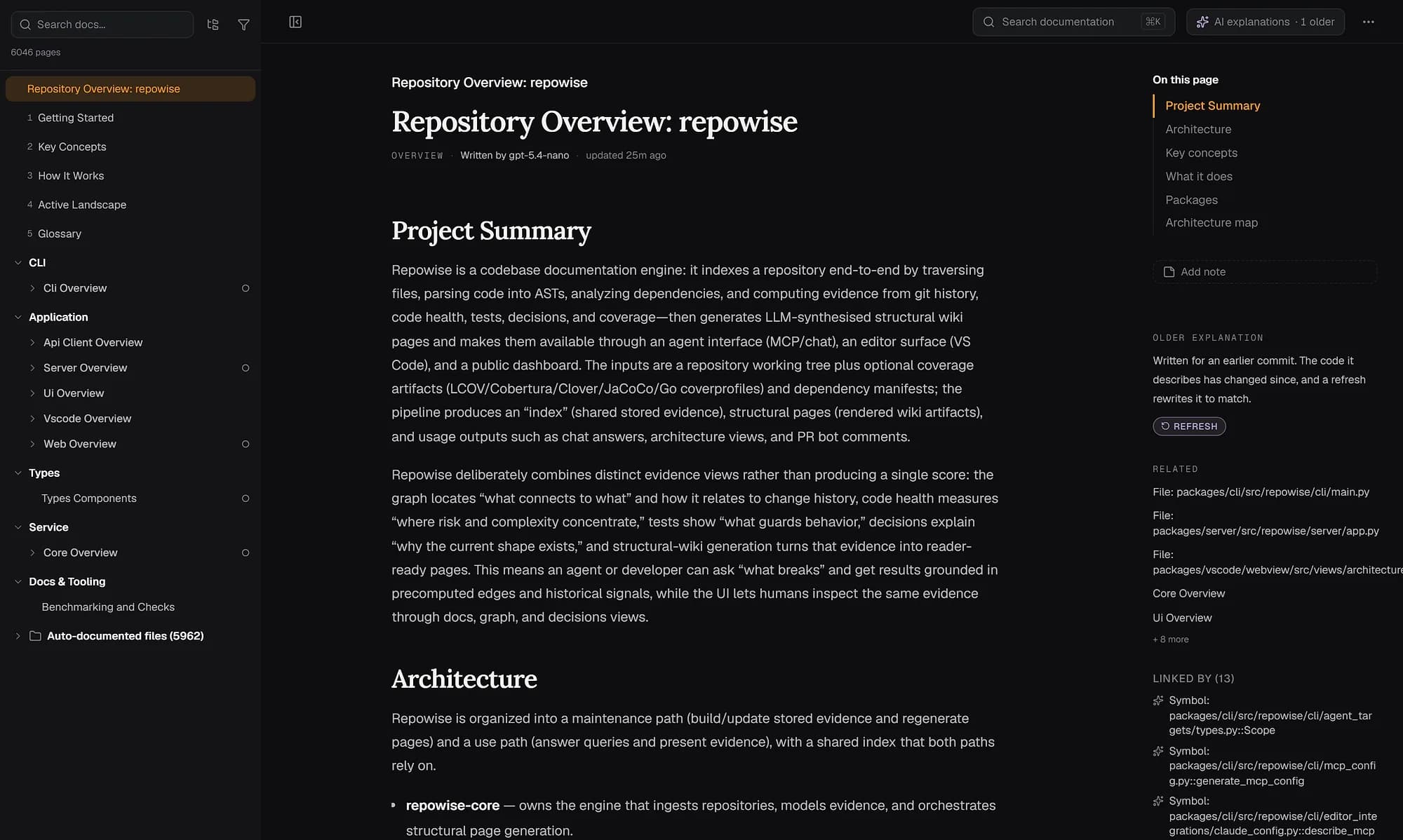
A post-commit hook runs repowise update, which re-renders only the pages your commits touched, and each page shows a freshness status. repowise export --format markdown writes the wiki out as files you can commit, and agents query the index through ten MCP tools such as get_answer, get_context and get_why. Like openwiki link, a workspace indexes several repositories together, and it also matches HTTP, gRPC and topic contracts between them.
Other tools that generate a codebase wiki
A few code graph tools now write wiki pages as a side feature: code-review-graph has a generate_wiki_tool, and GitNexus can generate a wiki from its knowledge graph, with auto-updating wikis in its paid Enterprise tier. They are worth a look if you already run them for agent context; our roundup of code graph MCP servers covers both.
How to choose an OpenWiki alternative
| If this is why you are looking | Try |
|---|---|
| You read public repos more than you write docs | DeepWiki, or Google Code Wiki when freshness matters; check the indexed date on the page |
| Your company wants a wiki website on its own servers | OpenDeepWiki for a multi-user platform, deepwiki-open for something lighter |
| The first-run model bill, on a large repo or many repos | repowise with --no-prose |
| You like OpenWiki's pages but want ownership and change history beside them | Keep OpenWiki and add repowise; OpenWiki's local search tools and repowise's MCP tools can run in one agent session |
Scroll the table sideways to see every column.
Related reading: repowise vs DeepWiki, tools that generate CLAUDE.md and AGENTS.md and the DeepWiki alternative page.
Compare the two on one repository
Run OpenWiki and repowise on the same repository and read the pages for one module in each:
# OpenWiki, inside your coding agent
npm install -g openwiki
# connect it to your agent as the README describes, then run the init from that agent

# repowise, no API key needed
pip install repowise
repowise init --no-prose
repowise serve                         # browse the wiki locally
FAQ
- What is OpenWiki?
- OpenWiki is an open-source CLI from LangChain, first published in June 2026 under the MIT license. It has your coding agent (Claude Code, Codex, Cursor and others) write a linked Markdown wiki into an
openwiki/folder in your repository, records the source lines behind each fact, and updates only the facts whose evidence changed. - What are the best OpenWiki alternatives?
- DeepWiki and Google Code Wiki for hosted wikis of public repositories, OpenDeepWiki and deepwiki-open for self-hosted wiki sites, and repowise for a wiki rendered from a parsed code graph with no model calls.
- OpenWiki vs DeepWiki: which should I use?
- Use DeepWiki to read a public GitHub repository in your browser with no setup. Use OpenWiki to keep docs for your own repository as Markdown files that your coding agent writes, reviews through pull requests and reads back over local tools.
- Is OpenWiki free?
- The software is free and MIT licensed. Generating a wiki uses a model, either through your coding agent's subscription or an API key in standalone mode, so the first run on a large repository costs model tokens. Updates where nothing changed skip model work.
- Is there an OpenWiki alternative that does not need an LLM?
- Yes. repowise builds its full wiki from the parsed code graph with
repowise init --no-prose, which makes no model calls. A provider key only adds prose to the subsystem and overview pages, and Ollama works for that too. - Can OpenWiki index private repos?
- Yes. It runs on your machine or in your CI, so nothing leaves your network beyond what your agent already sends to its model provider. A
.openwikiignorefile keeps chosen paths out of what the agent reads. - Does OpenWiki need my own API key?
- Not when it runs inside a coding agent: it uses the agent's authenticated model session, so your Claude Code or Codex plan covers the tokens. The standalone
openwiki --initasks you to pick one of fourteen providers and stores the key in~/.openwiki/.env. - Can I use OpenWiki and repowise together?
- Yes. OpenWiki writes prose docs into the repository, and repowise indexes the same code into a graph, history and health data. An agent can search the OpenWiki pages with OpenWiki's local tools and ask repowise's MCP server who owns a file or what breaks if it changes.