
On this page
- How is Copilot code review billed in 2026?
- How much does one Copilot code review cost?
- What do Copilot plans cost and include?
- Which Actions minutes does a review use?
- Who pays for a review, and what about unlicensed users?
- How do you set a budget for Copilot code review?
- What does a month cost for a 25-developer team?
- What does Copilot code review cost per year for 5, 20 and 50 developers?
- What are cost-predictable alternatives to Copilot code review?
- How we checked
- FAQ
Since 1 June 2026, each Copilot code review on a private repository is billed twice: in AI Credits for the model, and in GitHub Actions minutes for the agentic work around it. GitHub's docs estimate an average review at $1.50 of AI Credits on the default Balanced level ($0.25 on Lite, $10 on Max), plus Actions minutes at $0.006 a minute on a standard Linux runner once your included minutes run out. A Business seat is $19 a month with 1,900 credits, so at 10 PRs per developer a month a 20-developer team pays $4,560 a year in seats. To compare Copilot with six other reviewers on your own team size, use the AI code review cost calculator.
If your team already pays for Copilot, that makes it the easiest review to start with: no new vendor, no new install, and the cost sits on a bill you already read. The seat also buys completions, chat and agents, so review rides on a purchase most teams have already made.
| Copilot Business | repowise PR bot | CodeRabbit Essentials | Greptile Pro | Qodo Pro Team | |
|---|---|---|---|---|---|
| How it charges | $19 seat, 1,900 AI Credits a user, plus Actions minutes | Credits per PR, no per-seat or per-repo fee | $24 per developer a month annual | $1 a credit, no seat fee | Pooled credits at $0.012 each |
| Cost of one review | About $1.50 (Balanced), per GitHub's estimate | about 9 cents average | Included in seat, hourly allowance | $1 (Base), $3 (Plus), $10 (Apex) | About $1.67 from Qodo's pack sizes |
| Public repos | Review needs a paid plan | Signals free | Free reviews | Open-source program | Open-source program |
| Spend control | Budgets for AI Credits and Actions | Per-PR cap and monthly cap | Monthly cap on overage | Prepaid credits | Monthly overage cap |
Scroll the table sideways to see every column.
We build repowise, so weigh our entry accordingly. The measurements we publish about it, with their methods, are on the benchmarks page.
How is Copilot code review billed in 2026?
Copilot code review has two meters, and neither pays for the other. AI Credits cover the model interaction, which is the review itself. GitHub Actions minutes cover the agentic work: gathering context from the whole project and passing suggestions on to the Copilot cloud agent. GitHub says Actions minutes do not draw down AI Credits, and AI Credits do not cover Actions minutes.
Until 1 June 2026 a review used only your premium request allowance and no Actions minutes. GitHub announced the change on 27 April 2026 in its changelog: from 1 June, usage is billed as AI Credits under the usage-based model, and each review on a private repository consumes Actions minutes from the plan's included entitlement, with the rest billed at standard Actions rates. It applies to Copilot Pro, Pro+, Business and Enterprise, including reviews by people without a license who are billed through the organization.
You can see the Actions side yourself: filter the Actions metrics by the copilot-pull-request-reviewer workflow, or filter the billing usage report by the workflow path dynamic/agents/copilot-pull-request-reviewer.
How much does one Copilot code review cost?
About $1.50 at the default level. GitHub's code review docs, checked on 29 October 2026, say: "On average, a review costs an estimated $0.25 USD with Lite, $1.50 USD with Balanced, and $10 USD with Max." Balanced is the built-in default, and GitHub adds that actual costs can fall outside these figures and may change as models evolve. They exclude Actions minutes.
| Review level | Average AI Credits cost | 100 reviews |
|---|---|---|
| Lite | $0.25 | $25 |
| Balanced (default) | $1.50 | $150 |
| Max | $10 | $1,000 |
Scroll the table sideways to see every column.
GitHub publishes no number for minutes per review, so the Actions line is the one part of the bill you measure instead of look up. One AI Credit is $0.01, per GitHub's models and pricing page as read on 15 October 2026, so an average Balanced review is about 150 credits. The same page says the model behind a review is chosen automatically and not disclosed, so per-token cost varies between reviews.
What do Copilot plans cost and include?
Seat prices and monthly AI Credits, as listed on GitHub's plans page on 29 October 2026:
| Plan | Price a month | Monthly AI Credits |
|---|---|---|
| Copilot Pro | $10 | 1,500 (1,000 base plus 500 flex) |
| Copilot Pro+ | $39 | 7,000 (3,900 base plus 3,100 flex) |
| Copilot Max | $100 | 20,000 (10,000 base plus 10,000 flex) |
| Copilot Business | $19 per granted seat | 1,900 per user |
| Copilot Enterprise | $39 per granted seat | 3,900 per user |
Scroll the table sideways to see every column.
Code review is included on Pro, Pro+ and Max, and GitHub's code review docs describe it on Business and Enterprise too. Copilot Free does not include code review. Those credits are shared with chat, agents and everything else Copilot does, so reviews spend from the same pool.
A Business seat's 1,900 credits are worth $19. At the Balanced average, that is about 12 reviews per developer per month if the seat did nothing else, or 76 at Lite.
Which Actions minutes does a review use?
Reviews run on standard GitHub-hosted runners by default. Larger GitHub-hosted runners are supported and billed at a higher per-minute rate. Self-hosted runners do not consume Actions minutes. If you disable GitHub-hosted runners, agentic features are unavailable and reviews fall back to a more limited review, so GitHub suggests self-hosted runners in that case. You do not need Actions enabled for your organization to use the feature.
Included minutes on private repositories, per GitHub's Actions billing docs: 2,000 on Free, 3,000 on Pro and Team, and 50,000 on Enterprise Cloud. Past those, a standard Linux 2-core runner is $0.006 a minute on GitHub's rates page, and each job rounds up to the next whole minute.
The line most teams ask about: public repositories are unchanged. GitHub's changelog says Actions minutes remain free there.
Who pays for a review, and what about unlicensed users?
GitHub attributes AI Credits by who triggered the review:
- Automatic review: the pull request author.
- Manual review request: the person who requested it.
- Copilot cloud agent PRs: the human co-author first, then the organization if that person cannot be billed.
- Other bots' PRs, or bot-requested reviews: the organization.
Members with a paid license use their own entitlement by default, and an owner can switch billing to the organization, which requires AI Credits paid usage. Members without a license, or on Copilot Free, have no monthly allowance: their reviews are billed to the organization or enterprise as paid additional usage. Enabling that takes two policies in order, AI Credits paid usage first, then the sub-policy that allows members without a license to use code review on GitHub.com, which is off by default. The setting "Only allow Copilot code review to be triggered by authorized users" blocks reviews requested with an external license.
Actions minutes always attach to the repository and roll up to the enterprise or cost center.
How do you set a budget for Copilot code review?
Two budgets matter, one per meter. For AI Credits, set a user budget, an organization budget, a cost center budget or an enterprise spending limit. GitHub blocks reviews when the budget for whoever is billed is exhausted, along with other features that consume AI Credits. For Actions minutes, personal or organizational Actions budgets cap spending, and without a payment method on file, usage stops at the included quota. GitHub also emails alerts at 90% and 100% of included Actions usage.
In the first month, keep the org budget modest and read the usage report for the copilot-pull-request-reviewer workflow after week one. That gives you your own minutes-per-review figure, which GitHub does not publish.
What does a month cost for a 25-developer team?
This is our estimate, built from GitHub's published averages. We assume 10 PRs per developer a month (250 reviews), one review per PR, a Business seat for everyone, and private repositories.
| Line | Lite | Balanced (default) | Max | Basis |
|---|---|---|---|---|
| Business seats, 25 | $475 | $475 | $475 | $19 each, GitHub plans page |
| AI Credits for 250 reviews | $62.50 | $375 | $2,500 | GitHub's average per review |
| Included credits (25 x 1,900) | -$475 | -$475 | -$475 | $0.01 a credit, shared with chat and agents |
| Actions minutes | about $7.50 at most | about $7.50 at most | about $7.50 at most | assumed 5 minutes a review at $0.006, our assumption |
Scroll the table sideways to see every column.
At Lite or Balanced, the included credits cover the reviews and your month is the $475 in seats, as long as chat and agents leave room in the pool. At Max, 250 reviews use $2,500 of credits against $475 of allowance, an overage on the order of $2,025. The Actions line is small on standard runners: 250 reviews at an assumed 5 minutes is 1,250 minutes, inside the 3,000 included on Team, though CI shares that pool. The minutes-per-review figure is our guess and the one number worth replacing with your own.
What does Copilot code review cost per year for 5, 20 and 50 developers?
At 10 pull requests per developer a month, a 20-developer team pays $4,560 a year in Copilot Business seats, and Balanced reviews fit inside the included credits if the seats spend little else. The last column prices the same pull requests with repowise AI review on every one.
| Team, at 10 PRs per developer a month | Copilot Business seats | Balanced review credits (inside the seat allowance) | repowise AI review + Pro |
|---|---|---|---|
| 5 developers, 600 PRs a year | $1,140 | about $900 | about $246 |
| 20 developers, 2,400 PRs a year | $4,560 | about $3,600 | about $408 |
| 50 developers, 6,000 PRs a year | $11,400 | about $9,000 | about $732 |
Scroll the table sideways to see every column.
The repowise column is AI review at about 9 cents a pull request on average, plus the Pro plan that private repositories need at $192 a year, its yearly price for new subscribers from November 2026. If you would buy Copilot seats only for review, that is about 4.6x lower at 5 developers, 11x at 20 and 16x at 50. Most teams also use the seats for completions, chat and agents, which repowise does not replace, so the fair comparison for them is the review credits: about $1.50 a review against about 9 cents.
What are cost-predictable alternatives to Copilot code review?
Copilot is a strong fit when your team already has seats, since review comes with the plan and the bill is one you already track. If you want a review that does not draw on the shared credit pool, these are the options, with prices from each vendor's own page on 29 October 2026.
| Tool | Pricing model | 25 devs, 250 PRs a month | Public repos |
|---|---|---|---|
| repowise AI review | about 9 cents a PR on average in credits, no per-seat or per-repo fee | about $22.50 | Signals free |
| CodeRabbit Essentials | $24 per developer a month annual, $30 monthly | $600 annual | Free reviews |
| Greptile Pro | $1 a credit, no seat fee, Base review 1 credit | $250 at Base depth | Open-source program |
| Qodo Pro Team | $0.012 a credit, about $1.67 a review from its pack sizes | about $417 | Open-source program |
Scroll the table sideways to see every column.
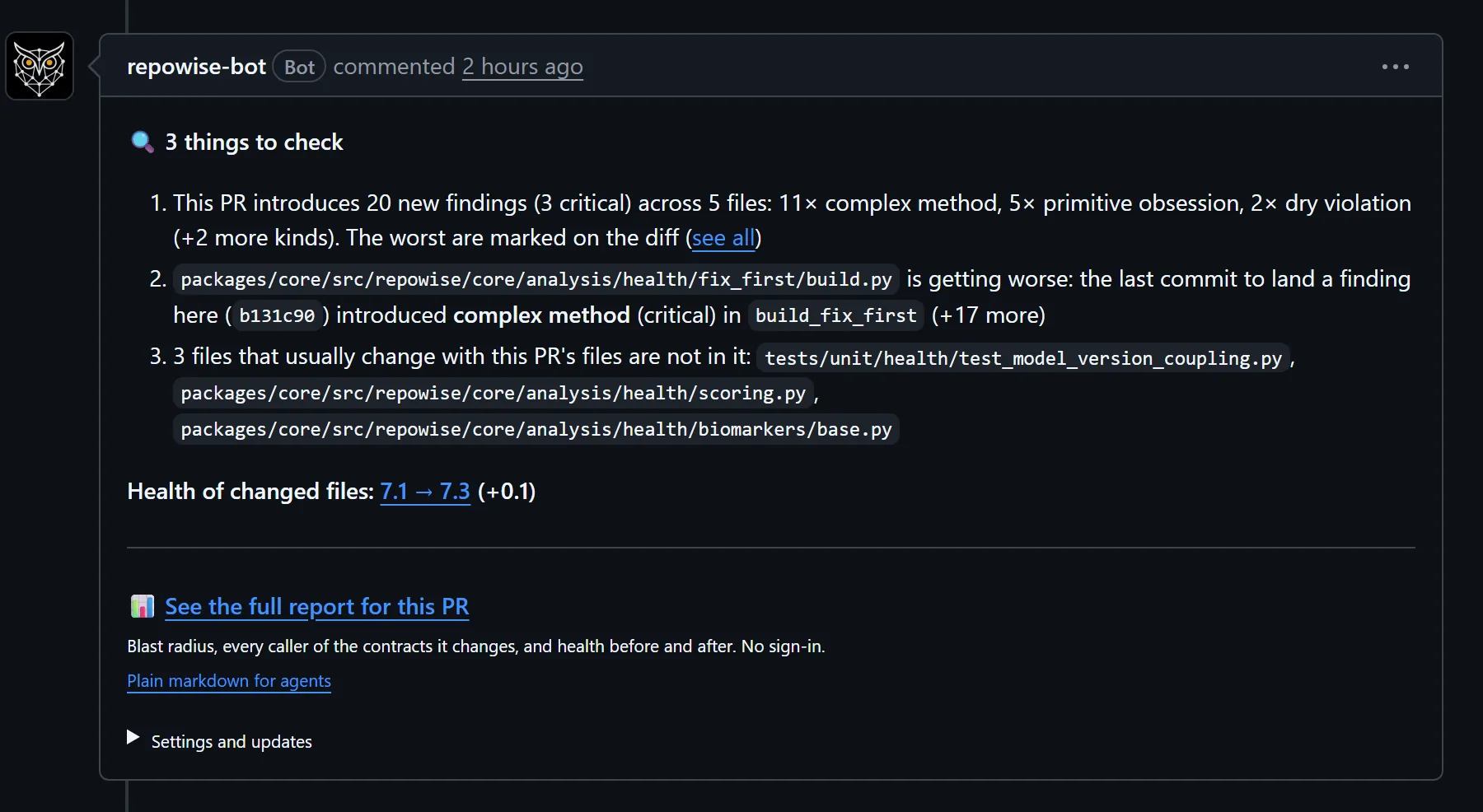
repowise prices review per pull request, with no per-seat or per-repo fee. AI review costs about 9 cents a pull request on average: a quick pass on every code change, a check on risky claims before they post, and one deep review on a risky pull request, with a default cap of 60 cents a PR and a monthly cap. Signals is deterministic, runs no model, is free on every repository and posts nothing on a clean PR. Private repositories need a paid plan, listed on the pricing page. See the PR bot and the full price comparison.
CodeRabbit charges per developer who opens pull requests, with an hourly review allowance (5 an hour on Essentials) and optional overage at $0.25 per reviewed file under a cap you set. The bill follows headcount, which makes it easy to forecast. See the CodeRabbit alternative page.
Greptile is prepaid credits at $1 each with no seat fee, and review depth sets the cost: 1 credit for Base, 3 for Plus, 10 for Apex. Starter is free for one developer. See Greptile pricing and the Greptile alternative page.
Qodo moved to pooled credits with a monthly overage cap; its pack sizes work out to about 139 credits, roughly $1.67, a review. See Qodo pricing. Pro Team is designed for up to 30 users, which fits a 25-developer team. See the Qodo alternative page.
For what each kind of reviewer actually catches, read deterministic vs LLM code review. For the wider list, see the best PR review bots roundup. Running Copilot for chat and agents while adding a flat-priced reviewer is a common pattern, and it keeps review spend off the shared credit pool.
How we checked
On 15 October 2026, and again on 29 October 2026, we read GitHub's 27 April 2026 changelog, the Copilot code review docs, the models and pricing page, the plans page, and the Actions billing and rates pages, plus the CodeRabbit, Greptile and Qodo pricing pages. GitHub publishes averages per review and no minutes per review, so the team tables are our estimates and the 5-minute assumption is ours. repowise figures come from its pricing page and PR bot page. We did not run the tools on the same PRs, so this compares cost and billing mechanics, not review quality.
FAQ
- How much does Copilot code review cost per review?
- GitHub's docs estimate an average of $1.50 of AI Credits for a Balanced review (the default), $0.25 for Lite and $10 for Max, and actual costs can fall outside those figures. Actions minutes are billed on top, at $0.006 a minute on a standard Linux runner past your included minutes. GitHub publishes no per-review minute count.
- Does Copilot code review use GitHub Actions minutes?
- Yes, on private repositories since 1 June 2026. Reviews run on standard GitHub-hosted runners by default and draw from your plan's included minutes (2,000 on Free, 3,000 on Pro and Team, 50,000 on Enterprise Cloud). Public repositories remain free, and self-hosted runners consume no minutes.
- Do AI Credits replace premium requests for code review?
- Yes. As of June 2026, GitHub bills Copilot usage, including code review, as AI Credits under its usage-based model. One AI Credit is $0.01, and plans include a monthly allowance, for example 1,900 credits per Business user.
- How much does Copilot code review cost per year?
- A Copilot Business seat is $19 a month, $228 a year, and review draws AI Credits from the seat's allowance. At 10 PRs per developer a month, a 20-developer team pays $4,560 a year in seats, and its Balanced reviews use about $3,600 of the $4,560 of included credits.
- Is Copilot code review free?
- Not on Copilot Free, which does not include code review. It is included on the paid plans, where each review draws AI Credits from the plan's allowance.
- Is Copilot code review free for public repos?
- The Actions minutes part is free on public repositories, per GitHub's changelog. AI Credits are still drawn from the plan of whoever requests or authors the review, and the docs we read did not describe a separate free tier for public repos.
- Can people without a Copilot license get reviews, and who pays?
- Yes, if an owner enables AI Credits paid usage and then the sub-policy for members without a license. Their reviews are billed to the organization or enterprise as paid additional usage, and they have no monthly allowance.
- How do I cap Copilot code review spending?
- Set an AI Credits budget (user, organization, cost center or enterprise limit) and an Actions budget. Reviews stop when the budget for whoever is billed is exhausted. Check usage by filtering the Actions metrics for the
copilot-pull-request-reviewerworkflow. - What are the best alternatives to Copilot code review?
- CodeRabbit, Greptile, Qodo and the repowise PR bot all review on GitHub with different billing: per developer, per seat with credits, pooled credits, or per pull request. Pick Copilot if your team already has seats, and add one of these if you want a fixed per-review number or a review that does not draw on shared credits.