
On this page
To set up Codex code review, connect your GitHub repository to Codex, open the code review page in Codex settings, choose the repository and turn on Automatic review, or comment @codex review on any pull request. As of 15 November 2026, per OpenAI's GitHub documentation, reviews run through GitHub count toward a code review usage category on your Codex plan, with no per-review fee.
This post covers the setup, what counts against your limits, a three-way comparison with Claude Code review and GitHub Copilot code review, and where a free first pass fits in front of any of them.
We build repowise, so weigh our entry accordingly. The measurements we publish about it, with their methods, are on the benchmarks page.
How do you set up Codex code review on GitHub?
Setup is three steps, and the third needs push or admin permission on the repository. These come from OpenAI's GitHub integration page, read on 15 November 2026.
- Connect your GitHub repository to Codex.
- Go to Codex settings and open the code review page.
- Choose the repository and turn on Automatic review under Review code.
Without automatic review you can still trigger a review by hand. A comment of @codex review on a pull request makes Codex react with an eyes emoji and post a review. In GitHub it flags only P0 and P1 issues.
| Trigger | How | Notes |
|---|---|---|
| Manual | Comment @codex review on the PR | Flags P0 and P1 only in GitHub |
| Focused | @codex review for issues in the database migration | Add the focus to the same comment |
| Automatic | Turn on Automatic review under Personal preferences, pick a Review trigger | No comment needed |
| Security (research preview) | @codex security review | Full report in the Security Report tab of the Codex task |
Scroll the table sideways to see every column.
How do you customize what Codex flags?
Codex follows a ## Code Review Rules section in the AGENTS.md closest to the code the rules govern. Put repository-wide rules in the root file and service-specific rules in a nested one, and group related checks under ### headings.
## Code Review Rules

### Database migrations
- Flag any migration that drops a column without a backfill, because rollbacks lose data.
- Allow additive nullable columns.
OpenAI recommends starting with two or three concise rules that name the behavior to flag, why it matters and the safe path. It says to keep formatting and lint checks in CI. It also states that review rules do not replace tests, branch protections or required approvals.
How much does Codex code review cost?
Codex code review has no per-review fee: GitHub reviews count toward a code review usage category on your plan, so the plan price is the cost you plan with. Prices are from OpenAI's pricing page, 15 November 2026.
| Plan | Price |
|---|---|
| Free | $0 a month |
| Go | $8 a month |
| Plus | $20 a month |
| Pro | From $100 a month ($100, $200 or $500 tiers) |
| Business | $20 per user a month billed annually, $25 monthly (2+ users) |
| Enterprise and Edu | Contact sales |
| API key | Billed at API pricing; no cloud features such as GitHub code review |
Scroll the table sideways to see every column.
Only reviews that Codex runs through GitHub count toward the code review category, such as tagging @codex or automatic reviews. Reviews run locally or outside GitHub count toward general usage. Plus and standard Business plans have rolling five-hour message limits, and weekly limits may also apply, so a busy repository can draw on an allowance that developers also use for coding.
Codex review is cheap to start: you use a seat you may already have, and the cost shows up as usage against a limit shared with coding.
How does Codex code review compare with Claude Code and GitHub Copilot?
The three tools differ most in what they bill: Codex draws plan usage, Claude Code Review bills tokens as usage credits, and GitHub Copilot bills AI Credits plus Actions minutes. Claude figures are from Anthropic's Code Review docs and launch post, Copilot figures from GitHub's code review docs, all read on 15 November 2026. More in Claude Code review pricing and GitHub Copilot code review cost.
| Codex | Claude Code Review | GitHub Copilot code review | |
|---|---|---|---|
| Who can use it | ChatGPT plans from Free to Enterprise (not API-key-only use) | Claude Team and Enterprise, GitHub repos | Copilot Pro, Pro+, Max, Business, Enterprise |
| How it bills | Plan usage in a code review category | Token usage via usage credits | AI Credits plus Actions minutes |
| Cost per review | Plan usage, no per-review fee | About $15 to $25 average, per Anthropic | About $1.50 at Balanced ($0.25 Lite, $10 Max preview), per GitHub |
| Trigger | @codex review or Automatic review | Per repository: on PR open, every push or @claude review | Copilot added as reviewer, or automatic review |
| Custom rules | ## Code Review Rules in AGENTS.md | REVIEW.md and CLAUDE.md in the repo | .github/copilot-instructions.md and path-specific instruction files |
Scroll the table sideways to see every column.
Choose by where your team already pays. Teams on a ChatGPT plan get Codex review without a new vendor. Teams on Claude Team get Anthropic's managed review at the highest per-review estimate. Teams on Copilot get a per-review cost on a bill they already see. For the wider price field see AI code review pricing compared.
Where does the repowise PR bot fit?
The repowise PR bot is a free first pass that runs alongside whichever model reviewer you choose. Signals mode runs no model: it posts the callers a change breaks, files that usually change with it but are not in the PR, and tests to run first, and it posts nothing on a clean PR. That information comes from the code graph and git history.
AI review is optional and costs about 15 cents a pull request on average, with a per-PR cap of 60 cents. A "View on Repowise" link opens a public page for each PR. See how the bot stays silent by default and deterministic vs LLM code review.
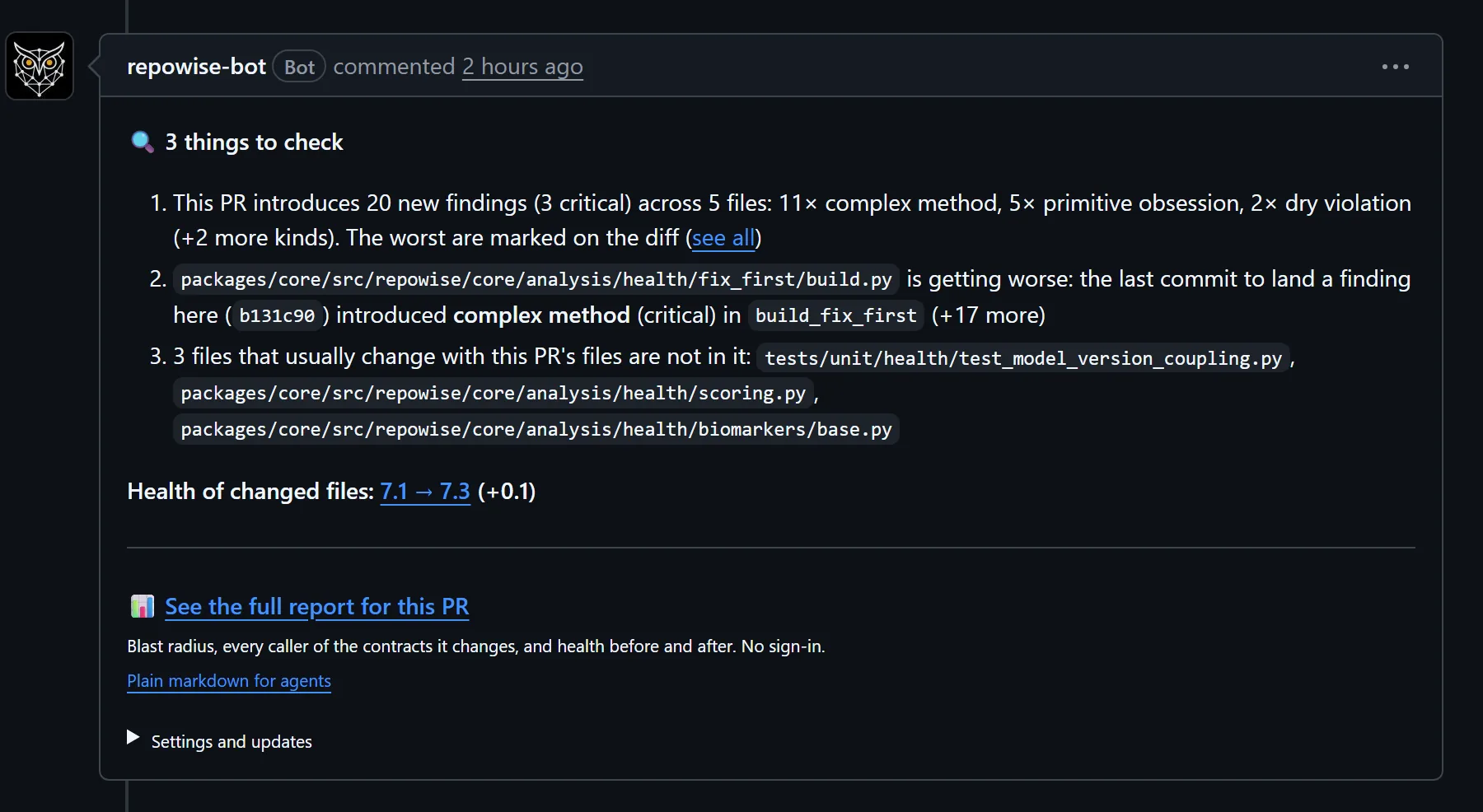
A common setup is Signals on every PR, Codex or Copilot for the model pass, and a deep review reserved for risky changes.
How we checked
On 15 November 2026 we read OpenAI's GitHub integration page and pricing page. We also read Anthropic's Code Review docs and GitHub's code review docs the same day. We compared setup and cost, not review quality. Vendors change plans often, so confirm on the pricing pages before you commit.
FAQ
- How do I enable Codex code review on GitHub?
- Connect the repository to Codex, open the code review page in Codex settings, pick the repository and turn on Automatic review. You need push or admin permission on the repository. To review a single PR, comment
@codex review. - How much does Codex code review cost?
- There is no per-review fee. As of 15 November 2026, GitHub reviews count toward a code review usage category on plans from Free ($0) through Plus ($20 a month) and Business ($20 a user a month billed annually).
- What does @codex review do?
- Commenting
@codex reviewon a pull request makes Codex react and post a review. In GitHub it flags P0 and P1 issues only. Adding text, such as@codex review for issues in the database migration, focuses it. - Can I customize Codex code review rules?
- Yes. Add a
## Code Review Rulessection to AGENTS.md. Codex reads the file closest to the code, so root rules apply repository-wide and nested files apply to a service. - Is Codex code review better than Claude Code review or Copilot?
- The vendors publish no like-for-like accuracy comparison, so this post compares setup and cost. Codex costs plan usage, Claude Code Review averages $15 to $25 a review per Anthropic, and Copilot averages about $1.50 at Balanced per GitHub.
- What can I use alongside Codex code review?
- The repowise PR bot posts free Signals on every PR with no model call, so it can sit next to Codex, Copilot or Claude. It lists callers a change breaks, files that usually change with it and tests to run first.