On this page
- Which CodeRabbit alternative should you pick?
- How do the CodeRabbit alternatives compare on price and features?
- repowise PR bot: the lowest cost per pull request
- Greptile: AI review with whole-codebase context
- Qodo and PR-Agent: bring your own LLM key
- GitHub Copilot code review: no new vendor
- Cursor Bugbot: review that hands findings to an agent
- Sourcery, Codacy and Graphite: the other three
- Should a reviewer weigh file risk as well as the diff?
- What does it cost to switch from CodeRabbit?
- FAQ
The best CodeRabbit alternative depends on what you are fixing. Pick repowise if cost per pull request and repeatable checks matter, Greptile if you want AI review with whole-codebase context, Qodo or Sourcery if you need to bring your own LLM key, GitHub Copilot code review if you already pay for Copilot, and Cursor Bugbot if your team lives in Cursor. Every price below was read from the vendor's own page on 15 November 2026.
CodeRabbit itself is a strong product: it reviews public repositories free and its per-seat bill is predictable. The usual reasons to look elsewhere are the price per developer ($24 to $72 a month on annual billing, per coderabbit.ai/pricing), the volume of comments on every PR, and the lack of a self-hosted or bring-your-own-key option below Enterprise. For a full CodeRabbit breakdown see CodeRabbit pricing.
We build repowise, so weigh our entry accordingly. The measurements we publish about it, with their methods, are on the benchmarks page.
Which CodeRabbit alternative should you pick?
Match the first column to your situation and read the section for that tool.
| Your situation | Pick | Why |
|---|---|---|
| Cost per PR is the problem | repowise | Free deterministic Signals; AI review about 15 cents a PR on average, no seat fee |
| You want AI review that reads the whole codebase | Greptile | Credit pricing, index of the full repo, no seat fee |
| You must bring your own LLM key or run on your network | Qodo (PR-Agent), Sourcery Enterprise, Greptile Enterprise | The only options here with your own model keys or self-hosting |
| Your team already pays for Copilot | GitHub Copilot code review | Reviews draw on the credits you already have |
| Your team works in Cursor | Cursor Bugbot | Findings go straight to Cursor agents |
| You want one tool for quality gates and review | Codacy | Static analysis and AI reviewer in one subscription |
| You use GitLab or Bitbucket heavily | Qodo, Greptile, Cursor Bugbot, Codacy | Broadest git host lists on their pages |
Scroll the table sideways to see every column.
How do the CodeRabbit alternatives compare on price and features?
As of 15 November 2026, list prices run from free to $72 per developer a month, or $1 to $25 per review on usage-priced tools. Prices are from each vendor's page, with plan details for CodeRabbit shown as the baseline.
| Tool | Pricing model | Entry paid price | Free for public or open source | Git hosts (vendor page) | Bring your own LLM key | Self-host |
|---|---|---|---|---|---|---|
| CodeRabbit | Per developer | $24 a month annual, $30 monthly | Yes, public repos | GitHub, GitLab | No | Enterprise |
| repowise PR bot | Per review from credits | about 15 cents a PR on average; Pro for private repos | Yes, public repos | GitHub (CI gates also on GitLab and other CI) | Not needed, no key to manage | Engine is open source, AGPL-3.0 |
| Greptile | Credits | $1 a credit, Base review 1 credit | Qualified non-commercial OSS | GitHub, GitLab, Bitbucket, Gitea (docs) | Enterprise (self-hosted) | Enterprise |
| Qodo | Pooled credits | $30 for 2,000 credits, about 14 reviews | Apply to open-source program | GitHub, GitLab, Bitbucket, Azure DevOps | Via open-source PR-Agent | Enterprise |
| GitHub Copilot code review | Credits inside Copilot plans | About $1.50 a review at default level | No Free-plan review | GitHub, Azure DevOps (preview) | No | No |
| Cursor Bugbot | Usage | $1.00 to $1.50 a run on average | No | GitHub, GitLab, Bitbucket, Azure DevOps | No | GitHub Enterprise Server, GitLab Self-Hosted, Bitbucket Data Center supported |
| Sourcery | Per developer | $12 a month annual, $15 monthly | Yes, public repos | GitHub, GitLab | Enterprise | Enterprise |
| Codacy | Per developer | $18 a month annual, $21 monthly | Yes, open source | GitHub, GitLab, Bitbucket (cloud) | No | No |
| Graphite | Per user | $20 a month Starter, $40 Team (annual) | Hobby plan, limited AI reviews | GitHub | No | Enterprise (GHES) |
Scroll the table sideways to see every column.
Sources, all checked 15 November 2026: Greptile, Qodo, Copilot code review docs, Bugbot docs, Sourcery, Codacy, Graphite, and repowise pricing. Claude Code Review is excluded from the table because it bills on token usage with no flat price, at about $15 to $25 a review by Anthropic's own estimate (launch post), and it covers GitHub repositories only.
repowise PR bot: the lowest cost per pull request
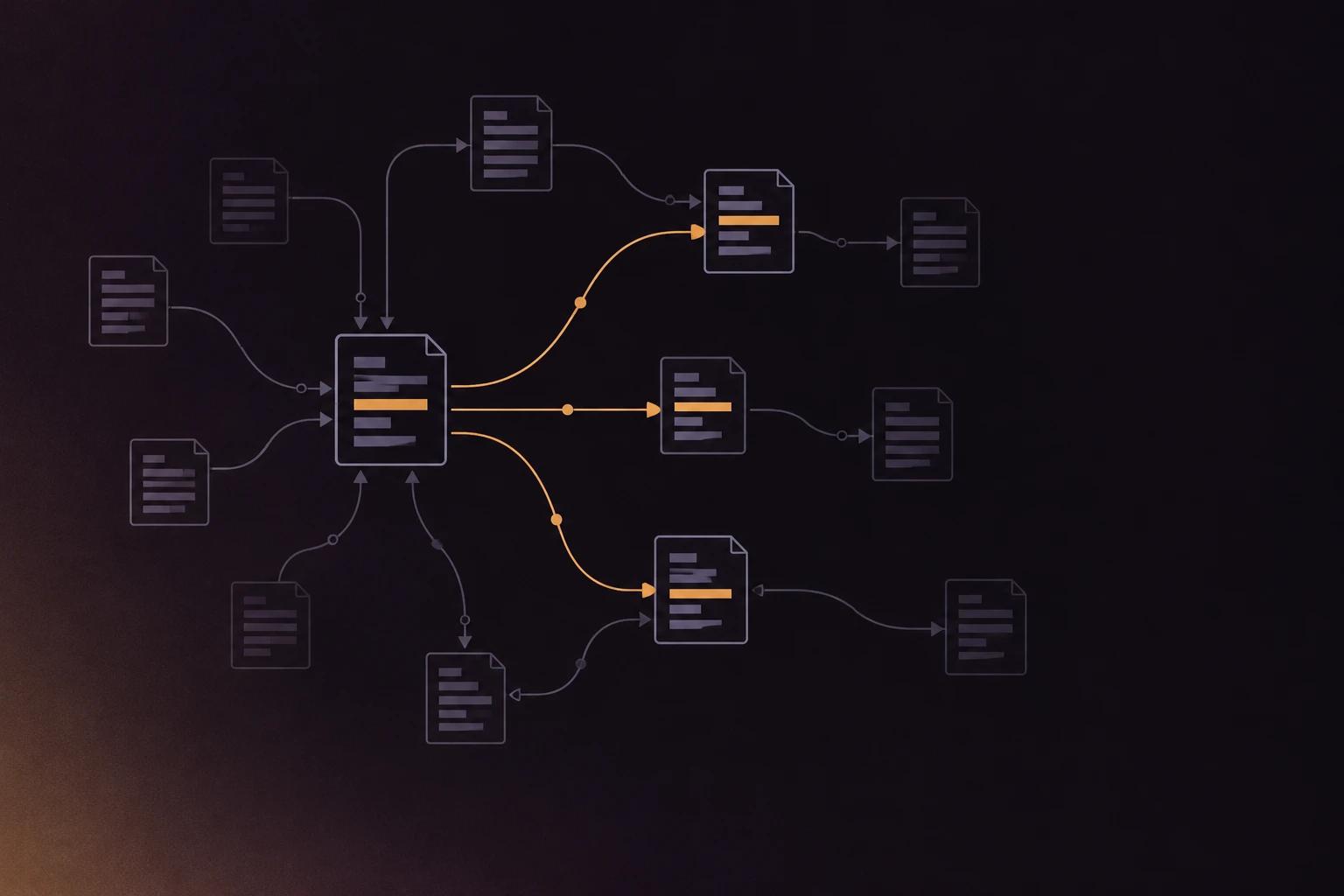
The repowise PR bot is a GitHub App that comments on a pull request with what the change touches, built from the code graph and git history. It has two modes. Signals is deterministic and free on every repository: callers a change breaks, files that usually change with it but are missing from the PR, and tests to run first. The same diff always gets the same comment, because no model is involved.
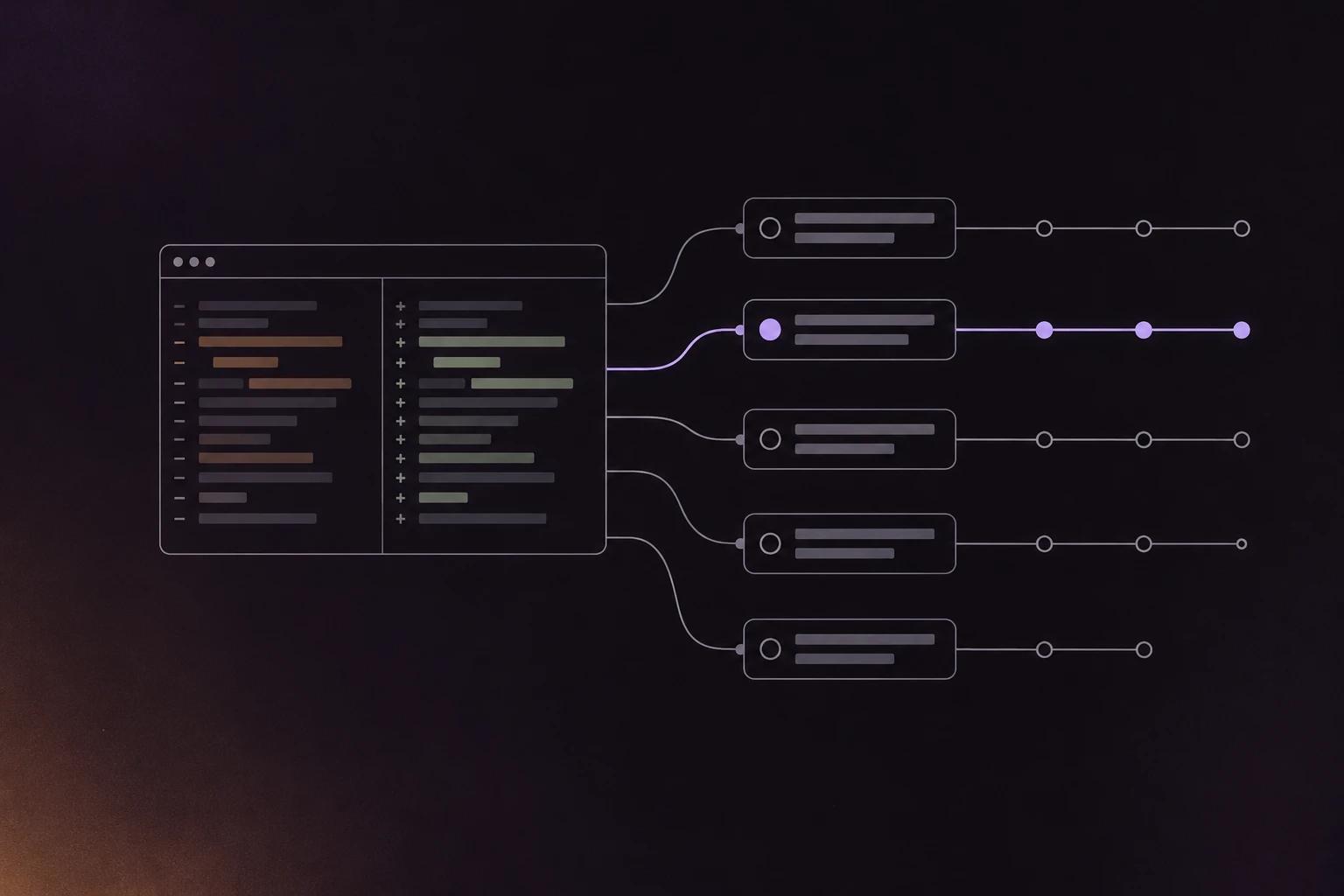
AI review is optional and paid from credits at about 15 cents a reviewed pull request on average, capped at 60 cents per PR by default. It runs a quick pass on code changes and a deep review once when change risk, breaking callers or size call for it. Every comment links to a public per-PR page, so reviewers can see the analysis without signing in on public repositories. Comment /repowise review deep to force the deep pass or /repowise recheck to re-run.
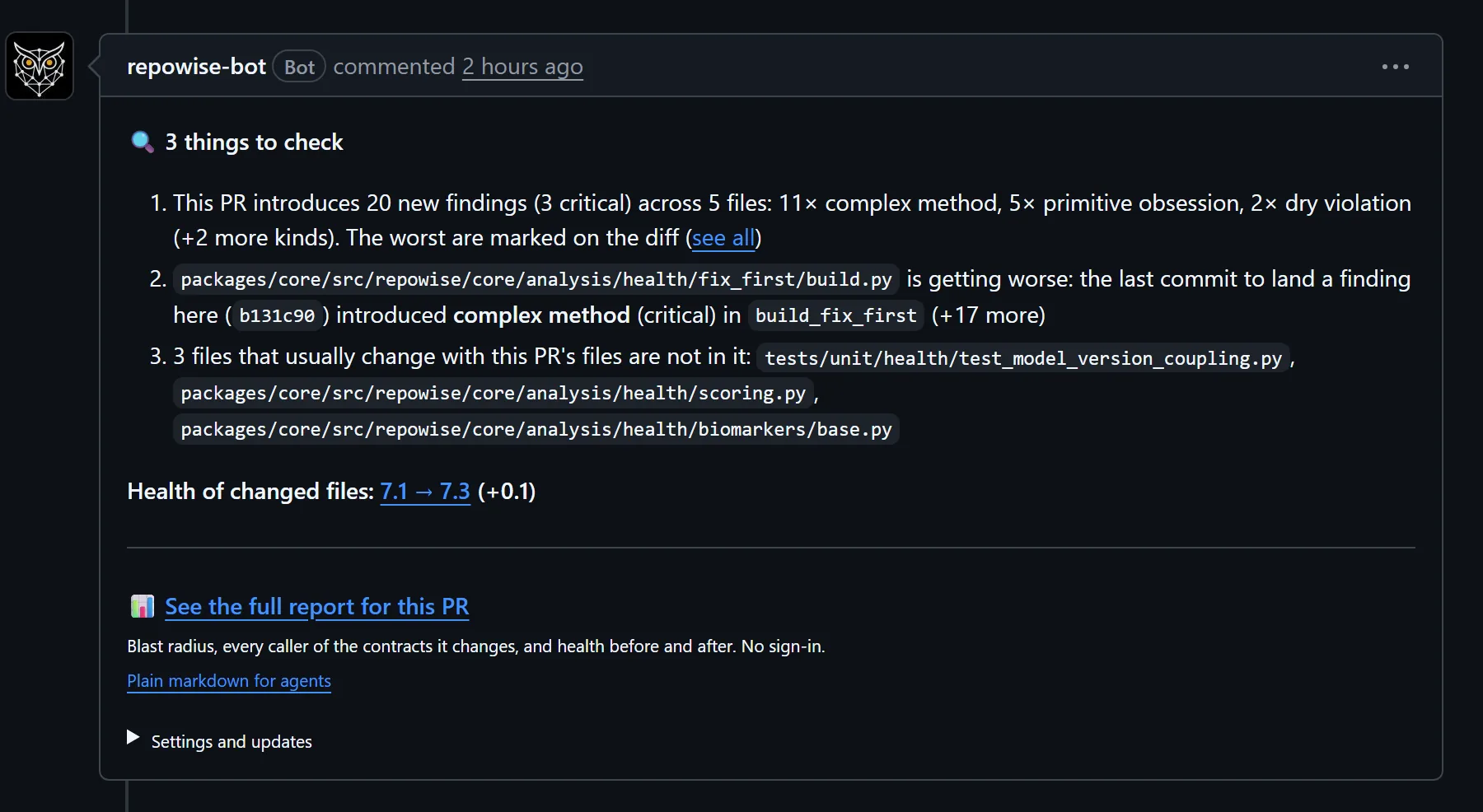
There is no LLM key to configure or rotate, and no seat to assign: private repositories need a paid plan, and the open-source engine and its CI gates run in your own pipeline with no model or key at all. See the PR bot page for a live example.
Pick it if you want the lowest cost per review, comments you can trust to be the same on every run, and context that comes from the dependency graph and change history instead of the diff alone.
Greptile: AI review with whole-codebase context
Greptile is the closest direct alternative if you want AI review that sees beyond the diff. It indexes the repository and reviews with that context. Pro is $1 a credit with no seat fee, a Base review costs 1 credit, Plus 3 and Apex 10, and the Starter plan is free for one developer with 50 credits a month (per greptile.com/pricing, 15 November 2026).
Self-hosting, SSO and the broader git host list (GitHub Enterprise Server, GitLab Self-Managed, Bitbucket Data Center, Gitea) are Enterprise features. Review depth drives the bill, so model it against your PR volume: Greptile pricing has the yearly numbers, and Greptile alternatives covers the reverse switch.
Pick it if AI review with full-repository context matters more than a flat per-seat bill.
Qodo and PR-Agent: bring your own LLM key
Qodo is the multi-host option, and its open-source PR-Agent is the cleanest way to bring your own model key. Qodo's Pro Team plan is pooled credits at $0.015 each, $30 for 2,000 credits (about 14 reviews), on GitHub, GitLab, Bitbucket and Azure DevOps, with no permanent free tier after a 14-day trial (qodo.ai/pricing, 15 November 2026). Single-tenant SaaS and on-prem or air-gapped deployment are Enterprise.
PR-Agent is MIT-licensed, supports OpenAI, Claude, Gemini, DeepSeek, Mistral and anything reachable through LiteLLM, and you supply the key. Its repository describes it as a community-maintained open-source project, so you run and update it yourself (github.com/qodo-ai/pr-agent, 15 November 2026). Details: Qodo pricing.
Pick it if your policy requires your own model provider, or you need Bitbucket or Azure DevOps support.
GitHub Copilot code review: no new vendor
Copilot code review is the easiest alternative for a team that already pays for GitHub Copilot. GitHub estimates an average review at about $0.25 of AI credits on Lite, $1.50 on Balanced (the default) and $10 on Max in public preview, plus Actions minutes. It works on GitHub.com, in IDEs and, in public preview, on Azure DevOps (GitHub docs, 15 November 2026). Copilot Free does not include it.
Rules live in .github/copilot-instructions.md, path-specific .github/instructions/**/*.instructions.md files and AGENTS.md. See GitHub Copilot code review cost.
Pick it if procurement is the obstacle and Copilot is already approved.
Cursor Bugbot: review that hands findings to an agent
Cursor Bugbot reviews pull requests on GitHub, GitLab, Bitbucket and Azure DevOps and can spawn a Cloud Agent to fix what it finds. It is usage-billed, averaging $1.00 to $1.50 a run according to Cursor's help article, and reads rules from .cursor/BUGBOT.md and .cursor/config/bugbot.yaml (docs, 15 November 2026). See Cursor Bugbot pricing and alternatives.
Pick it if your developers already work in Cursor and want fixes without leaving it.
Sourcery, Codacy and Graphite: the other three
Sourcery is the cheapest per-seat AI reviewer here. Pro is $12 a developer a month billed annually ($15 monthly), Team is $24 ($30), public GitHub and GitLab repositories are free, and bring-your-own LLM keys and self-hosting are Enterprise (sourcery.ai/pricing, 15 November 2026).
Codacy pairs an AI reviewer and merge gates with static analysis. Team starts at $18 a developer a month billed yearly ($21 monthly) and is free for open-source projects. It is cloud-only, with GitHub, GitLab and Bitbucket, and the FAQ says it does not support on-premise Git (codacy.com/pricing, 15 November 2026). More options: Codacy alternatives.
Graphite is a stacked-PR workflow tool with AI reviews attached. Starter is $20 per user a month and Team $40 (both annual), where AI reviews are unlimited on Team and limited below it; it supports GitHub only (graphite.com/pricing, 15 November 2026). Pick it for the stacking workflow, not as a like-for-like swap.
Should a reviewer weigh file risk as well as the diff?
A reviewer that knows which files are risky puts its attention where bugs actually land. In our analysis of 195 popular public repositories (1,000+ stars each, production code only, November 2026), the median repository had its least-healthy 20% of files holding 60% of the files that needed a bug fix in the last 180 days, and the 20 lowest-scoring files were bug-fixed 5.4 times as often as the average file (state of code health 2026).
That is the case for a review that reads the dependency graph, change history and file health instead of treating every PR as a fresh diff. It is also why repowise's Signals mode flags the callers a change breaks and the files that usually change with it. For how the two review styles differ, see deterministic vs LLM code review and deterministic PR review bot with no LLM.
What does it cost to switch from CodeRabbit?
At 10 pull requests per developer a month, a 20-developer team pays $5,760 a year for CodeRabbit Essentials on annual billing and $2,400 for Greptile Base. repowise AI review on every PR plus its Pro plan comes to about $312 a year, per the AI code review pricing comparison. Use the cost calculator with your own PR count.
A switching checklist that takes an afternoon:
- Count merged PRs last month and divide by the people who opened them.
- Install the new reviewer on one active repository and leave CodeRabbit running beside it for two weeks.
- Copy your review rules (CodeRabbit's
.coderabbit.yamlinstructions) into the new tool's format:.github/copilot-instructions.md,.cursor/BUGBOT.mdorAGENTS.md. - Compare the comments you acted on, not the comments posted.
- Uninstall CodeRabbit from the repositories you moved so a PR never gets two reviews.
For the full product-by-product view see best AI code review tools and best GitHub PR review bots. Head to head: Greptile vs CodeRabbit and repowise vs CodeRabbit.
FAQ
- What is the best alternative to CodeRabbit?
- It depends on the problem. repowise has the lowest cost per pull request, Greptile gives AI review with whole-codebase context, Qodo and Sourcery support bring-your-own keys, and Copilot code review is easiest for teams already on Copilot. All prices here were checked on 15 November 2026.
- Is there a free alternative to CodeRabbit?
- Yes. The repowise PR bot's Signals mode is free on every repository with no model call, Sourcery and Codacy are free for open source, and Qodo's PR-Agent is MIT-licensed if you supply your own model key. CodeRabbit itself reviews public repositories free.
- Is there an open-source alternative to CodeRabbit?
- Qodo's PR-Agent is MIT-licensed and works with GitHub, GitLab, Bitbucket, Azure DevOps and Gitea using your own LLM key. The repowise engine is open source under AGPL-3.0, and its CI gates run in your own pipeline without a model or key.
- Which CodeRabbit alternative works with GitLab or Bitbucket?
- Qodo, Cursor Bugbot and Codacy list Bitbucket, and Qodo and Bugbot also list Azure DevOps. Greptile's docs list GitHub, GitLab, Bitbucket and Gitea, while Sourcery covers GitHub and GitLab. Check each vendor's host list before you commit.
- Is CodeRabbit worth the price?
- At $24 a developer a month it is predictable and gets cheaper per review the more PRs each developer opens. It is worth it for teams that open many PRs per person and want one flat bill. Teams with few or uneven PRs usually pay less on a per-review tool.
- Can I bring my own LLM key to a CodeRabbit alternative?
- Yes, on Qodo's open-source PR-Agent, on Sourcery Enterprise and on Greptile Enterprise self-hosting, which uses your own LLM providers. The repowise PR bot runs on credits, so there is no key to supply or rotate.
- Does the repowise PR bot replace CodeRabbit?
- For many teams it does, with Signals on every PR and AI review where it pays. Some teams run repowise Signals beside an AI reviewer, since the two answer different questions: what the change touches, and whether the logic is right.