FOR ENTERPRISE
Operate codebase intelligence inside your environment and your governance model.
Evaluate the same Repowise engine for customer-managed deployment, commercial terms, organization-wide support, and operational controls. Every capability below keeps its shipping status visible.
Available, In development, and Planned are product states. Contract scope remains in the signed agreement.
Book an enterprise demo- deterministic core
- Open
- flagship MCP tools
- 10
- full-tier languages
- 11
- operating models
- 3
The AGPL-3.0 engine and its analysis heuristics remain inspectable.
The documented task-shaped interface over the same index.
16 languages are parsed to AST across the headline tiers.
Open Source, managed Hosted, and scoped Enterprise deployment.
Operational evidence
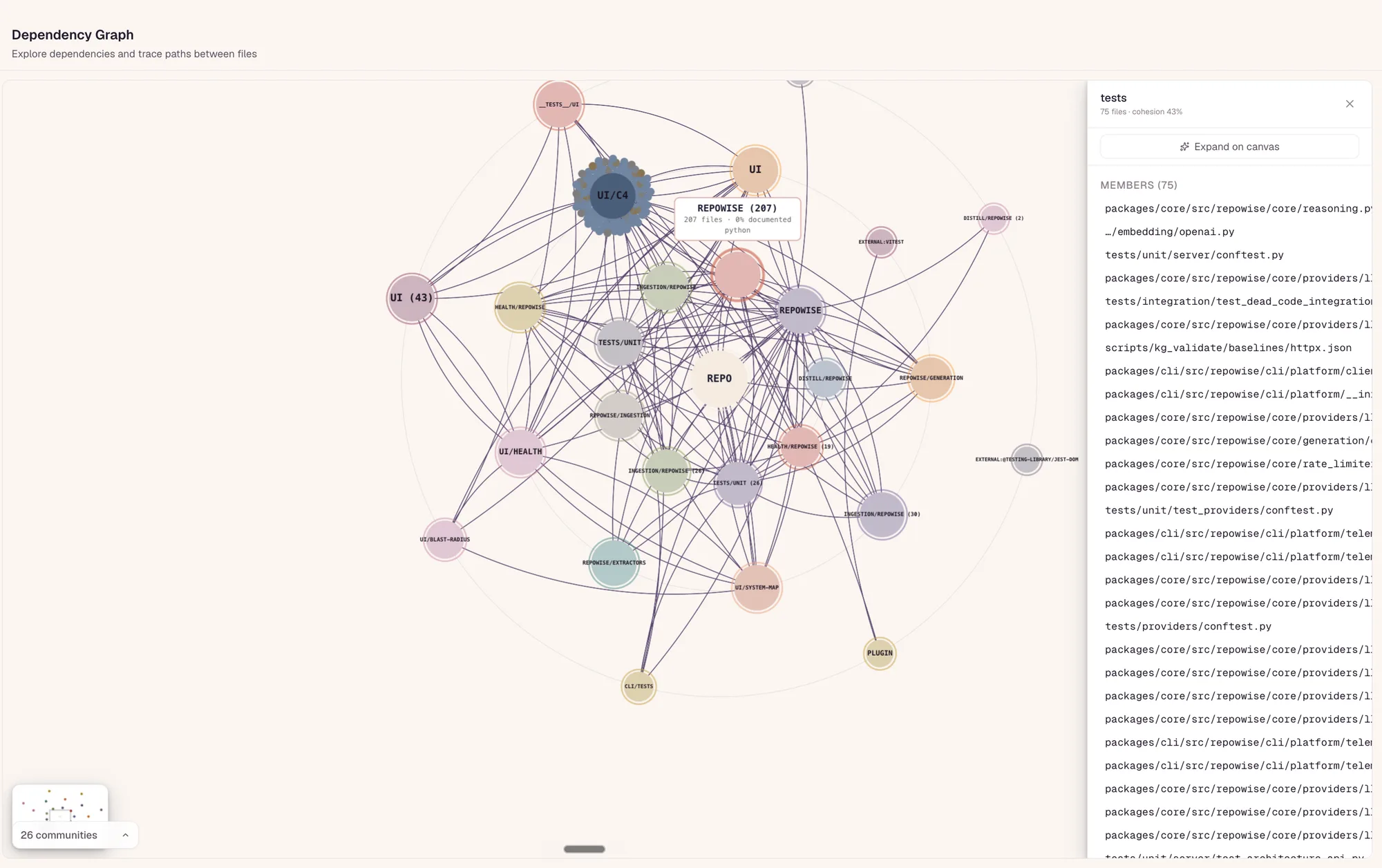
The graph is an inspectable system model, not an enterprise promise by itself.
Architecture, dependencies, scope, and truncation stay visible in the product. Teams can use the same index for documentation, risk, health, decisions, security, and MCP retrieval without adopting separate evidence models for each workflow.
Capture: the Architecture view for the Repowise repository. It shows product output, not a proposed deployment topology.
Operating workflow
Scope the deployment before promising the controls.
Enterprise adoption begins with the code and environment, then fixes responsibility for analysis, storage, model calls, identity, updates, and support in one explicit operating plan.
- 01 / Evaluate
Prove the engine on representative repositories
Run the deterministic index, inspect graph and health output, and test MCP retrieval against the languages and repository shapes that matter. - 02 / Design
Choose the data and model boundary
Decide where source is processed, where derived artifacts are stored, and whether optional model-backed work uses a configured external or local provider. - 03 / Integrate
Connect identity and repository workflows
Map currently available roles and integrations first; treat SSO, SCIM, broader RBAC, and private-cloud control-plane work according to the status below. - 04 / Operate
Agree support and change responsibility
Document upgrades, incident ownership, response targets, custom work, and any commercial rights in the order form rather than relying on marketing shorthand.
Plan or deployment fit
Choose the operating model before the feature list.
Open Source, Hosted, and Enterprise use the same core engine. The decision is primarily about who runs it, where derived data lives, how optional model work is configured, and which support or governance responsibilities are contractual.
Open source
Operate the core yourself
Use the AGPL-3.0 engine locally or on your own infrastructure, with community support and direct control of the runtime.
Hosted
Use the managed service
Repowise operates indexing, derived-artifact storage, billing, and the hosted application for Free, Pro, and Teams.
Enterprise
Scope a customer-managed deployment
Use a supported private-cloud or on-premise engagement when environment, commercial, support, or governance requirements exceed Hosted.
Exact topology and obligations are confirmed during evaluation.
Shipping status
Status belongs beside the capability.
These labels prevent roadmap work from becoming a procurement promise. Available capabilities may still have plan, ecosystem, deployment, or contract conditions stated in the same row.
Scroll sideways to read capability scope and availability.
| Capability | Status | Scope and boundary | Where |
|---|---|---|---|
| Open-source self-hosting | Available | Run the AGPL-3.0 core on infrastructure you control. The deterministic index and MCP server do not require the hosted application. | Open source |
| Managed hosted service | Available | Hosted Free, Pro, and Teams plans operate the same engine with managed indexing, storage, billing, and GitHub integration. | Hosted |
| Customer-managed deployment | Available | Private-cloud and on-premise deployments are scoped and delivered with Repowise support. Topology and operational responsibility are agreed per engagement. | Enterprise agreement |
| SAML / OIDC single sign-on | In development | Enterprise identity configuration is rolling out. Provider coverage and timing must be confirmed for the intended deployment. | Confirm with sales |
| SCIM provisioning | In development | Automated user provisioning is not a categorical shipped promise. Scope and timing are confirmed during evaluation. | Confirm with sales |
| Packaged air-gapped install | Planned | The local engine can run without hosted services, but a repeatable packaged air-gapped enterprise bundle is still roadmap work. | Roadmap |
| Enterprise RBAC and multi-tenant control plane | Planned | Hosted Teams ships owner, admin, and member roles today. Broader enterprise RBAC and multi-tenant deployment controls are planned. | Roadmap |
Honest limitations
This page is not a compliance or legal determination.
Availability does not certify a customer's architecture, satisfy a regulatory framework, or replace review of the AGPL-3.0 license and commercial agreement. SSO, SCIM, packaged air-gapped deployment, broader RBAC, and multi-tenant controls retain their current product status. Confirm the deployment topology, model provider, data retention, support target, and contractual terms for the intended environment.
Questions, answered
The details behind the claim.
Can we self-host Repowise?
Yes. The AGPL-3.0 core can be installed and operated on infrastructure you control. Customer-managed private-cloud and on-premise deployments are available as scoped Enterprise engagements. A repeatable packaged air-gapped enterprise bundle is planned rather than presented as generally shipped.
Which identity controls are available?
Hosted Teams ships owner, admin, and member roles. SAML / OIDC single sign-on and SCIM provisioning are in development. Broader enterprise RBAC and multi-tenant control-plane capabilities are planned. Confirm provider coverage and timing during evaluation.
What support is included?
Enterprise support, response targets, deployment assistance, and any custom engineering work are scoped in the commercial agreement. This page does not publish a universal response-time or uptime promise that could differ from the signed order form.
How does model-backed processing work in a customer-managed deployment?
The deterministic parser, graph, git, health, and risk pipeline does not require a model. Optional documentation, grounded answers, and generated code may send code-derived context to the model provider configured for that deployment. A local provider can keep that optional processing inside the environment where supported.
Is a commercial license available?
Commercial licensing is evaluated for organizations that need terms beyond AGPL-3.0, including embedding or proprietary modification. Rights, indemnities, support, and deployment obligations are contract terms and are not categorical legal conclusions on this page.
Which languages have the deepest analysis?
11 languages are in the full analysis tier and 16 are parsed to AST across the headline tiers. Exact framework and resolver depth varies by language and is documented rather than implied from the total.
Last reviewed: September 2026
Evaluate the deployment you can actually operate.
Bring the target repositories, environment boundary, identity requirements, and support expectations. Or email hello@repowise.dev.