repowise reads your git history (not a snapshot of the code) to surface four behavioral signals static analysis can't see: hotspots (top 25% of both churn and complexity), bus factor (files owned over 80% by one author), hidden change coupling (files that change together with no import edge), and code heritage. Every signal is deterministic and zero-LLM, computed straight from git log and git blame, so the same history always produces the same result. It is self-hostable under AGPL-3.0 and reachable in the dashboard, on PRs, and over MCP via get_risk and get_context.
Git intelligence is the set of behavioral signals repowise mines from your version-control history rather than a static snapshot: hotspots (files in the top 25% of both churn and complexity), bus factor (files owned over 80% by one author), hidden change coupling, and code heritage. Every signal is deterministic, computed straight from git log and git blame with zero LLM.
Why does git intelligence matter?
Your code tells you what it does. Only your history tells you how it behaves: where bugs keep landing, who is the only person who understands a module, and which files quietly change together.
The riskiest files are where churn meets complexity, and the knowledge often lives in one head. A linter sees neither.
- A file that is complex but never changes is rarely worth refactoring; a file that is complex and changes constantly is where defects cluster.
- When one author owns over 80% of a file, their departure is an outage you did not schedule.
- Two files that always change together (with no code link between them) are a coupling no dependency graph will warn you about.
How does git intelligence work?
repowise reads your last 500 commits (configurable up to 5,000) plus git blame, parses the repo into a dependency graph, and derives every signal deterministically: no LLM in the path, the same history always producing the same result.
1. Read history. git log and git blame are parsed and the repo is built into a dependency graph. No code leaves your infrastructure.
2. Derive signals. Churn, complexity, co-change pairs, and per-file ownership are computed deterministically; empirically the signals stabilize around 300–500 commits.
3. Rank risk. Hotspots and bus-factor files are ranked and rolled up per module, then surfaced in the dashboard, on PRs, and over MCP.
| Signal | What only git history reveals | Threshold |
|---|---|---|
| Hotspot | Files where churn meets complexity, ranked first | Top 25% of both churn and complexity |
| Bus factor | Key-person risk: one author carries a file's history | One author owns >80% (bus_factor: 1) |
| Change coupling | Files that move together with no code link | Co-change in the same commits, no import edge |
| Code heritage | How old a file is and how it has evolved | First appearance + 90-day change trend |
How does git intelligence help you?
The four signals are not a dashboard you admire. repowise turns each into an action you take the same day.
Hotspots: target refactoring where it pays
A hotspot is a file in the top 25% of both churn and complexity, not either alone. That joint filter is what keeps you from drowning in every complex file you never touch.
Guardrail: a hotspot is a ranking signal, not an auto-refactor. repowise ranks and explains, it never rewrites your code.
- Churn comes from git history, complexity from the parsed code; the composite risk score blends them.
- The riskiest files surface first, recomputed on every commit, deterministically.
- The same churn × complexity view powers the dashboard, the Repowise PR bot, and
get_riskover MCP.
Bus factor: de-risk offboarding before it is a fire
bus_factor: 1 means a single author owns over 80% of a file's history. repowise attributes lines to contributors from git blame, names the primary owner, and flags key-person risk.
Guardrail: this reads commits, it does not watch people: no IDE plugins, no instrumentation, no surveillance.
- Primary owner, recent owner, and contributor count per file.
- The bus-factor warning surfaces in the ownership view and in
CLAUDE.md. - Works retroactively on the history you already have: nothing to instrument going forward.
Change coupling: find the dependencies your graph never sees
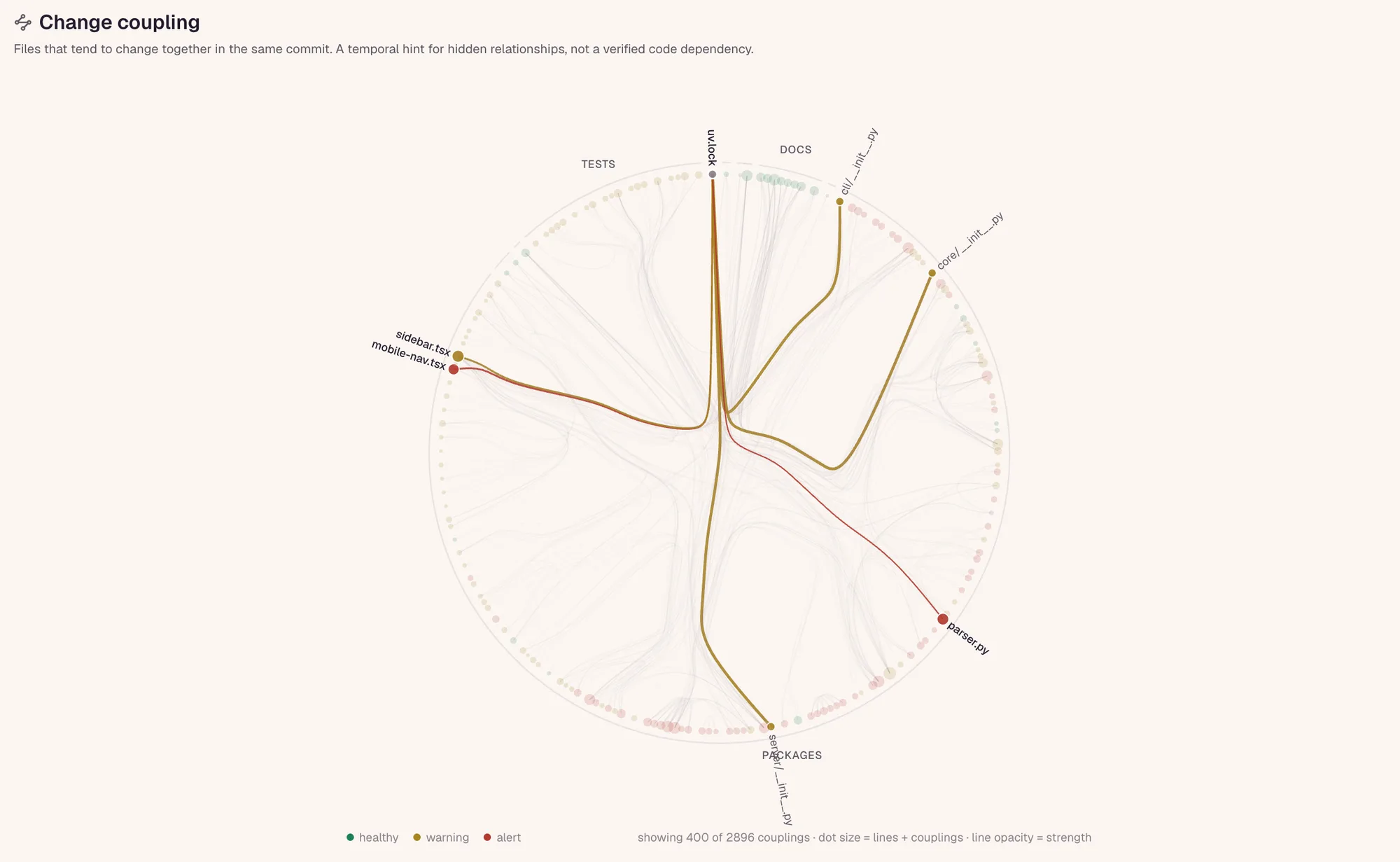
Hidden coupling is a pair of files that repeatedly change together in the same commits without an import edge between them. AST analysis cannot detect it; git history reveals it.
- Co-change partners are mined from commit history, per file.
- They surface in
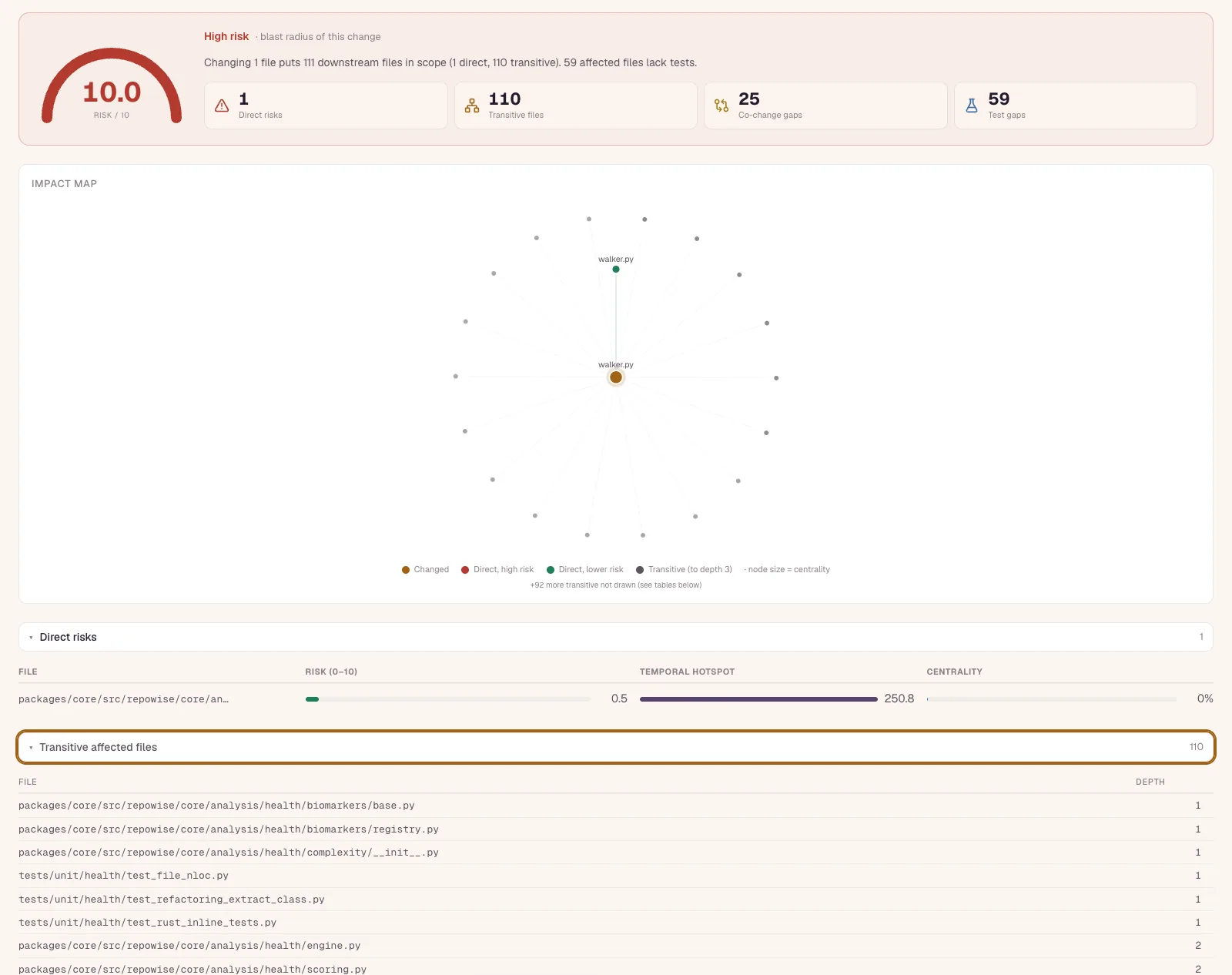
get_contextalongside direct dependencies. get_riskflags a missing historical partner on the PR blast radius, so the omission is caught in review.
Heritage: read a file's age and evolution
Code heritage shows how old each file is and how it has evolved: first appearance, change magnitude over the last 90 days, and a churn trend (increasing / decreasing / stable from the 30-day versus 60-day rate).
- The change pattern is classified:
feature-active,fix-heavy,primarily refactored,dependency-churn, ormixed-activity. - Change magnitude tracks lines added/deleted and average commit size over the last 90 days.
- The last meaningful commit messages per file inform why it is shaped the way it is.
Walkthrough: three views in five minutes
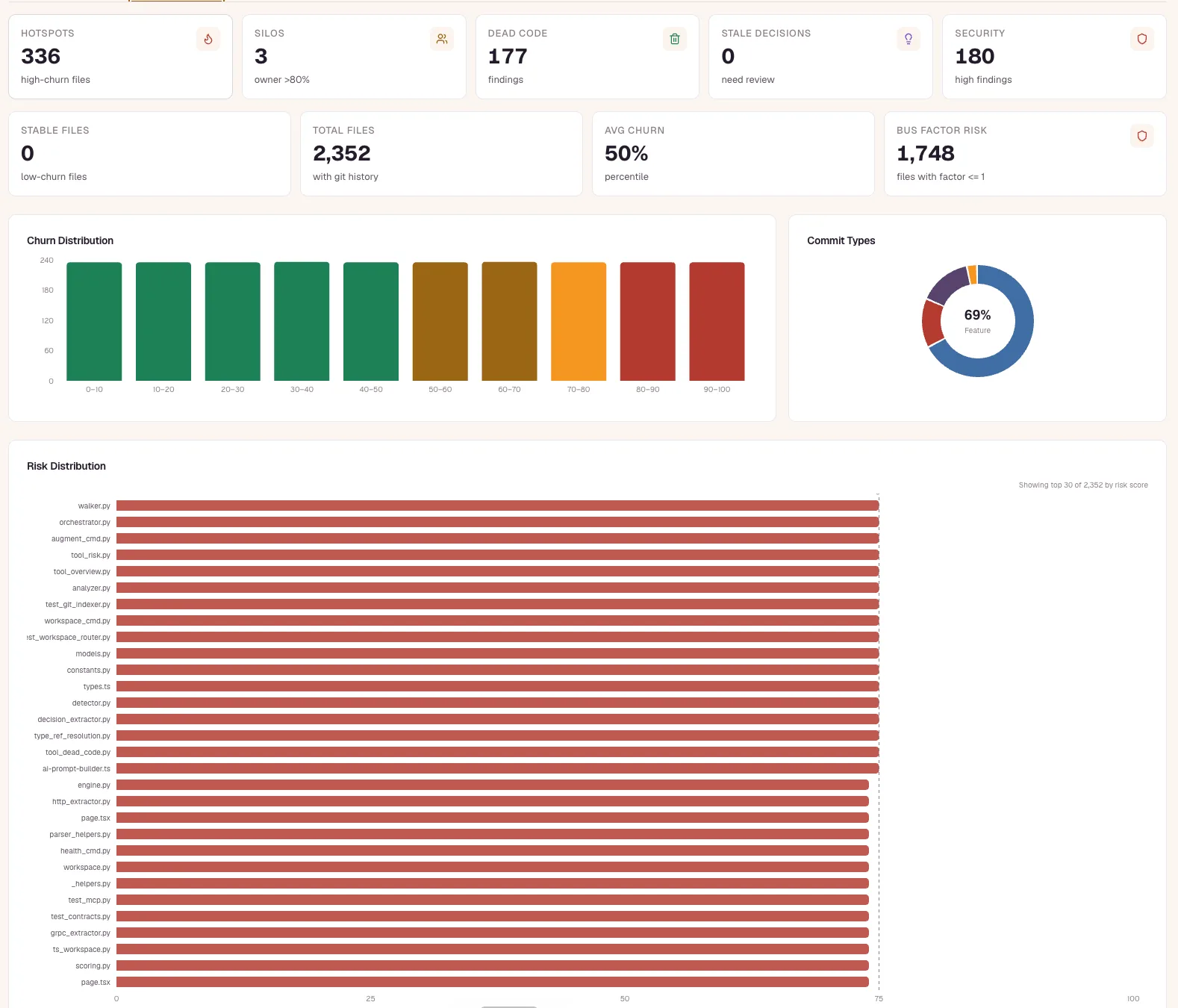
Step 1: Open hotspots. The riskiest files sit at the top. Each row shows churn percentile, complexity, and the composite risk score that blends them.
Step 2: Open ownership. Filter to bus_factor: 1 to find the files most exposed if one person leaves. The owners view rolls the same git-blame data up per contributor: who carries which part of the codebase.
Step 3: Open change coupling. Each pair shows how many commits the two files moved together in. High counts with no import edge are the ones to investigate before your next change.
Proof: deterministic signals, straight from your history
Each stat stands alone and is reproducible on your own repo, and every signal is open source under AGPL-3.0.
| Signal | Definition |
|---|---|
| Hotspot | A file in the top 25% of both churn and complexity, not either axis alone |
| Bus factor | Files owned >80% by a single author are flagged bus_factor: 1 key-person risk |
| Ownership source | Derived from git blame only: primary owner, recent owner, contributor count |
| Change coupling | Co-change partners that change together without an import edge: invisible to static analysis |
| History window | The last 500 commits (configurable up to 5,000 via --commit-limit); signals stabilize around 300–500 |
| Determinism | Every signal is zero-LLM: the same history always produces the same result, no cloud calls, no drift |
The engineering case for why these process metrics outpredict structural metrics alone lives in process metrics beat structural metrics.
Try it on your repo
See where the risk and knowledge concentrate in your repo: deterministic, self-hosted, straight from your history.
pip install repowise
repowise init                          # reads 500 commits + git blame
repowise init --commit-limit 5000      # deepen the history window
The same numbers are reachable by AI agents via the get_risk and get_context MCP tools.
How each role uses this feature
See where key-person risk concentrates while you can still act on it: files owned over 80% by one author, surfaced from history rather than the exit interview. The same git signals tie hotspots to the owners accountable for them, no developer surveillance required.
Catch the file that should have changed alongside this one but didn't: hidden co-change coupling flagged on the PR before merge. Blast radius from the dependency graph names the right reviewers from ownership instead of guesswork.